The best bird perches are the ones matched to your specific bird's foot size, made from safe natural materials, varied in diameter and texture, and placed thoughtfully around the cage. That's the short answer. But most first-time bird owners start with whatever came with the cage (usually a pair of identical smooth wooden dowels), keep them for years without changing anything, and then wonder why their bird has scaly, sore feet or seems bored and restless. This guide is about fixing all of that, step by step.
Best Bird Perches: How to Choose, Set Up, and Maintain

Marcus Chen
22 Apr 2026
What "best" actually means for your bird
"Best" is not a universal label you can slap on a single perch brand or style. It's a combination of factors that depend entirely on your bird. A perch that's perfect for a cockatiel can actively injure a finch. A rope perch that works well for a young, healthy budgie might be a foot-entanglement hazard for an older bird with long nails. So before you buy anything, you need to know three things: your bird's species (which determines appropriate diameter), the current state of their feet (any redness, swelling, or favoring one foot tells you a lot), and how many perches are already in the cage and what type they are.
From that baseline, "best" means a perch that allows your bird's foot to wrap about two-thirds around the diameter without the toes either gripping all the way underneath or barely touching the surface. It means a material that's non-toxic, gives some grip, and isn't so uniform in shape that it forces the same pressure point on the foot every single time the bird lands. And it means placement that lets the bird move naturally through the cage without bumping into walls, fouling the food dish, or risking a fall.
Perch types and materials: what's safe and what's not
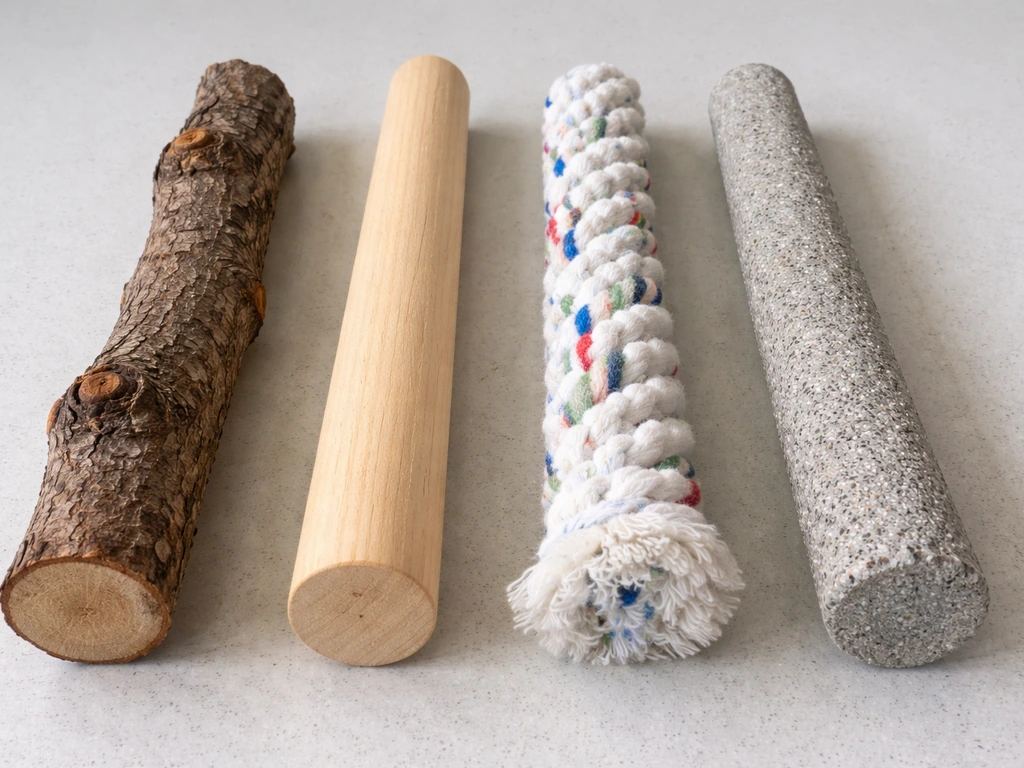
There are five main types of perches you'll encounter: natural wood branches, manufactured wood dowels, rope/cotton perches, cement or mineral perches, and flexible or platform perches. Each has a legitimate role, but not all are equal, and a few have real risks worth knowing upfront.
Natural wood branches
This is the gold standard. Species like manzanita and java wood (sometimes called java fern or java branch) are frequently recommended by avian vets because the natural knobby, irregular shape means your bird's foot lands differently almost every time. That variety is crucial for foot health. Manzanita is especially popular because it's extremely hard and durable, easy to clean, and non-toxic. Other safe woods include apple, willow, elm, and eucalyptus. The irregular surface gives grip without being abrasive, and the varying diameter along a single branch means one perch can serve multiple grip positions.
If you're sourcing branches from your yard or a park, stick to known-safe species, strip the bark, wash thoroughly, and bake them at around 200-250°F (93-121°C) for 30 minutes to kill parasites and bacteria. Avoid anything treated with pesticides or from roadsides where runoff contamination is likely. Cherry, oak, and pine (resinous pines especially) are on the avoid list for many birds. When in doubt, skip backyard branches and buy commercially prepared natural wood perches.
Manufactured wooden dowels
Here's where a lot of beginner setups go wrong. Smooth wooden dowels are almost universally included with starter cages, and they're not inherently dangerous, but using only dowels is a problem. The uniform diameter means your bird's foot wraps the exact same way every single landing, creating constant pressure on the same spots. Over time, this leads to pododermatitis (bumblefoot), a bacterial infection of the foot tissue that's painful and can become serious. Dowels aren't evil, but they should never be the only perch in a cage, and they work better in a variety of diameters rather than one size throughout.
Rope and cotton perches
Rope perches (usually cotton or sisal) are great for adding flexibility and a different texture, and birds often love them. The soft surface is comfortable, and the slight give when a bird lands is good for joints. The risk is fraying. Once a rope perch starts to unravel, loose threads can catch toes and cause serious injury, or a bird may ingest the fibers. Inspect rope perches every week and retire them the moment they start to look shaggy. Cotton is generally considered safer than synthetic rope materials.
Cement and mineral perches
Cement perches (sometimes called conditioning or nail-trimming perches) get marketed as a way to keep nails filed down naturally. They do work for that purpose, but placement matters enormously. Put one near a favorite perching spot and it becomes a constant abrasive surface, which can cause sore, cracked feet. The USDA APHIS guidance on bumblefoot specifically lists [overly abrasive perch surfaces as a cause of pododermatitis](https://www.
aphis. usda. gov/sites/default/files/ac-aid-pododermatitis-bumblefoot-in-birds. pdf).
Used sparingly, one cement perch placed near a food or water dish (where a bird lands briefly but doesn't roost for hours) is reasonable. Concrete, ceramic, or cement perches should not be the only perches because they can be abrasive to the bottom of a bird’s feet and can cause irritation or sores, which can contribute to bumblefoot. Used as a primary perch, it's a foot problem waiting to happen.
What to avoid completely
- Sandpaper-covered perches: sold as nail trimmers, but the constant abrasion damages foot skin and can lead directly to bumblefoot. Multiple avian veterinary sources specifically warn against these.
- Perches with paint, varnish, or chemical coatings: birds chew perches constantly, and ingesting finish chemicals is a toxicity risk.
- Toxic wood species: avocado wood, cherry (some sources), cedar, and freshly cut pine should all be avoided.
- Plastic perches with rough or cracked surfaces: bacteria accumulate in cracks and plastic doesn't give the natural texture variation birds need.
- Unstable or poorly anchored perches: a perch that wobbles or drops when a bird lands causes stress and can injure a bird who can't brace properly.
Getting the size right: diameter, texture, and species fit
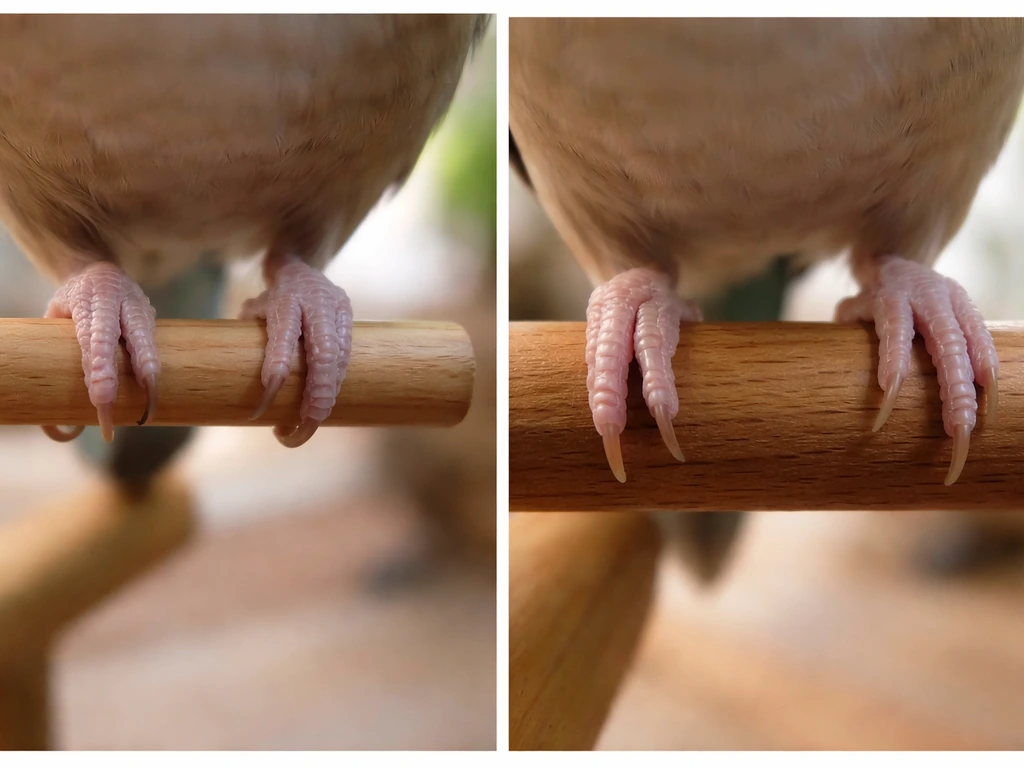
Diameter is the single most important dimension to get right. Too small, and the bird's toes wrap under and the nails dig in uncomfortably. Too large, and the foot can't grip properly, which causes fatigue and increases the risk of falls and pressure sores. Inappropriately sized perches can lead to leg swelling and are a direct risk factor for bumblefoot. The widely cited guideline is that a bird's foot should wrap roughly two-thirds of the way around the perch, with the front and back toes not touching each other underneath.
| Bird Size/Species | Recommended Perch Diameter |
|---|---|
| Small birds (budgies, finches, lovebirds) | 10–20 mm (roughly 3/8" to 3/4") |
| Medium birds (cockatiels, conures) | 20–40 mm (roughly 3/4" to 1.5") |
| Large birds (cockatoos, macaws, Amazons) | 40–60 mm (roughly 1.5" to 2.5") |
These are starting ranges, not hard cutoffs. A large cockatiel might be comfortable at the upper end of the medium range, and individual birds vary. If you're buying natural wood branches or java wood perches, the natural taper means one perch will hit multiple diameters along its length, which is one reason natural wood is so well-suited for this. When buying manufactured perches, aim for at least two different diameters in the cage at all times.
Texture matters too. A smooth surface gives poor grip and forces the bird to grip harder, tiring the muscles. Slightly rough, natural bark texture is ideal. The goal isn't sandpaper rough, just enough irregularity that the bird can perch without constant muscular effort. This is another reason natural wood wins over factory-smooth dowels.
Placing perches in the cage: height, spacing, and keeping things sanitary
Even the best perches cause problems if they're placed badly. This is an area where I've seen a lot of beginner cages set up in ways that frustrated the birds and made cleaning miserable for the owner. Here's how to think about it.
Height and hierarchy
Birds want to be high up. The highest perch in any cage will almost always be the preferred sleeping and resting spot, so make sure the top perch is comfortable, appropriately sized, and stable. In multi-bird setups, expect some competition for the top spot. Place a second high perch of similar quality nearby so a lower-ranking bird still has access to a good rest spot without being constantly displaced.
Spacing and flight room
Perches should be spaced far enough apart that the bird has to move meaningfully between them, but not so spread out that smaller birds struggle to hop across. For parrots and cockatiels, leave at least enough gap that the bird can extend its wings slightly without hitting both perches at once. Don't fill the cage with so many perches that there's no airspace to move through. Two to four perches is typical for most cage setups, and variety in height and style matters more than quantity.
Keeping food and water clean
Never place a perch directly above a food or water dish. Droppings in the water bowl are both a contamination risk and a cleaning headache. Position dishes to the side and slightly below a perch rather than underneath one. Some cages are designed with side-access cups exactly for this reason.
Perch length and bird count
A general rule of thumb cited in avian husbandry guidance is roughly 10 inches of perch length per bird for larger species like macaws and cockatoos. This doesn't mean a single 10-inch perch is enough, but it's a useful baseline when calculating whether a cage has adequate perching real estate for the number of birds in it. In practice, I'd rather have more perch space than less and let the birds sort out who wants which spot.
Preventing falls and instability
Perches that spin, droop, or pop loose when a bird lands are a genuine hazard. Check mounting hardware before putting any perch in service. Bolt-through perches (where a bolt passes through the perch and locks to the cage bar with a nut) are more secure than friction-fit or hook-loop systems. For rope perches, make sure the attachment points are tight and check them monthly.
Why variety is non-negotiable for foot health and enrichment
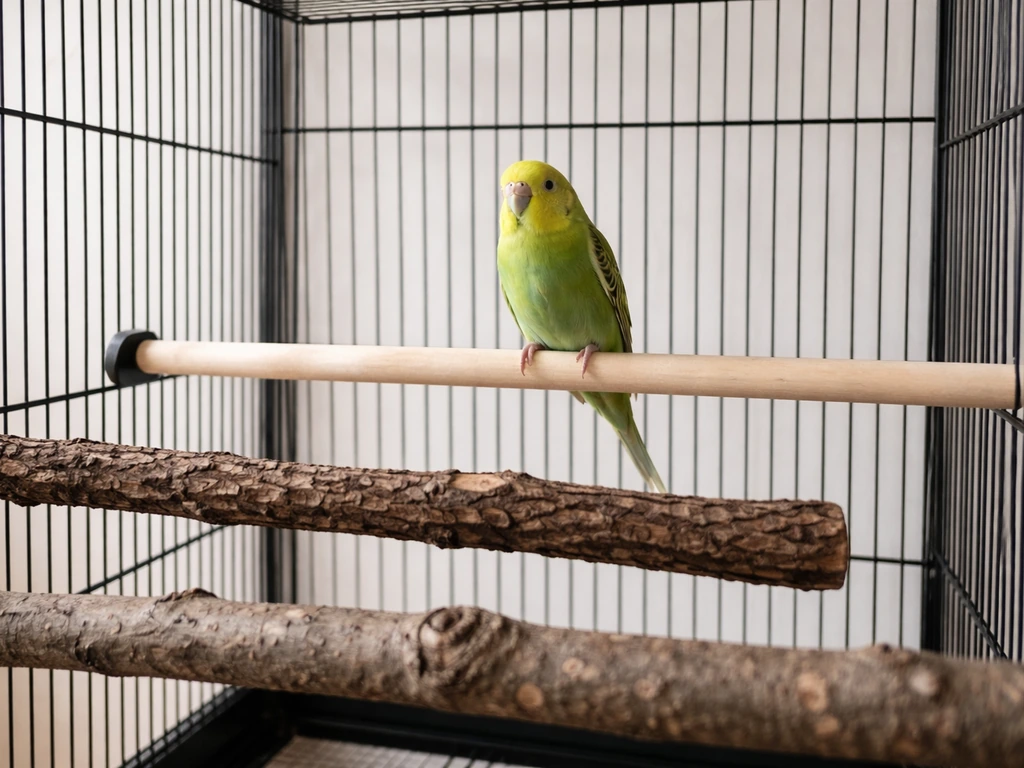
One of the clearest lessons from avian veterinary guidance on bumblefoot is that repetitive pressure on the same foot contact points is a primary cause of the condition. When a bird perches on the same uniform-diameter smooth surface all day every day, the same small area of each foot takes all the pressure, all the time. Offering a variety of perch sizes provides more foot exercise and relieves that repeated pressure. This isn't a nice-to-have, it's a legitimate health intervention.
But foot health isn't the only reason variety matters. Enrichment is the other half of this. Birds are intelligent, active animals. A cage with two identical dowels at the same height is dull, and boredom in parrots especially leads to feather plucking, screaming, and other stress behaviors. Adding perches of different textures, flexibility (rope versus rigid wood), heights, and positions gives the bird more choices about how and where to spend time. Combine this with tabletop play stands or bird playgrounds for out-of-cage time and you're giving a bird something closer to the environmental complexity they'd experience in the wild.
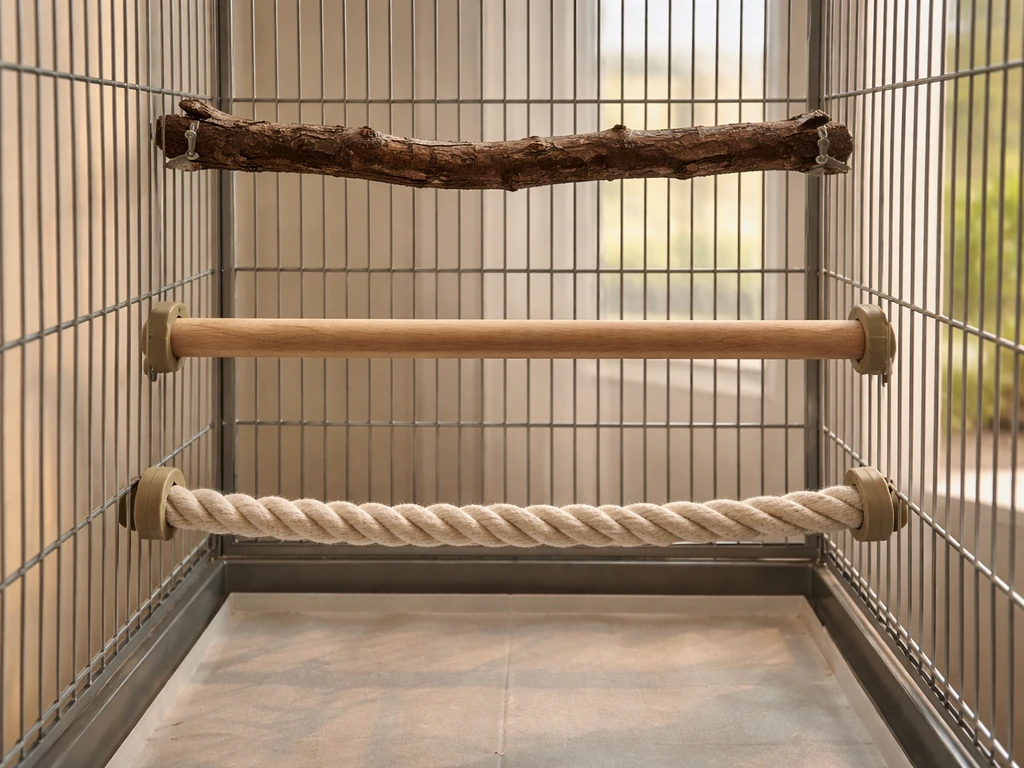
Aim for at least three different perch types in a cage: one natural wood branch perch with variable diameter, one rope or flexible perch, and one platform or flat perch (flat perches let birds rest without gripping, which is especially valuable for birds with any foot sensitivity or older birds). A cement perch near the food dish can be a practical fourth option for mild nail maintenance.
Cleaning, replacing, and rotating your perches
Perches get dirty fast. Droppings accumulate, food bits stick, and the surface becomes a bacterial breeding ground if you don't stay on top of it. The cleaning frequency depends on the bird and the perch material, but a weekly scrub is the baseline for most setups.
How to clean different perch types
- Natural wood and manzanita: scrub with a stiff brush and hot water. Avoid soaking, which can cause cracking. Let dry completely before returning to the cage. Avoid soap residue since birds chew everything.
- Rope perches: hand wash with mild, unscented dish soap, rinse very thoroughly, and air dry fully. Never return a damp rope perch to the cage as it will grow mold quickly.
- Cement perches: scrub with hot water and a brush. The porous surface holds bacteria if not cleaned regularly.
- Dowels: hot water scrub, allow to dry. Replace when they develop deep gouges or cracks where bacteria can hide.
When to retire a perch
Replace rope perches the moment they start to unravel visibly. Replace wood perches when the surface is deeply gouged, cracked, or the wood has softened from repeated cleaning or chewing. Natural wood perches from enthusiastic chewers (like macaws and cockatoos) might last only a few months. Manzanita holds up longer than softer woods. Rotating perches out of the cage periodically, cleaning them, and swapping in a "fresh" perch from storage also acts as minor environmental enrichment since the bird gets something new to investigate.
Common beginner mistakes and how to fix them
Most perch-related problems I've seen in new bird owners come down to the same handful of mistakes. They're all fixable once you know what to look for.
- Using only uniform wooden dowels: The cage came with them, so many owners never add anything else. Fix this by adding at least one natural wood branch and one rope or platform perch within the first week. This single change has a large impact on foot health.
- Never changing the perch size: As birds age, foot health changes. A bird with early signs of arthritis needs softer, more varied perching surfaces. Reassess your setup at least once a year or any time you notice a bird standing differently or favoring one foot.
- Placing perches directly over food and water: This is a hygiene problem every time. Move dishes to the side and add a perch next to (not over) them.
- Using sandpaper perch covers or abrasive cement as the primary surface: These cause skin damage with prolonged contact. If you have a sandpaper sleeve on any perch, remove it today. Cement is fine as a secondary perch in a low-traffic spot.
- Ignoring early foot symptoms: Redness on the bottom of the foot, slight swelling, or a bird that seems reluctant to perch are early bumblefoot warning signs. At this stage, switching to softer, varied perching surfaces and consulting an avian vet can prevent a much more serious infection.
- Buying perches based on price or appearance rather than fit: An expensive decorative perch in the wrong diameter or made from an unclear wood species is worse than a cheap natural branch that's correctly sized. Match size and material first, aesthetics second.
- Overcrowding the cage with perches: More isn't always better. Too many perches leave no room to move or fly short distances, which reduces exercise and can increase stress. Aim for variety and good placement over maximum quantity.
If you're troubleshooting an existing setup, start by pulling out every perch and evaluating it against the criteria in this guide: correct diameter for the species, non-toxic natural material, varied texture, and no sandpaper or abrasive surfaces. Then look at the cage layout: anything directly over food or water, anything unstable, anything too high or too low for comfortable movement. Fix those two things first and you'll solve the majority of common perch problems before they become veterinary visits.
If your bird's out-of-cage time is also limited or unstructured, that's worth addressing alongside the perch setup. Tabletop bird stands and dedicated play areas can extend enrichment well beyond the cage and give your bird the activity they need for long-term physical and mental health. Open top bird tables can also give your bird a safe, engaging space to explore during out-of-cage time.
FAQ
My bird has bumblefoot concerns. Should I switch to cement perches immediately?
Not necessarily. If the bird is foot-sore, favoring one foot, or showing redness, check that at least one perch has a diameter that matches a proper two-thirds wrap and that the surface is not overly abrasive. If you only add a “nail trimming” cement perch, it can worsen pressure on the same roost area, so ensure the bird can choose a softer natural wood or platform perch for long rests.
Can I use any branch from my yard or neighborhood park as a perch?
The safest move is to avoid using any perch until you identify the wood. Many “unknown” backyard branches can be contaminated (pesticide runoff, sap, or rot) even if the species seems safe. If you cannot confirm the species and source, buy commercially prepared natural wood or use only known-safe woods like manzanita or apple.
Why does my bird’s foot look swollen after being on perches for a while?
Yes, those are common signs of a sizing or placement problem. Too-small diameters make toes curl under and nails dig, leading to swelling. Too-large diameters reduce grip, causing fatigue and sore contact points. Measure the perch diameter at the roost height, then adjust so the foot wraps roughly two-thirds without the toes touching underneath.
What should I look for between weekly inspections on rope perches?
If the rope looks intact but you notice increased toe clutching, clumps of fibers on the feet, or the bird is suddenly spending less time on that perch, inspect attachment points and the underside where toes hook first. Replace rope at the first sign of fraying, shaggy fibers, or looseness, because partial damage can still catch toes or shed loose material.
How do I know if my perch mounting hardware is actually safe?
It depends on the bird, but a few simple checks prevent most incidents. Confirm the perch cannot rotate or droop when you apply gentle hand pressure, use a secure bolt-through style mount when available, and verify the perch sits level (not at an angle that forces uneven pressure). Recheck mounts after cage cleaning, since hardware loosens when surfaces get grime or vibration.
Are platform perches useful if my bird has sensitive feet?
Yes. A platform perch lets birds rest without constant gripping, which can reduce repetitive pressure on sensitive feet. If your bird is older or already prone to foot irritation, include at least one platform perch at a comfortable height near other roost options so the bird can choose it for recovery time.
Should I replace all perches at once when upgrading to better ones?
Do it as a controlled “rotation,” not all at once. Swap in one new perch type or one new diameter while leaving the familiar roost in place temporarily, then observe foot comfort and where the bird chooses to sleep. Sudden removal of the top perch can trigger stress and displacement, which can increase injury risk if multiple birds compete for the replacement spot.
My cage has good perches, but my bird still seems restless. What layout mistakes commonly cause this?
Look for a clear lengthwise route for movement and make sure no perches block access to the water line or force the bird to hop over dishes. Also, keep the top perch stable and appropriately sized because it will likely become the sleeping spot. If the cage is crowded, remove one perch rather than relocating dishes under perches.
If I use a cement perch, where should I put it so it doesn’t harm feet?
Choose a perch that the bird can grip comfortably for long rests, then pair it with a second roost option. A cement perch can be a “nearby brief-stop” accessory when positioned by the side of a favorite area, but it should not be the only roost surface. Include at least one irregular natural wood branch or one platform perch so the bird can rotate pressure across surfaces.
How can I tell whether the perch diameter is right if I cannot measure perfectly?
One helpful indicator is whether your bird’s toes touch each other underneath (too small) or whether the feet feel like they slide or fatigue the muscles (too large). Another practical sign is whether the bird repeatedly shifts stance on the same perch after landing. Adjust diameter or add a branch with natural taper so the bird can choose a grip position along the length.
Is rotating perches an enrichment strategy, or does it replace proper cleaning?
A “fresh” perch rotation can help, but it should not replace ongoing cleaning. Replace or deep-clean based on material and chewing, then rotate periodically so the bird gets novelty in texture and grip, not bacteria buildup. For naturally durable woods like manzanita, rotation plus weekly cleaning is usually sufficient for most setups, especially if the bird is not heavy drooler.