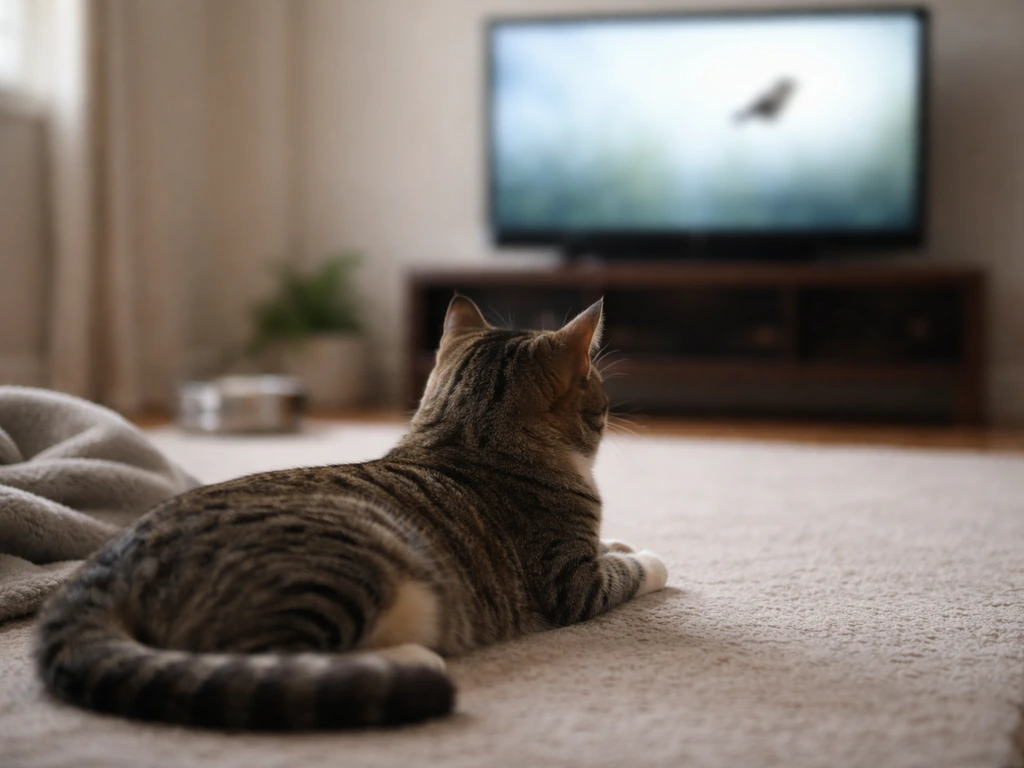
Keep bird video sessions to 5 to 10 minutes at a time, one to three times a day. That's the sweet spot most veterinary behaviorists land on for structured predatory play, and it maps directly onto cat-watching-screen enrichment. Beyond that window, a lot of cats tip from entertained into genuinely frustrated or overstimulated, which is the opposite of what you want, especially if you share your home with real pet birds.
How Long Should I Let My Cat Watch Bird Videos?

Marcus Chen
27 Apr 2026
Recommended viewing time limits
The 5-to-10-minute guideline comes from clinical guidance on predatory play sessions: cats can satisfy a meaningful chunk of their predatory drive in a short, focused burst, and after about 10 minutes they either lose interest or start to escalate. Neither outcome is great if you're trying to use videos as calm enrichment. Think of it less like putting on a nature documentary for yourself and more like running a structured play session. Short, deliberate, and bookended by a clear start and stop.
For most cats, two or three of these micro-sessions spread across the day is plenty. Morning and late afternoon tend to work best because those roughly match a cat's natural hunting activity windows. Avoid scheduling a session right before bedtime unless your cat is reliably calm after watching, because an overstimulated cat at 11pm is nobody's friend.
| Cat type | Suggested session length | Sessions per day | Best timing |
|---|---|---|---|
| Calm, low-prey-drive adult | Up to 10 minutes | 1 to 2 | Morning or afternoon |
| Average adult cat | 5 to 8 minutes | 2 to 3 | Morning and late afternoon |
| High-prey-drive or young adult | 3 to 5 minutes | 2 to 3 | With immediate toy redirect after |
| Kitten under 1 year | 3 to 5 minutes max | 2 | Supervised only, stop at first escalation sign |
Signs your cat is getting too stimulated
This is the part most people skip, and it's actually the most important part of the whole routine. The time limit is just a starting guideline. What you really need to watch for is your cat's arousal level in real time, because some cats hit their ceiling at 3 minutes and others stay relaxed at 12. Learning to read the escalation curve is the skill that makes enrichment actually enriching instead of stressful. In a Reddit r/CatAdvice thread, some people report that letting cats watch prey like window or bird activity can actually reduce stress for certain cats, with discussion that adds anecdotal balance to the usual “watch for escalation” advice some cats view window prey viewing as calming.
Early engagement looks fine: focused eyes, ears forward, maybe a little tail twitch. That's normal predatory attention and it's what you want to see. The trouble starts when the behavior shifts toward frustration or displacement. Predatory behaviors like stalking, crouching very low, chattering, and paw-swiping at the screen are fine in small doses, but when they intensify or your cat starts yowling, growling softly, or whipping their tail hard, you've crossed a line. At that point the video isn't enriching them, it's winding them up with no outlet.
- Chattering or chirping at the screen (normal in small doses, a warning sign if it becomes loud or frantic)
- Hard, fast tail lashing (distinct from a gentle swish)
- Crouching low and going very still, then repeatedly lunging at the screen
- Yowling, growling, or vocalizing in a way that sounds distressed rather than excited
- Redirected aggression: turning to swipe at you, another pet, or a nearby object
- Pawing or scratching at the screen itself repeatedly
- Dilated pupils that stay wide even when the video pauses
- Panting (rare in cats and always a sign of extreme arousal)
If you see any of those in the second half of the list, stop the video immediately. Don't just pause it, turn it off and physically move away from the screen. Trying to distract your cat while the video is still running often doesn't work because the visual stimulus is stronger than whatever you're offering. End the session cleanly, then give them 10 to 15 minutes to decompress before offering an interactive toy.
How to set up bird-video enrichment safely
The setup matters almost as much as the timing. A few practical rules make the difference between a genuinely calming enrichment session and an accidental frustration spiral.
Screen placement and room setup
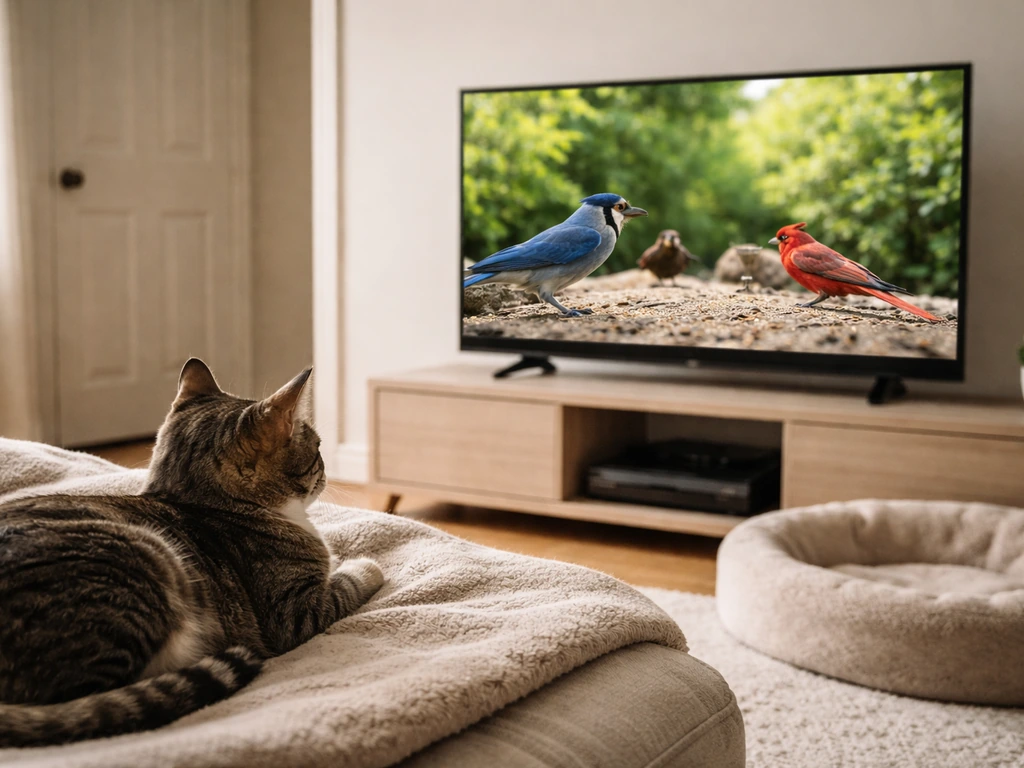
Put the screen somewhere your cat can sit comfortably at eye level without having to crane upward or perch precariously. A TV at a low table height, a tablet on a stable stand, or a laptop on the floor all work. If your cat is a screen-swiper, prop the device so it's not going to tip over and get it out of easy reach of claws. You want watching, not contact.
Keep the volume moderate. Some cats actually respond more intensely to bird audio than to the visuals, and a loud birdsong track can ramp up arousal faster than you'd expect. Test at a low volume first and watch their reaction before turning it up.
Supervision is non-negotiable
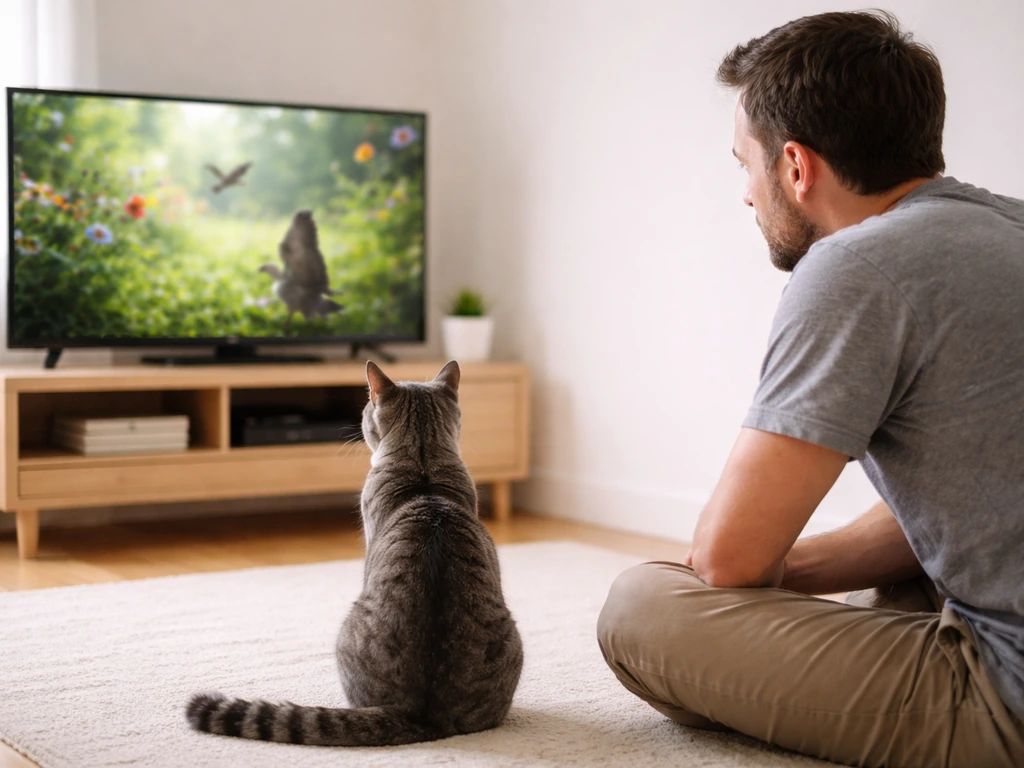
Don't treat bird videos like background TV you can leave running while you do something else. Stay in the room. You're there to watch your cat watch the video, not to watch the video yourself. The whole point of the session guideline is that you're actively managing it, which you cannot do from another room. If you can't supervise, don't start the session.
Have a redirect toy ready before you press play
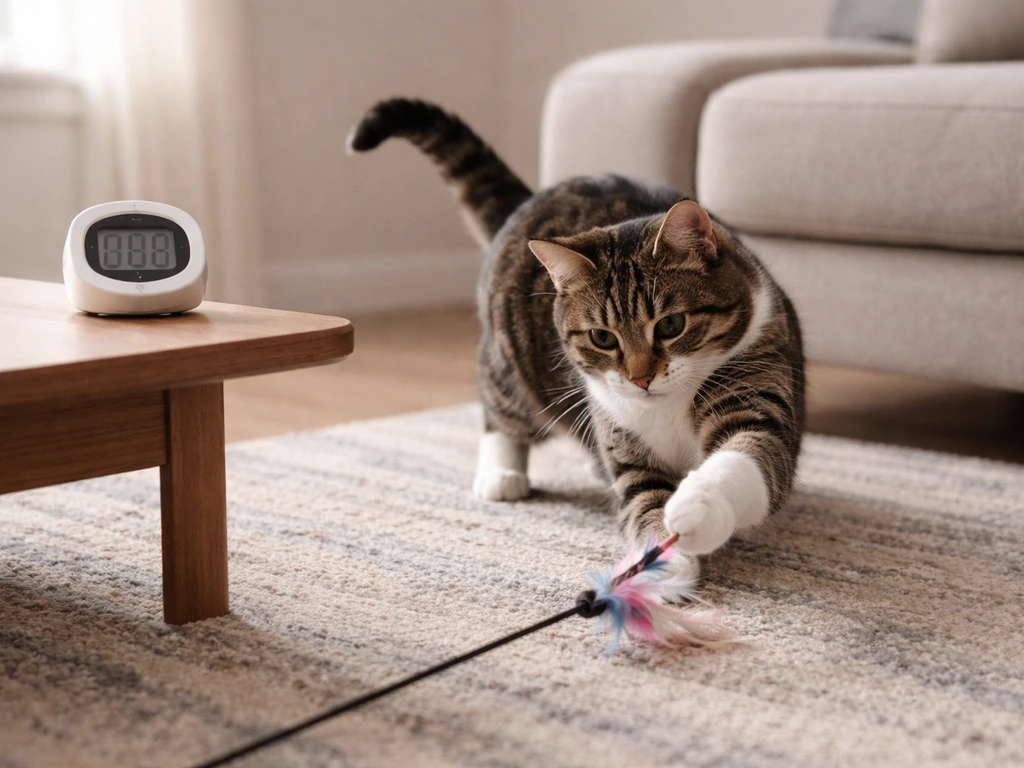
This is a step I wish I'd built into my routine from the start. Have a wand toy or a feather toy in your hand or right next to you before the video starts. When the session ends, or when you see early escalation signs, you can immediately redirect that predatory energy into something physical. The transition from watching to playing is smooth and satisfying for the cat, and it helps close the predatory loop instead of leaving them in a heightened state with nowhere to put it.
Adjusting duration based on your cat's personality and prey drive
Not every cat is the same, and the 5-to-10-minute rule is a starting point, not a prescription. You'll need to calibrate based on who you're actually living with.
A laid-back older cat who watches with mild interest and then wanders off to nap is telling you the session can safely run closer to the 10-minute end, or even a little beyond, because their arousal ceiling is naturally low. Conversely, a young cat or a breed with a high prey drive (think Bengals, Abyssinians, or any cat with a strong outdoor hunting background) may hit their escalation point at 3 or 4 minutes. For those cats, shorter is consistently better. It's much easier to extend a session that's going well than to recover from one that went too far.
Kittens are a special case. Their predatory instincts are intense, their impulse control is basically nonexistent, and they escalate fast. Keep kitten sessions to 3 to 5 minutes maximum, always supervised, and be ready to end it the moment things get frantic. If your kitten is in a household with real birds, I'd honestly skip the bird videos entirely until they're older and have more impulse control, and use non-bird enrichment instead.
One useful self-test: after a session, is your cat relaxed and ready to settle, or are they pacing, vocalizing, or redirecting onto other things in the room? A successful session should leave them slightly tired and satisfied, the way a good play session does. If they're wound up, shorten the next session by a couple of minutes and see if that changes the outcome.
If you have real pet birds in the home, read this section twice
This is where the topic gets genuinely complicated, and where a lot of cat owners who also keep birds make a mistake that seems harmless but isn't. Letting your cat watch bird videos while real birds are in the same home is like running a training program for predatory fixation. You are actively reinforcing and practicing the exact behavior pattern that puts your birds at risk.
Research on predatory behavior in cats is pretty clear on this: when a cat watches prey-like stimuli but has no real outlet for that drive, frustration builds. That frustration doesn't stay contained to the screen. It generalizes. A cat who's been watching bird videos for 20 minutes and then walks past a birdcage is a cat whose predatory arousal is already elevated. Even a well-secured cage can become a source of intense stress for the bird inside when a highly aroused cat is pressing against it or staring it down.
If you keep pet birds, here's how to manage this responsibly. First, never let your cat watch bird videos in the same room as a bird, caged or otherwise. Second, after any bird-video session, give your cat time to fully decompress, at least 15 to 30 minutes of calm activity or rest, before they have any access to areas where birds are housed. Third, keep sessions shorter and monitor closely, because the stakes of getting it wrong are higher in a multi-species home.
If your cat is already showing intense fixation on your real birds (stalking the cage, vocalizing at it, spending long stretches pressed against it), bird videos are likely making this worse. In that case, drop the bird videos entirely and shift to non-prey enrichment. The goal of enrichment is to reduce stress and predatory frustration, not amplify it.
When to stop completely and what to do instead
Some cats genuinely don't do well with bird videos, full stop. If you've tried short sessions, consistent redirection, and careful monitoring, and your cat still escalates predictably, or redirects aggression onto you or other pets, that's the answer: bird videos aren't the right enrichment for this particular cat. That's not a failure, it's just information.
Stop using bird videos if you consistently see redirected aggression toward people or other animals, if your cat's fixation on real birds in the home visibly increases after sessions, if the cat is unable to settle for 30 or more minutes after a session ends, or if the arousal level during sessions is intense regardless of how short you make them. dvm360 describes redirected aggression as aggression directed toward a person or animal other than the arousing trigger, and notes arousal-related signs such as growling or yowling, nervous pacing, tail lashing, dilated pupils, and fixed gaze.
Alternatives that still satisfy predatory drive
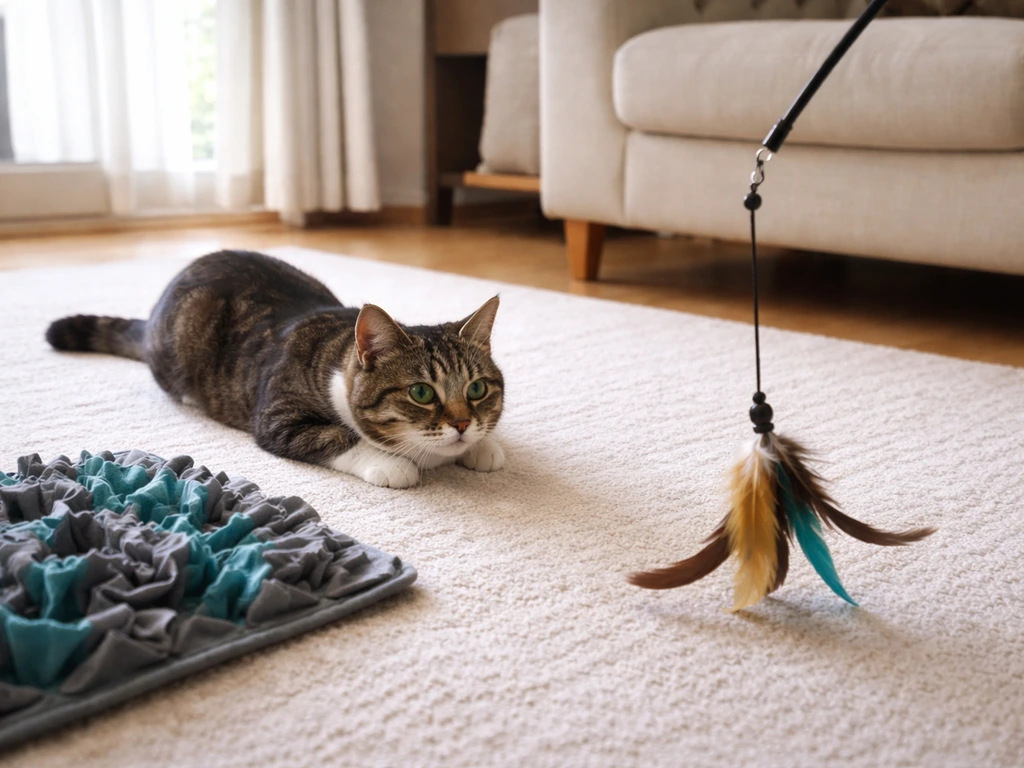
The underlying goal of bird videos is enrichment: giving your cat an outlet for the predatory sequence (spot, stalk, pounce, catch). You can absolutely achieve that without using bird content at all. Interactive wand toys used in short structured play sessions are the most effective alternative, and the physical element is actually better for closing that predatory loop than screen watching is. Puzzle feeders and snuffle mats engage hunting behavior through scent and problem-solving.
Robotic or battery-operated toys that move unpredictably can substitute well for screen stimulation without the escalation risk that bird audio and visuals sometimes bring. A top bright magnetic bird toy can be a great hands-on alternative that gives your cat a realistic outlet for the same predatory energy.
For cats who need more of a moving outlet than screens can provide, the best flying bird cat toy for indoor cats can be a helpful next step alongside short structured play.
For cats who are drawn to visual stimulation specifically, consider videos of insects, fish, or other moving objects that have lower predatory intensity for most cats than birds do. Squirrel or fish videos tend to produce a more relaxed watching response in cats who escalate with bird content.
If your cat's predatory behavior is causing real problems, whether with redirected aggression, fixation on real birds, or general arousal issues, it's worth talking to a veterinary behaviorist. The American Veterinary Society of Animal Behavior maintains position statements on arousal and aggression management and can help you find a credentialed professional. This isn't an exotic resource, it's just the right tool for a problem that's bigger than a screen-time tweak can fix.
A simple daily routine that works
- Morning session: 5 to 8 minutes of bird or nature video, supervised, with a wand toy ready
- Immediately follow with 5 minutes of active interactive play using the wand toy
- Allow 15 to 20 minutes of calm downtime before your cat has access to any area with birds
- Optional afternoon session: same structure, same length, same redirect
- No sessions in the hour before bed unless your cat is reliably calm afterward
- Adjust session length by 1 to 2 minutes based on how the previous session went
That structure is what makes bird-video enrichment actually enriching instead of just stimulating. Keep it short, pair it with a physical outlet, and stay in the room. PetMD notes that feather wand style toys can activate a cat’s hunting and chasing components, but they still don’t satisfy the capture urge by themselves, which is why interactive play is important [pair it with a physical outlet](https://www. petmd.
com/cat/wellness/these-are-best-cat-toys-simulate-hunting-prey/). Everything else is calibration based on your specific cat. If you're also exploring other options for keeping your cat engaged around birds, bird-themed cat toys and indoor bird setups can be part of a broader enrichment strategy that satisfies both species without putting either one at risk.
If you're also exploring other options for keeping your cat engaged around birds, best indoor bird can be part of a broader enrichment strategy that satisfies both species without putting either one at risk.
FAQ
How should I start if my cat has never watched bird videos before?
Begin with 2 to 3 minutes at a low volume, stay within arm’s reach to supervise, and stop at the first sign of escalation such as chattering that ramps up, pawing that intensifies, or hard tail whipping. If your cat settles afterward, you can gradually build toward the 5 to 10 minute window.
What are the most reliable signs that it’s time to end the session, even if I’m near the 5 to 10 minute mark?
End it immediately if your cat starts yowling or growling softly, presses forward repeatedly as if trying to reach the screen, or shows displacement behaviors like aggressive paw swipes mixed with frantic pacing. If they cannot redirect quickly when you remove access to the video, that’s another strong cutoff signal.
Is it okay to pause the video instead of turning it off when my cat gets too excited?
Usually not. Pausing keeps the visual stimulus “in waiting,” and many cats stay fixated. The better approach is to turn the video off and physically move away from the screen, then offer a decompression period before any toy session.
Should I watch bird videos in the evening if my cat is usually calm at night?
If they are truly calm after watching, you can try a short session earlier in the evening, but avoid starting right before bedtime. A practical rule is to schedule it at least 2 to 3 hours before sleep so you can confirm they settle rather than carry arousal into the night.
How long should I wait after a bird-video session before letting my cat roam near birds or bird areas?
If there are any real birds in the home, plan for a longer buffer than you think. Give at least 15 to 30 minutes of calm rest or non-prey enrichment before access to any area where birds are housed, even if your cat looks okay right after the video ends.
Do bird videos affect indoor-only cats differently from cats that go outside?
Yes. Cats with a strong outdoor hunting background often reach arousal faster and may show escalation earlier, even within a few minutes. If you know your cat tracks prey outside, treat the 5 to 10 minute window as an upper limit and start closer to 3 to 5 minutes.
What if my cat keeps trying to swipe at the screen or climb toward it?
That’s a cue to change setup and possibly shorten sessions. Secure the device so it cannot be tipped, position it at comfortable eye level, and do not leave the cat unsupervised. If screen-contact behavior persists even with a safer setup, switch to non-video enrichment.
Can I use bird video sessions as the main form of enrichment, or should I combine them with play?
Don’t rely on videos alone. The most helpful routine includes a transition to physical outlet immediately after the session ends, such as wand play or a feather toy, so the predatory sequence can complete rather than stall.
Are insect or fish videos a safe alternative if my cat escalates with birds?
They are often less intense for many cats, but they are not automatically safe for every cat. Test with short supervised sessions, watch for the same escalation signs, and avoid using any prey-like content when real birds are nearby or when your cat has shown fixation.
What should I do if my cat seems more aggressive toward people after bird videos?
Stop the sessions. Redirecting energy only works up to a point, and redirected aggression is one of the clear “wrong match” outcomes. Replace bird-video enrichment with non-prey options and consider a veterinary behaviorist if aggression patterns persist or increase.
How often per day is too much, and how can I adjust if my cat is already wired?
If you already run 2 to 3 micro-sessions, additional sessions often push arousal into frustration. If your cat is pacing, vocalizing, or unable to settle after a session, reduce the number of sessions and shorten each one by a couple of minutes for the next try.
Should I use bird videos for kittens at all?
Keep kitten sessions very brief (3 to 5 minutes max), always supervised, and be ready to stop at the first sign of frantic behavior. If the kitten lives with pet birds, the safest option is usually to skip bird videos entirely and use non-bird enrichment until impulse control improves.