
In most cases, no, you cannot freely collect and keep bird feathers you find on the ground, at least not legally, if you live in the U.S., Canada, or the U.K. The common assumption that 'shed' or 'found' feathers are fair game is one of those pieces of popular advice that turns out to be genuinely backwards. In the U.S., the Migratory Bird Treaty Act (MBTA) prohibits possession of feathers from native North American birds without a permit, and the U.S. Fish and Wildlife Service is explicit that the restriction applies to all feathers regardless of how they were obtained. So even a feather you watched fall off a bird is technically covered. That said, the rules vary by country, species, and context, and there are legal paths forward if you know where to look.
Can You Collect Bird Feathers? What’s Legal and OK

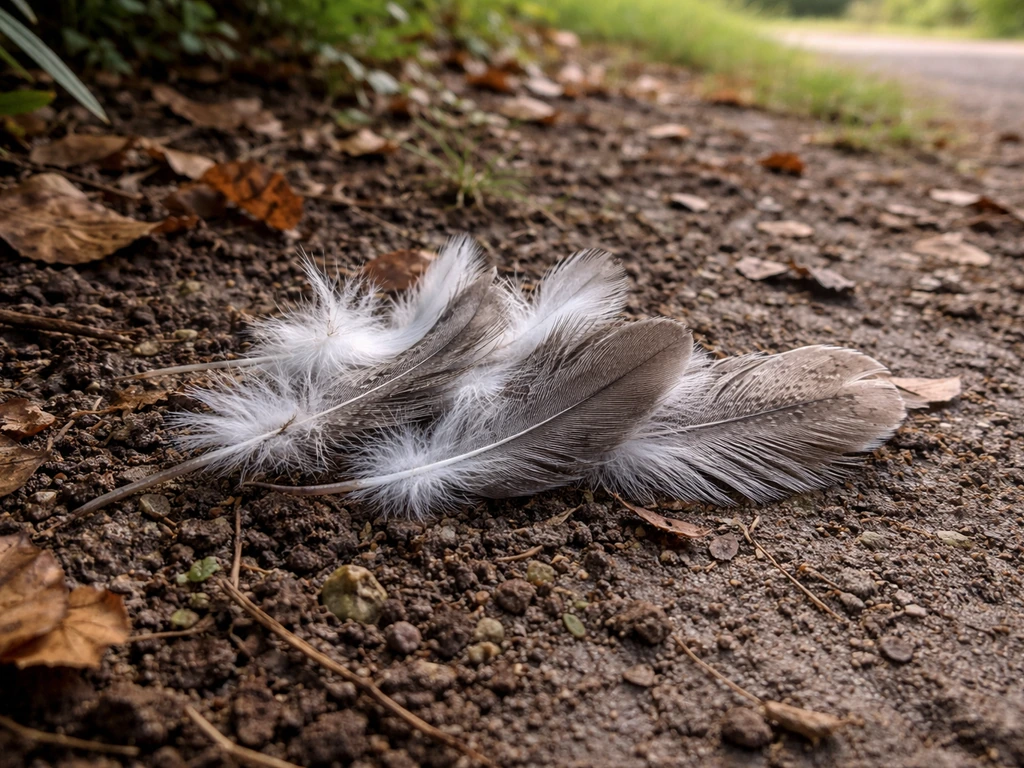
Is collecting bird feathers legal where you are
The legal picture depends almost entirely on where you live and which species the feather came from. Here is a quick breakdown of the three major regulatory environments most readers will be dealing with.
United States
The MBTA, enforced by the U.S. Fish and Wildlife Service, covers the vast majority of native North American birds. Permitting rules are laid out in 50 CFR Part 21. Unless you hold an appropriate FWS permit or fall under a narrow defined exception, possession of feathers, nests, or other parts of covered species is prohibited. The list of covered species is long and based on four international treaties, so 'is this bird migratory?' is not a reliable filter. Crows, sparrows, hawks, owls, songbirds, and most shorebirds are all included. Bald eagles and golden eagles have an even stricter layer of protection under the Bald and Golden Eagle Protection Act, governed by 50 CFR Part 22, which restricts personal possession essentially outright unless you are a qualifying institution or authorized entity. There are no casual personal-use exceptions for eagle feathers, full stop.
The birds that are NOT covered by the MBTA are a short list: non-native, non-migratory introduced species like European starlings, house sparrows, and rock pigeons. Feathers from those birds sit in a legal gray zone at the federal level (not protected by MBTA), but always check your state laws because some states add their own protections.
United Kingdom
The U.K.'s Wildlife and Countryside Act 1981 covers wild birds broadly, and possession of a wild bird or its parts can indicate an offence under the Act. Scotland's NatureScot guidance makes this especially clear: it is an offence to possess wild birds or their parts unless the item was taken legally, and the legal burden can fall on you to prove lawful provenance. The Barn Owl Trust advises keeping detailed records of where and when any feather or dead bird was found, precisely because you may need to demonstrate it was obtained lawfully.
Canada
Canada's Migratory Birds Regulations (updated in 2022) allow temporary possession of migratory bird parts without a permit only in very limited, specifically authorized situations. Canadian Migratory Birds Regulations (2022) include an Indigenous rights context where individuals may possess migratory bird feathers “under a right recognized and affirmed by section 35,” and they outline possession and exchange rules in Section 23 Canada's Migratory Birds Regulations (updated in 2022) allow temporary possession of migratory bird parts without a permit. Eggs are excluded entirely. The default position is the same as in the U.S.: possession requires legal authority, not just good intentions or an 'I found it' explanation.
A quick reference by region
| Region | Governing Law | Personal Feather Possession | Key Exception/Note |
|---|---|---|---|
| United States (most birds) | MBTA, 50 CFR Part 21 | Prohibited without permit | Non-native species like starlings/house sparrows not covered federally |
| United States (eagles) | Bald and Golden Eagle Protection Act, 50 CFR Part 22 | Prohibited for personal use | Qualified institutions can apply for permits |
| United Kingdom | Wildlife and Countryside Act 1981 | Offence unless provenance is lawful | Burden of proof can fall on the holder |
| Canada | Migratory Birds Regulations 2022 | Prohibited except limited authorized situations | Eggs excluded entirely; no casual 'found it' exception |
| Other countries | Varies widely | Check national/regional wildlife law | CITES also applies to internationally traded feathers |
Ethical and environmental considerations (leave no trace)
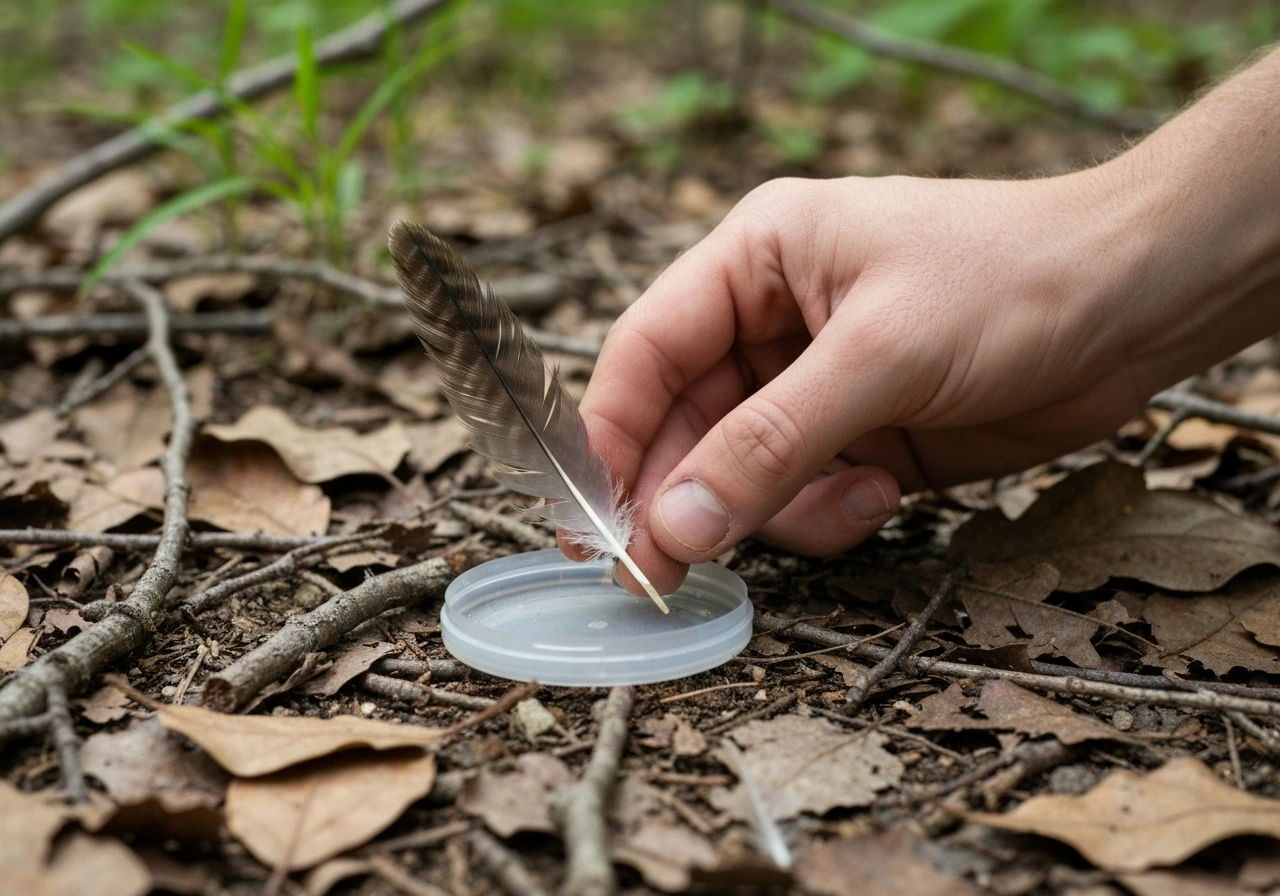
Even where possession might technically be allowed (say, feathers from a non-protected species in a jurisdiction with no specific rule against it), there is still an ethical side worth thinking through. The Leave No Trace principle of respecting wildlife applies not just to living animals but to the ecosystems around them. Picking up feathers near an active nest, roosting site, or feeding area means you are in close proximity to wildlife, and repeated human presence near those spots causes measurable stress to birds, disrupts natural behaviors, and can lead to nest abandonment.
There is also a practical ecological angle: shed feathers are not waste. Other birds use them for nest insulation, small mammals use them for bedding, and feathers break down and return nutrients to the soil. Collecting in large quantities, even legally, removes material that serves a purpose in the habitat. The NPS and Appalachian Mountain Club both frame it simply: you are a visitor in wildlife's home. Take nothing that is not yours to take.
How to collect safely if it's ok (shed feathers only)
If you have confirmed through your local wildlife authority that collection is lawful for the species and location you are dealing with (for example, feathers from a domestic or non-protected bird species that you own or that are definitively not MBTA-covered), here is how to do it responsibly.
- Only collect feathers that are already on the ground and clearly shed, not plucked or taken from a carcass unless you have explicit authorization.
- Wear disposable gloves or use a plastic bag turned inside out as a barrier, both to protect yourself from pathogens and to avoid contaminating the feather with skin oils.
- Place feathers in a sealed zip-lock bag immediately to contain any mites, lice, or debris.
- Do not approach active nests, roosting spots, or feeding areas, even if a feather is lying right nearby. Back off and let it go.
- Keep a written record of the date, location, and apparent species (or best guess) in case you need to demonstrate lawful provenance later, especially relevant in the U.K.
- Take only what you genuinely need. A handful of feathers as a craft material or pet-bird enrichment item is very different from filling a bag.
- Handle shed feathers carefully to avoid tearing the rachis or damaging the barbules, they degrade quickly once structural integrity is broken.
How to check if a feather might be from a protected species

This is genuinely tricky. Feather identification is a specialist skill, and even the FWS's own Feather Atlas, which is one of the best public resources available, carries a disclaimer that its identifications are not definitive unless confirmed by a qualified expert. That said, there are practical steps you can take before deciding whether to keep a feather.
- Start with context: Where were you when you found it? If you were in a national park, wildlife refuge, or area known for raptors, owls, or shorebirds, assume protection applies until proven otherwise.
- Use the FWS Feather Atlas (fws.gov) to compare the feather visually against forensics-grade scans. Look at size, color pattern, and feather type (flight feather vs. down vs. contour feather).
- Post a clear, well-lit photo to iNaturalist with something for scale (a coin or ruler next to the feather). The community includes ornithologists who can offer identification, though note this is not a legal determination.
- Cross-reference with Audubon's identification resources and field guides for your region. Bill shape and size clues used for live birds do not apply to feathers, but size, pattern, and iridescence can narrow things down.
- If the feather is large, strikingly patterned, or appears to be from a raptor or owl, treat it as protected and do not keep it. The risk-to-reward ratio is not worth it.
- When in genuine doubt, contact your regional FWS office (U.S.), Natural England or NatureScot (U.K.), or Environment and Climate Change Canada. They are usually approachable about genuine public inquiries.
For anyone interested in digging deeper, the related question of exactly which species' feathers are permissible to keep is worth reading up on separately, as the specifics get detailed fast. The permit question also ties closely into this, especially if you are considering any kind of organized collection.
Cleaning, sanitizing, and storing feathers safely
If you are keeping feathers you have confirmed are legal to possess (for example, from your own pet birds, domestically sourced chickens, or legally sold craft feathers), proper cleaning and storage matter a lot, especially with pet birds in the house.
Dealing with mites and pests first
The most important step is killing any insect life stages before a feather comes inside. The NPS museum collections program uses freezing as a standard pest-control method for organic materials like feathers, and it is the approach I would recommend. Seal the feather in a zip-lock bag, making sure as much air as possible is out, then freeze it at 0°F (-18°C) for at least 72 hours. This kills mite eggs, lice, and other insect life stages without using harsh chemicals that could damage the feather or create fumes around pets.
Cleaning the feather itself
Feathers are keratinous materials and are naturally water-resistant when undamaged, but the Canadian Conservation Institute notes that cleaning them may require a trained conservator if they are fragile or heavily soiled. For practical purposes with a typical found or pet-shed feather: brush off loose debris with a soft dry brush, then if needed, lightly mist with a diluted dish soap solution (barely damp, not soaked), stroke gently in the direction of the barbules, rinse sparingly, and let air dry flat on a clean surface. Do not rub, twist, or use a hair dryer on high heat.
Storage
- Store cleaned, dry feathers in a rigid container (like a shallow box) lined with acid-free tissue, away from direct sunlight which causes fading and brittleness.
- Keep storage containers away from humidity (bathrooms, basements) to prevent mold on the quill.
- Add a cedar block or dried lavender to the storage box as a natural deterrent to future insect infestation, but do not let these touch the feathers directly.
- Do not store feathers near your bird's cage, food, or accessories. Keep them in a separate room if possible.
- Label each container with species (if known), date collected, and source, both for legal documentation purposes and for your own reference.
Risks to pet birds and household health
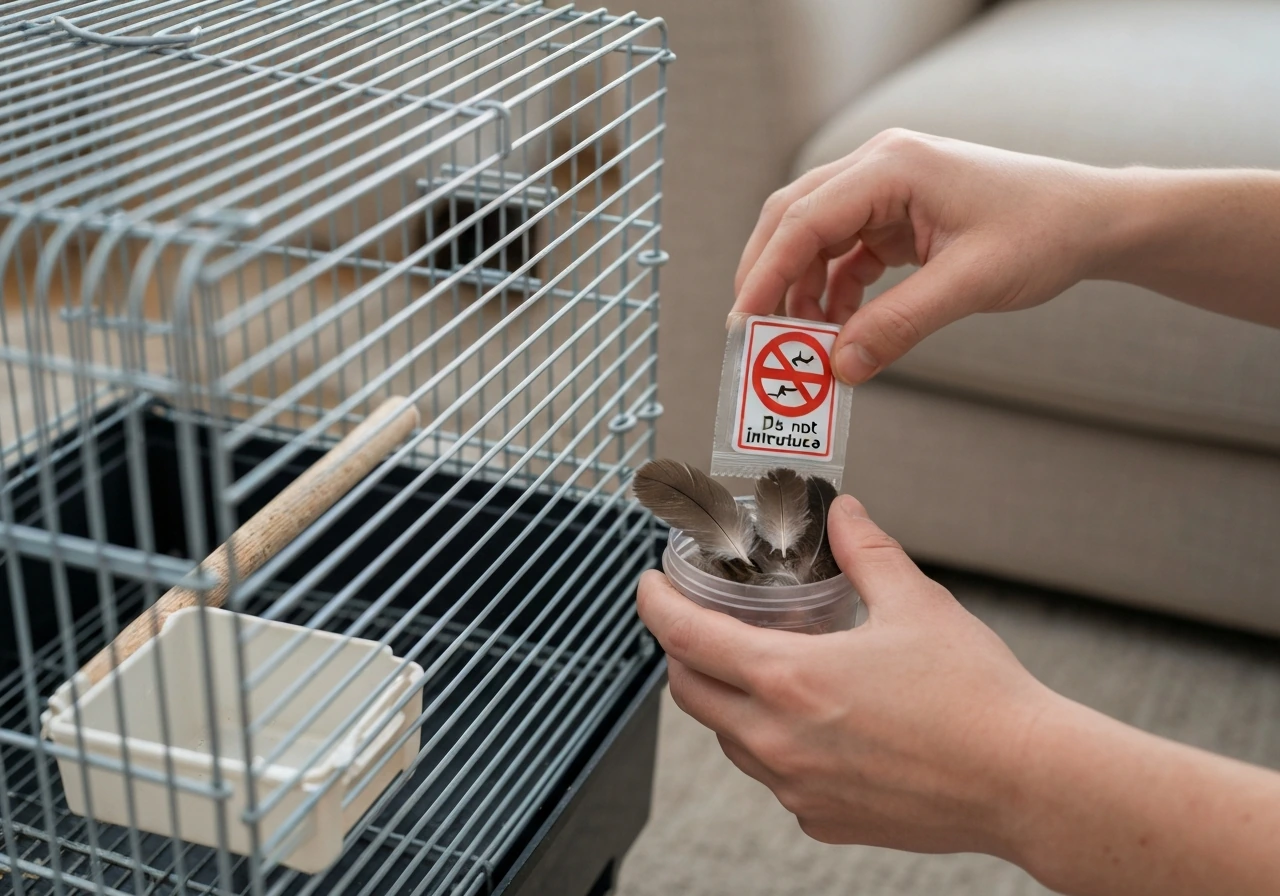
This is the section I really want pet bird owners to pay attention to, because it is easy to underestimate. Bringing wild or unknown-origin feathers into a home with pet birds is genuinely risky, and not in a vague, theoretical way.
Bird mites (Dermanyssus gallinae and related species) live on the skin and feathers of wild and domestic birds. They lay eggs in nests and on feathers, and they can survive for extended periods without a host. Massachusetts Audubon notes that large infestations can cause anemia in birds and may prompt nest abandonment in the wild. If mite-infested feathers end up near your bird's cage, the mites can transfer to your bird, crawl into cage cracks, perches, and substrate, and become genuinely difficult to eradicate. WebMD confirms that bird mites can persist in home environments even if they cannot reproduce on human blood.
Beyond mites, wild feathers can carry fungal spores, including those associated with aspergillosis, a serious respiratory disease in birds. Veterinary literature identifies environmental fungal load as a key risk factor for aspergillosis in pet birds, alongside stress and poor ventilation. You do not want to introduce a pile of wild feathers into the same room as an immunologically stressed parrot or canary.
The practical rule: treat any wild or unknown-origin feather as contaminated until it has been frozen, cleaned, and fully dried. Even then, keep it stored away from your bird's living space. Pet-shed feathers from your own healthy birds are lower risk but should still be discarded promptly rather than stockpiled near food or water.
Responsible alternatives if you shouldn't collect
If collecting in the wild is not legal in your area, the species is likely protected, or you just do not want the hassle and risk, there are legitimate alternatives that give you feathers for craft, display, or enrichment purposes without any of the legal or health baggage. If you are curious about the end uses of feathers, you may also be wondering what pens are made from bird feathers.
- Buy from licensed commercial suppliers: Feathers from domestically raised chickens, turkeys, pheasants, peacocks, ostriches, and emus are commercially available and not covered by the MBTA or equivalent protections. Many craft stores and online specialty shops sell these legally. Look for suppliers who clearly state the feathers come from domestic (farm-raised) birds.
- Use feathers from your own pet birds: If you keep chickens, parrots, or other domestic birds, the feathers they shed are yours to keep. Clean and store them properly as described above.
- Synthetic feather alternatives: For many craft applications, high-quality synthetic feathers are visually indistinguishable and eliminate all health and legal concerns entirely.
- Educational institutions and museums: If your interest is identification or study rather than keeping, many natural history museums have legally held specimens you can view, and organizations like iNaturalist let you engage with feather identification without physical possession.
- Contact a licensed wildlife rehabilitator: In the U.S., licensed rehabilitators sometimes have legally held feathers that they use for education purposes and can point you toward legitimate acquisition channels.
If your goal is enrichment for a pet bird, most birds are just as engaged by safe commercial feather toys made from domestic-bird feathers as they would be by anything found in the wild, without the mite risk or legal ambiguity. That is probably the easiest win here for most pet bird owners reading this.
What to do today: a quick action checklist
- Do not bring any found feather inside until you have gone through the steps below.
- Identify your region's wildlife law (U.S.: FWS MBTA and 50 CFR Part 21; U.K.: Wildlife and Countryside Act 1981; Canada: Migratory Birds Regulations 2022).
- Use the FWS Feather Atlas and/or iNaturalist to attempt species identification on any feather you are considering keeping.
- If the feather is from a bird you cannot confidently identify as non-protected, do not keep it.
- If collection is lawful, freeze the feather at 0°F for 72 hours immediately upon bringing it inside.
- Clean with a minimal, gentle approach, air dry fully, and store in a sealed container away from your birds.
- For craft or enrichment needs, source feathers from commercial domestic-bird suppliers as the simplest, cleanest solution.
FAQ
If I only pick up feathers that fell on the ground, can I keep them?
In the U.S., “found” does not make it legal. If the feather is from a covered native species, possession can still be prohibited even if you watched it drop naturally, you never touched the bird, and you have no intent to harm wildlife. If you are not 100% certain of the species and your jurisdiction’s rules, treat it as not legal to keep.
Does the law treat down, nests, and feathers the same way?
Yes, the rules can differ by the bird and by the legal jurisdiction, but also by the type of material. Feathers are treated as protected parts in many cases, and eggs are excluded entirely in Canada’s framework. If you are keeping anything other than feathers (down, nests, talons), confirm separately, because the allowance or permit needs may change.
What if I want to collect feathers for a hobby display or a group project?
Organized “collection” is where permissions often get stricter. If you are gathering for a hobby collection, teaching, sale, or any group activity, you should not rely on informal advice. Contact your local wildlife authority to ask what you are allowed to possess without a permit in your specific location and for that species.
How can I show that a feather was collected legally?
The quickest way to reduce risk is to avoid removing material from active wildlife locations and to document legality instead of just documenting discovery. If it is legal for that species where you live, keep a record of date, location, and what made you confident of the species (for example, clear identifying traits). This can help if you are asked to demonstrate lawful provenance later.
Are feathers safe for households with pet birds?
If you have pet birds, the safest approach is to assume any wild or unknown-origin feather is contaminated until it has been frozen, fully cleaned, and completely dried. Store it away from your bird’s enclosure even after treatment, because mites and fungal spores can persist in the environment.
What is the safest way to clean feathers to prevent mites?
Do not disinfect with harsh chemicals or heat. For pest control, freezing is the recommended method because it targets insect life stages without damaging keratin or creating fumes. For cleaning, avoid rubbing or using a high-heat hair dryer, which can harm the feather and may not remove contaminants effectively.
Are there special restrictions for certain “high-profile” birds like eagles?
Some species are covered under stricter protections that do not have typical casual possession allowances. For example, eagle feathers are restricted under separate rules, so do not assume “rare or beautiful” birds are treated more leniently. Confirm the exact species category before you try to keep feathers long-term.
Is it safer and more legal to keep feathers from my own pet birds or craft supplies?
Yes, sourcing matters. Domestically sourced or legally sold craft feathers and feathers from your own healthy pet birds are generally lower risk for both legal ambiguity and pest introduction, but they should still be managed responsibly. Avoid stockpiling near food or water, and discard promptly if a bird sheds heavily or seems unwell.
What are the most common misconceptions about picking up shed feathers?
A common mistake is relying on “migratory” as an easy test for legality. The coverage is based on specific protected species lists and legal definitions, not your personal sense of whether the bird migrated. Another mistake is assuming feathers are “waste” you can remove without consequences; repeated removal can still affect nests and local ecology.
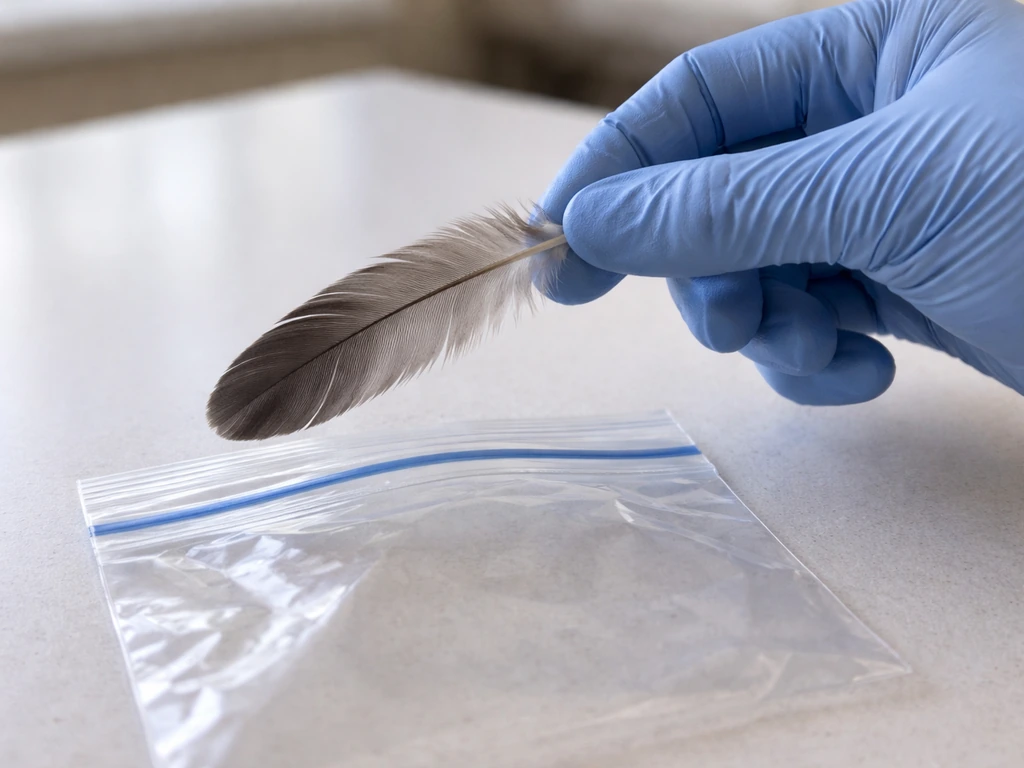
Learn when you can safely pick up loose bird feathers, how to handle and clean them, and protect pet birds from parasite
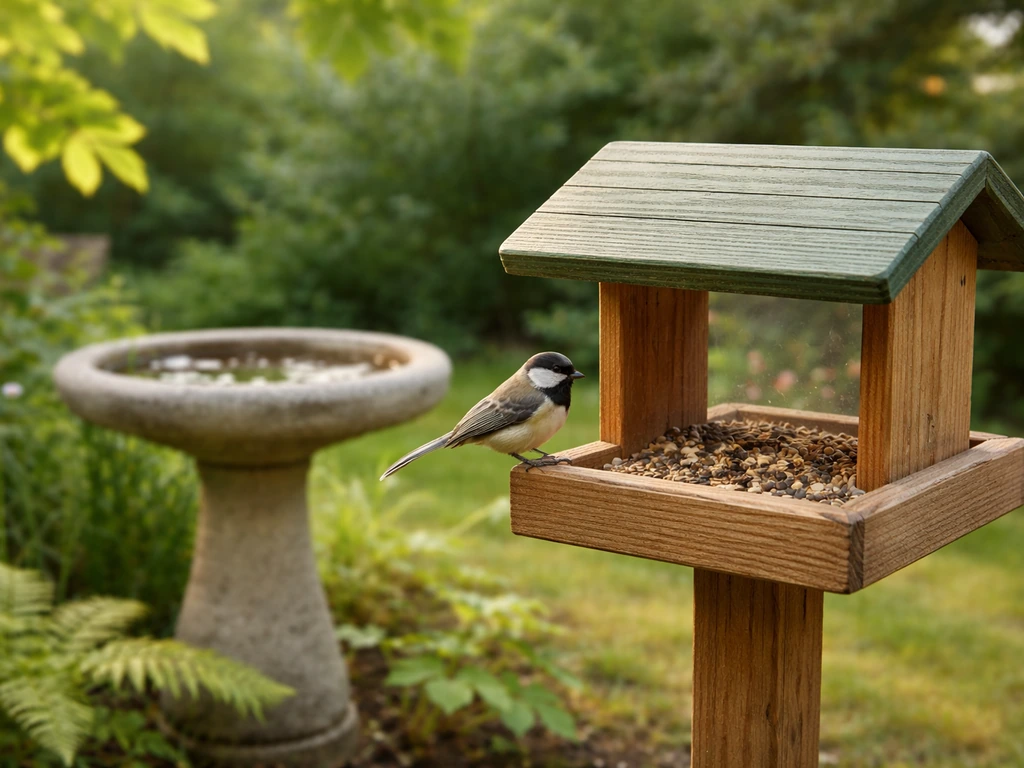
Ready-to-use wild garden bird checklist with IDs, field marks, tracking tips, and a bird station setup for beginners.
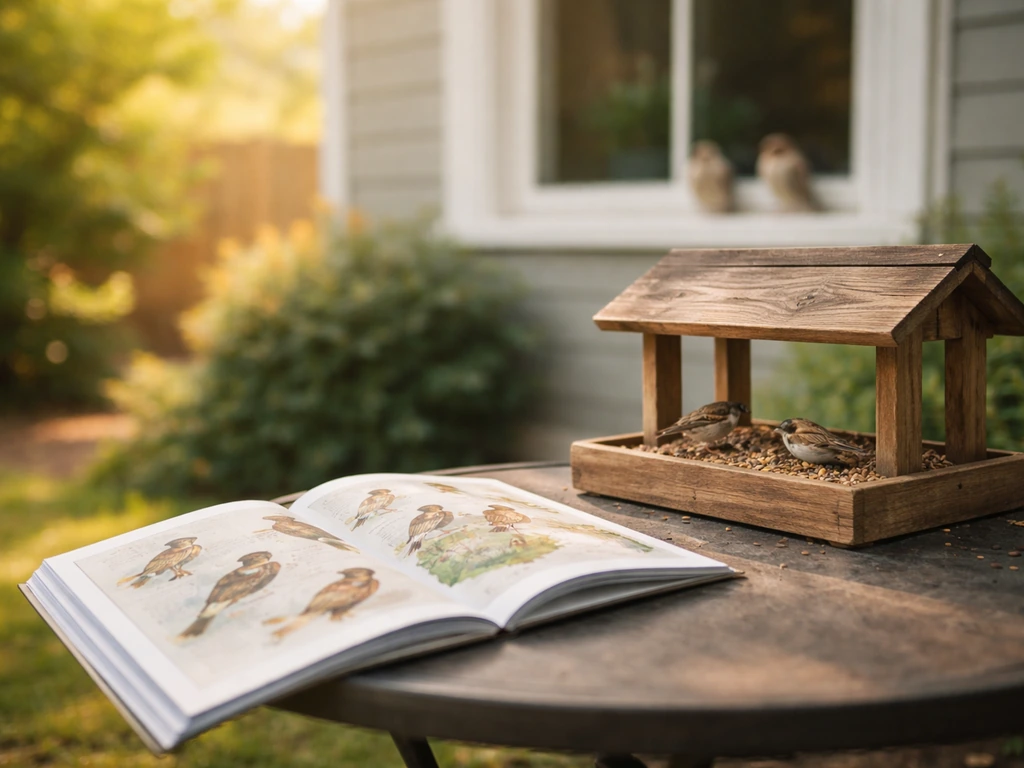
Printable backyard bird guide for beginners: simple ID key, look-alikes, and a ready-to-fill checklist for backyard sigh