For most bird owners, the right air purifier is a true HEPA unit with an activated carbon layer, sized to deliver at least 4–5 air changes per hour in the room where the cage lives. The Winix 5500-2 handles small-to-medium rooms well (CADR: dust 243, pollen 246, smoke 232 CFM), the Blueair Blue Pure 211+ covers larger spaces (CADR around 350 CFM), and if odors or VOCs are your main headache, the Austin Air HealthMate with its 15 lbs of activated carbon is hard to beat. That's the core answer, but choosing the right unit for your specific birds, room, and budget takes a little more nuance, so let's walk through exactly how to think about it.
Best Air Purifier for Bird Owners: Top Picks and Setup

Marcus Chen
1 May 2026
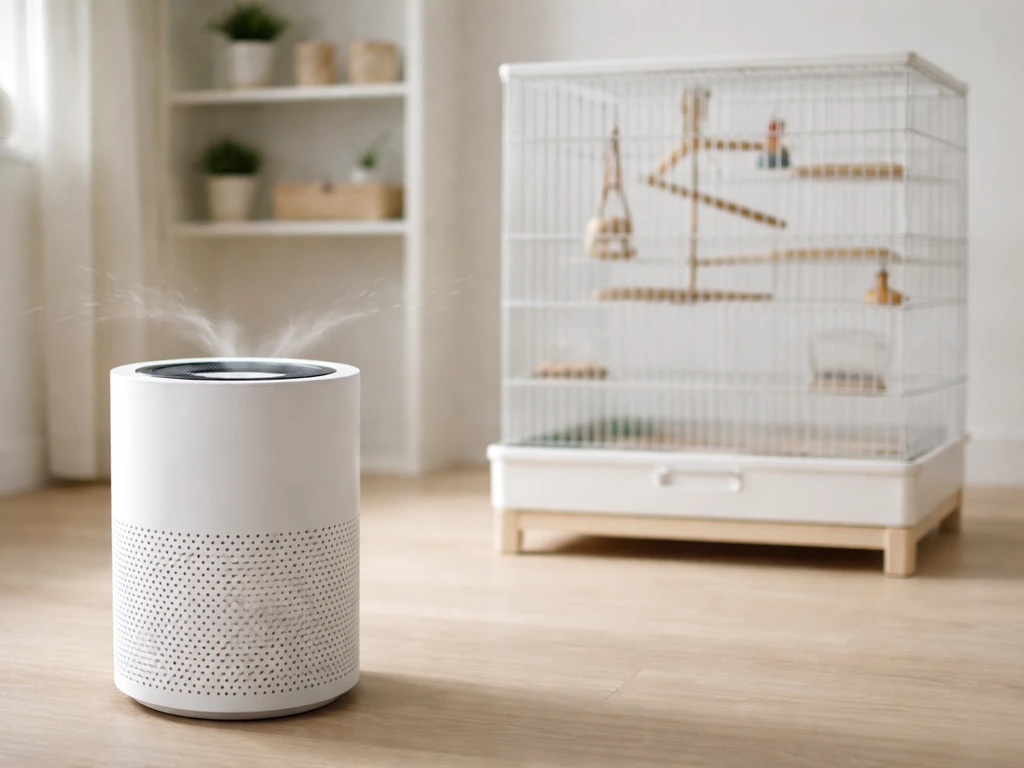
Why bird owners actually need an air purifier
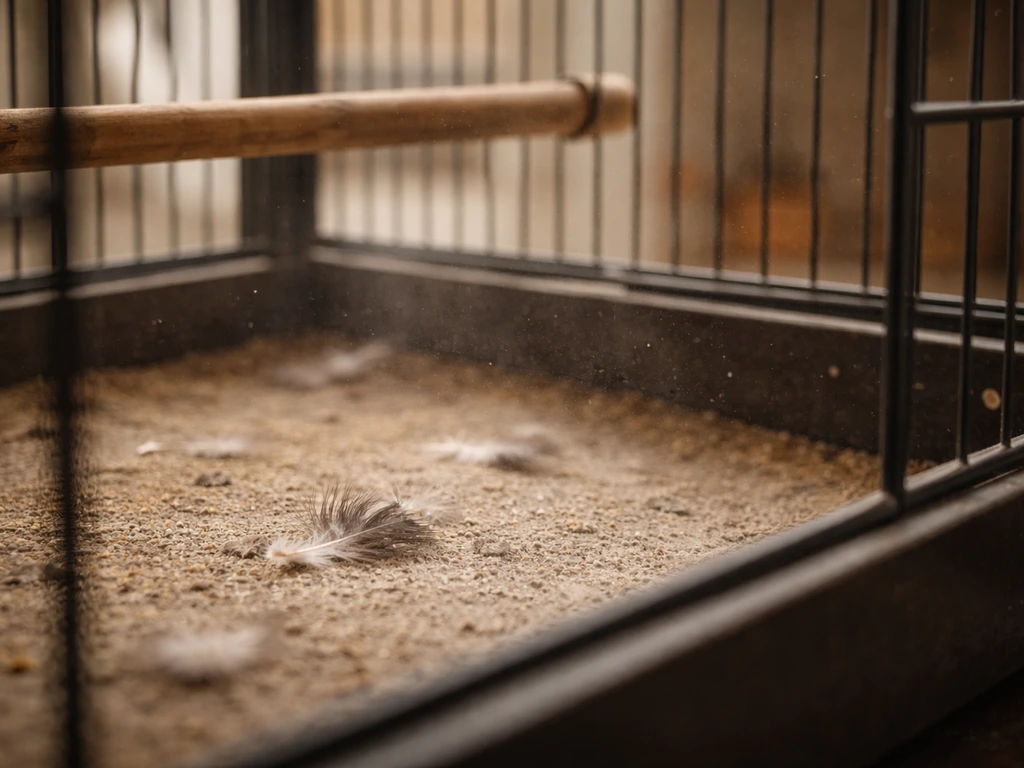
Bird dust is genuinely in a category of its own compared to cats or dogs. Fine particles from feathers, dried droppings, dander, and cage litter are constantly shedding into the air, and a meaningful portion of that dust is PM2.5-sized, particles small enough to travel deep into the lungs. The Association of Avian Veterinarians specifically flags PM2.5 as a significant concern for pet birds' environmental air quality, and it's just as relevant for the humans in the house.
There's a real medical condition called hypersensitivity pneumonitis, sometimes called 'bird fancier's lung,' that results from long-term inhalation of avian antigens found in feather and dropping dust. A scientific review of hypersensitivity pneumonitis describes bird fancier’s lung (bird fancier’s lung, BFL) as hypersensitivity pneumonitis caused by prolonged bird exposure to avian antigens blank" rel="noopener noreferrer">bird fancier’s lung (BFL) as hypersensitivity pneumonitis caused by prolonged bird exposure. The American Thoracic Society lists bird dust as one of the known exposures associated with this condition. I don't say that to scare anyone, I say it because it's why running a proper air purifier around birds isn't optional gear, it's basic responsible ownership.
Beyond the health angle, bird environments generate ammonia from droppings and a whole range of volatile organic compounds (VOCs) that particle filters alone can't touch. Cockatoos, African greys, and cockatiels are especially prolific dust producers. Even a single budgie in a small apartment can noticeably degrade the air quality over a week if nothing is filtering it. An air purifier handles both the particle side and, if it has carbon media, the odor and gas side.
What to actually look for when buying
The feature list gets confusing fast when you're shopping, so here's what actually matters for bird owners specifically.
True HEPA filtration
This is non-negotiable. True HEPA filters capture 99.97% of particles at 0.3 microns, which covers the fine dander and feather particulate that causes the most problems. Some brands use vague terms like 'HEPA-type' or 'HEPA-style', avoid those. Look for 'True HEPA' or a clear 99.97%+ particle capture specification.
Activated carbon for odors and gases
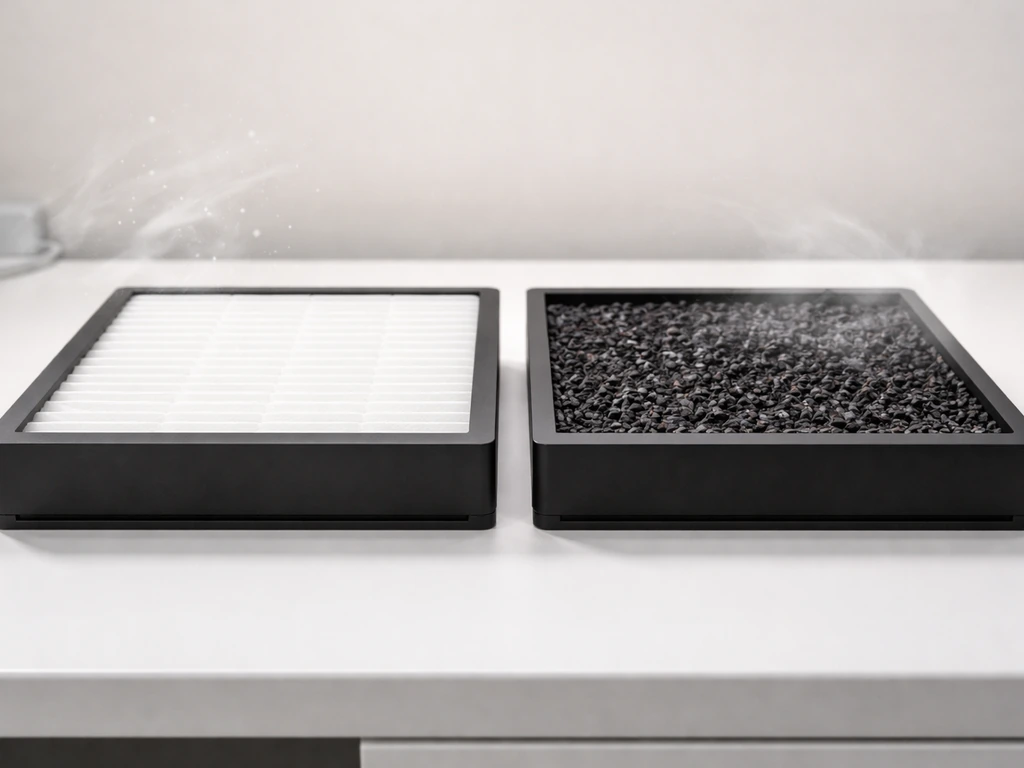
HEPA handles particles. Activated carbon handles gases, odors, and VOCs. These are two completely separate jobs, and a HEPA-only unit will do nothing for the smell of droppings or ammonia. The amount of carbon matters a lot, a thin carbon-impregnated pre-filter (common in budget units) will saturate within weeks. A unit like the Austin Air HealthMate carries up to 15 lbs of activated carbon, which is why it can actually stay effective for months in a bird-heavy environment.
CADR and room sizing
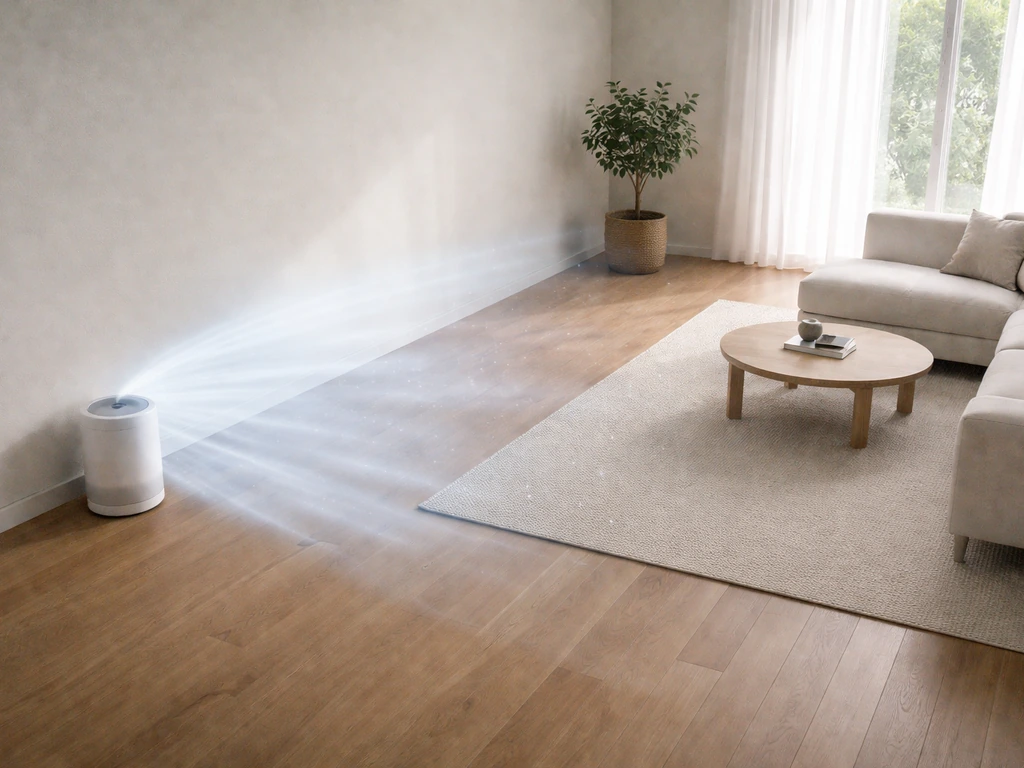
CADR (Clean Air Delivery Rate) is measured in cubic feet per minute (CFM) and tells you how much clean air the unit produces for specific particle sizes: dust, pollen, and smoke. The Association of Home Appliance Manufacturers (AHAM) recommends targeting around 4.8 air changes per hour (ACH) for a room. A simple way to apply this: look at the unit's dust CADR, and use AHAM's sizing guidance to confirm it covers your room square footage. For bird rooms, I'd suggest sizing up one tier from the manufacturer's stated 'maximum room size', you want more capacity in reserve, not less, given the particle load birds generate.
Noise level
Birds are sensitive to sudden sounds and can be stressed by a unit that cycles through high-speed blower modes with loud transitions. Look for units with a clearly quiet 'sleep' or low setting (under 30 dB is ideal) that you can run continuously without bothering the birds. The Rabbit Air MinusA2 is a well-known choice here specifically because of its ultra-quiet operation. If your birds are in a bedroom, this matters even more.
No ozone or ionizers
This one is critical. The US EPA explicitly states that ozone-generating air cleaners, including most ionizers, produce ozone at levels that can be harmful in occupied spaces. Birds have extremely sensitive respiratory systems, their air sac anatomy makes them far more vulnerable to airborne irritants than mammals. Any unit with an ionizer, plasma, or UV-C feature that produces ozone as a byproduct should be either switched off or avoided entirely. Stick to pure mechanical (HEPA + carbon) filtration.
Understanding the filter types and what each one does
Most quality air purifiers for bird owners use a multi-stage setup. Here's how the layers work and why each one matters in a bird environment.
| Filter Type | What It Catches | Bird-Specific Role | Replacement Frequency |
|---|---|---|---|
| Pre-filter (mesh) | Large particles: feathers, visible dust, hair | Extends HEPA life by catching big debris first | Monthly cleaning, replace every 3–6 months |
| True HEPA | Fine particles: dander, feather dust, PM2.5 | Core protection against lung-damaging particulate | Every 12–18 months (varies by dust load) |
| Activated carbon | Odors, VOCs, ammonia, gases | Handles dropping smell and cage odors | Every 3–12 months depending on carbon weight and bird load |
| Optional: specialty odor media | Heavy chemical/VOC loads | Useful for multiple large birds (e.g., macaws, greys) | Per manufacturer guidance |
One thing worth knowing: the carbon layer and the HEPA layer are doing completely different work. If you smell odors in a room with a HEPA-only purifier, adding carbon is the fix, not upgrading to a bigger HEPA unit. And if you're seeing dust settle on surfaces near the cage, the particle filtration is what needs attention. Diagnosing your actual problem first will save you from buying the wrong solution.
Where to place the air purifier in a bird room
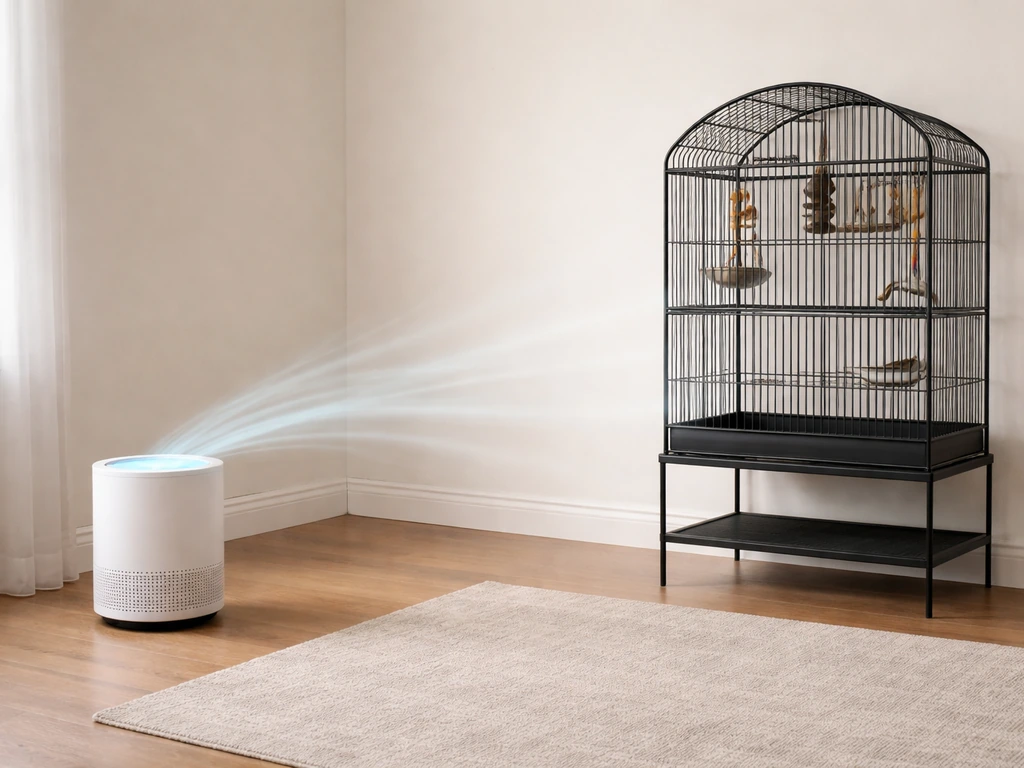
Placement makes a surprising difference in how effective a unit actually is. The goal is to maximize the amount of bird-generated particulate that passes through the filter before it settles on surfaces or gets inhaled, by you or the bird.
- Place the unit within 6–10 feet of the cage, not across the room. The closer it is to the source, the more airborne particles it intercepts before they disperse.
- Never position it so the intake or output is blowing directly at the cage. Direct airflow drafts stress birds and can cause respiratory problems. Aim the output toward an open area of the room, not at the bird.
- Elevate it off the floor if possible—on a table or stand—since a lot of bird dust becomes airborne at mid-height and floor-level placement misses it.
- Keep at least 12–18 inches of clearance on all sides of the unit so it can draw and circulate air freely.
- Run it continuously on a low-to-medium setting rather than running it on high for short bursts. Continuous low-speed operation processes more air over time and keeps the room steadier.
- If you have multiple cages in different rooms, size and place a dedicated unit for each room. One purifier trying to cover two rooms through a doorway won't work well.
I'd also suggest turning up the fan speed for 30–60 minutes after any cage cleaning, bedding changes, or when you notice visible dust in the air. These are peak particle events, and bumping the fan handles the spike before it settles.
Top picks by scenario
Rather than ranking air purifiers in a vacuum, here's how I'd match specific units to specific bird-owner situations. These are concrete starting points, not the only options, but they cover most of the real-world cases I hear about.
Best all-around for small to medium rooms (one or two small birds)
The Winix 5500-2 is a strong default for a single-bird household with a budgie, parrotlet, cockatiel, or conure in a room up to around 360 square feet. If you want the best vacuum for bird owners by analogy, focus on models that handle both fine dust and odors well in your room size. Its published CADR values (dust 243, pollen 246, smoke 232 CFM) are genuinely verified, it uses True HEPA, and it has a carbon filter layer for odors. It's not the heaviest carbon load, so if your bird is a big smell producer you'll want to check the filter more often, but for light-to-moderate odor situations it works well. It's also widely available and reasonably priced, which matters for long-term filter replacement costs.
Best for large rooms or multiple birds
The Blueair Blue Pure 211+ is one of the better options for larger spaces, with a CADR of around 350 CFM and coverage up to roughly 540 square feet. If you have a dedicated bird room with several birds, or a large open-plan living area where the cage is placed, this gives you the air-moving capacity to actually keep up with the particle load. Pair it with the SmokeBlock or AllergenBlock filter upgrade if odors are a concern in your setup.
Best for serious odor problems (heavy dust birds or multiple large parrots)
If you have an African grey, cockatoo, or multiple medium-to-large parrots, the particle and odor load is on another level. This is where the Austin Air HealthMate earns its reputation. If you want the best air purifier for bird dust, prioritize a True HEPA filter plus a meaningful activated carbon layer so it can handle both particles and odors. Its filter contains up to 15 lbs of activated carbon alongside a HEPA component, that's dramatically more carbon than most consumer air purifiers carry. It's more expensive upfront and the filter is a larger periodic cost, but the odor control genuinely holds up over months rather than weeks. The HealthMate Plus adds HEGA (high-efficiency gas absorption) for VOC-heavy environments.
Best for quiet operation (bird bedroom or noise-sensitive birds)
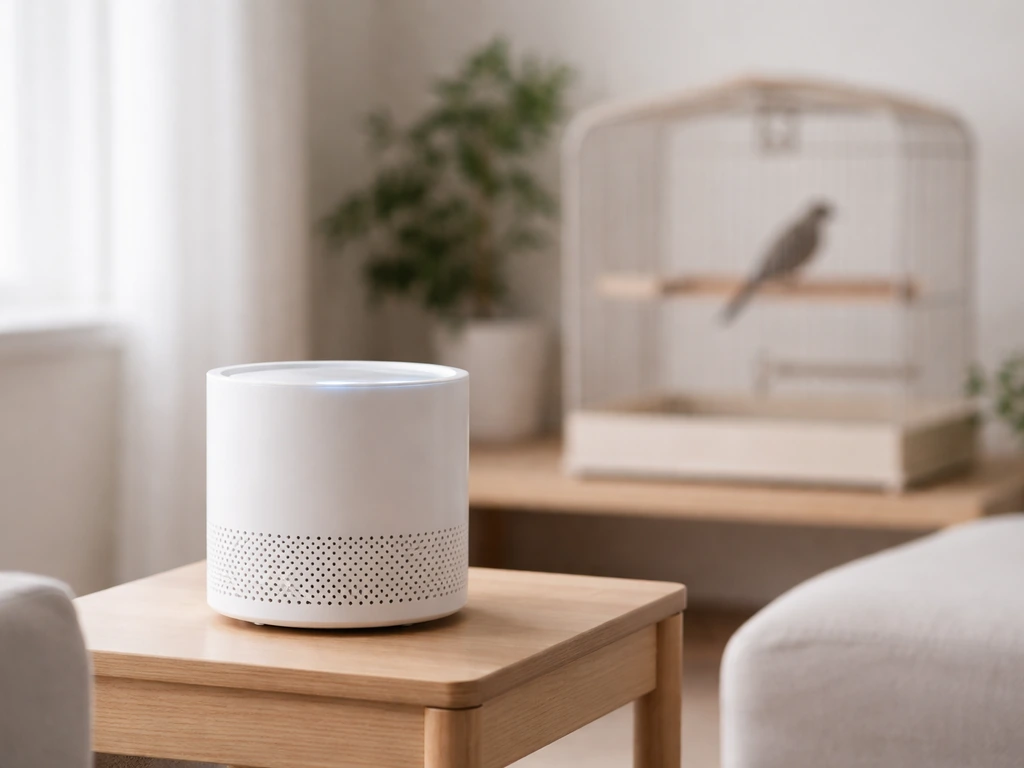
The Rabbit Air MinusA2 is the go-to when quiet matters most. It's specifically marketed around ultra-quiet performance and publishes its decibel specs clearly, which not every brand does. Its CADR values (dust 193, smoke 180 CFM) cover medium-sized rooms well, and its multi-stage filtration includes a customizable filter layer you can configure for odor control. It's one of the pricier mid-range options, but for birds that get anxious around fan noise, or for a bedroom where you need to sleep next to the cage, it's worth it.
Best budget option for tight spaces
The Coway AP-1512HH Mighty is a well-tested budget option that covers rooms up to around 360 square feet, uses True HEPA, and has consistently shown up in performance testing roundups. It has a carbon pre-filter that handles light odors, and its filter replacement costs are among the lowest you'll find. It won't match the Austin Air or Rabbit Air for odor depth, but for a first-time bird owner with a single small bird on a tight budget, it's a genuinely good starting point. You can always upgrade later once you understand your specific bird's dust and odor patterns.
Best for maximum particle + odor + VOC coverage (no compromises)
The IQAir HealthPro Plus uses a three-stage filtration system that combines a V5-Cell gas and odor filter with a HyperHEPA filter rated to capture particles down to 0.003 microns. It's the most capable option available at the consumer level and is priced accordingly. If you or a family member has a respiratory condition, or if you're keeping dust-heavy birds like cockatoos in an enclosed space, this is the unit that leaves nothing on the table. It's also the heaviest investment in ongoing filter costs.
Maintenance, running costs, and keeping it working
An air purifier you forget to maintain is basically a fan with a clogged filter. Bird environments are hard on filters because of the volume and type of particulate, so the replacement schedules most manufacturers print on the box often need to be shortened.
Filter replacement guidelines for bird households
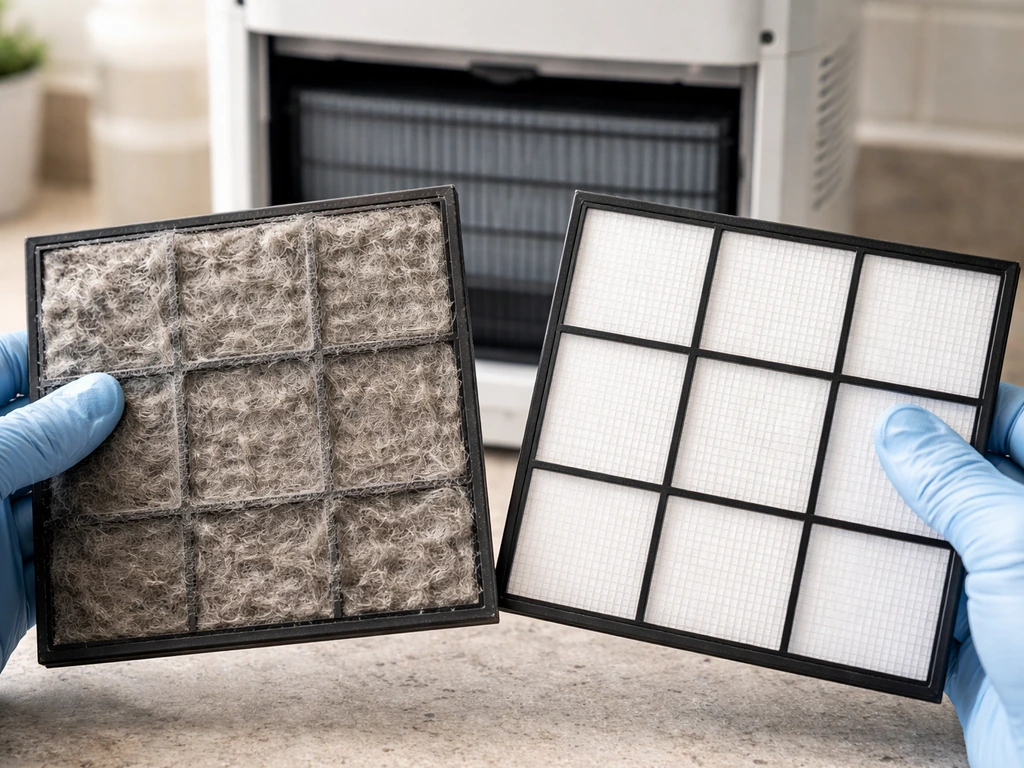
- Pre-filter: Rinse or vacuum monthly. Replace every 3–6 months rather than the standard 6–12 months. A clogged pre-filter cuts airflow and destroys HEPA efficiency.
- True HEPA: Plan for replacement every 12 months in a bird household, even if the packaging says 18–24 months. High particulate load saturates HEPA faster.
- Activated carbon/odor filter: Replace every 3–6 months for heavy odor situations (multiple birds, large parrots). IQAir's guidance puts standard replacement at 3–12 months—with birds, lean toward the shorter end.
- Watch for 'odor breakthrough'—when you start smelling the cage again despite the purifier running, the carbon is saturated regardless of how new it looks.
Running cost realities
A unit like the Coway AP-1512HH might cost you $20–30 per year in electricity at continuous low-speed operation and around $50–70 for filter replacements, making it genuinely affordable long-term. The Austin Air HealthMate has a single large filter that costs more to replace but lasts longer, potentially 3–5 years in lower-load situations. The IQAir HealthPro Plus has the highest replacement costs by a significant margin. Factor these in when comparing upfront price. A purifier that costs $80 but requires $100 in filters every 6 months will cost more than a $300 unit with $60 annual filter costs.
A note on smart features and air quality monitors
Several mid-range and premium purifiers include built-in air quality sensors that auto-adjust fan speed. These are useful in bird rooms because they respond to dust spikes during cage cleaning or feeding without you having to manually change settings. If your unit doesn't have one, a separate PM2.5 monitor (standalone sensors are available for $30–80) gives you real data on whether your purifier is actually keeping up with your bird's output, and tells you when it's time to replace a filter.
Keeping your birds safe: what to avoid and what to monitor
Birds have a respiratory system that's fundamentally different from mammals. Their air sacs allow for a unidirectional flow of air through the lungs, which is efficient for flight but means airborne toxins have longer contact time with lung tissue. They can show signs of respiratory distress before most humans even notice a problem, and they can deteriorate very quickly once affected. This is why air quality in the bird room matters more than many first-time owners realize.
Hard no: ozone and ionizers
Do not use any air purifier around birds that has an ionizer, plasma cluster, UV-C with ozone byproduct, or ozone generator mode. The US EPA has clearly stated that these devices can produce ozone above levels considered safe, and they are not recommended for occupied indoor spaces. For birds, this is especially serious, ozone is a respiratory irritant, and their sensitive air sac anatomy means exposure that a human might barely notice can be dangerous for a bird. Some purifiers include an ionizer you can toggle off; turn it off and leave it off.
What to watch in your bird's behavior
- Tail bobbing at rest, labored breathing, or open-mouth breathing are signs of respiratory stress—if you see these, get to an avian vet, and check your air quality immediately.
- Excessive sneezing (more than occasional) or discharge from the nares can indicate airborne irritant exposure.
- Lethargy or sudden loss of appetite can also signal environmental air quality issues, especially in a space with poor ventilation.
- If you introduce a new air purifier and the bird shows stress or behavioral changes, check whether the unit has any ozone-generating features and whether the airflow is blowing directly at the cage.
Air quality targets for bird rooms
The AAV recommends that bird owners pay particular attention to PM2.5 levels in the environment. While there is no universally agreed-upon indoor PM2.5 target specifically for birds, the principle is straightforward: lower is better, and you want to stay well below the EPA's 24-hour PM2.5 standard of 35 micrograms per cubic meter. In a room with heavy bird activity, an unfiltered space can exceed this during peak dust events like preening or cage cleaning. A properly sized HEPA purifier running continuously should keep your bird room well within safe ranges during normal daily activity.
It's also worth noting that air quality is connected to other room environment factors. If you're thinking about temperature regulation for your bird's space, a dedicated bird-safe heater is part of the same conversation as air purification, and a good humidifier can help with dry air that can increase dust suspension and respiratory sensitivity. A humidifier can also make the air feel more comfortable for birds when the room runs dry, but you’ll still want to pair it with proper filtration good humidifier. A good bird heater that is designed for pet birds can complement purification by keeping conditions comfortable without adding extra airborne irritants dedicated bird-safe heater. Getting the whole environment dialed in matters more than any single piece of equipment.
Your next steps
Here's the short version of everything above, distilled into action:
- Measure your bird room in square feet, then find a HEPA purifier with a CADR (dust) that comfortably covers that space at 4–5 air changes per hour—and size up a tier if you have multiple birds or heavy dust producers.
- Confirm the unit has both True HEPA and a real activated carbon layer (not just a carbon-dusted mesh). If odors are your primary problem, prioritize carbon weight.
- Turn off any ionizer, plasma, or ozone feature the unit might have—permanently.
- Place the unit 6–10 feet from the cage, elevated off the floor, with output directed away from the bird.
- Run it continuously on low-to-medium speed. Bump it up for 30–60 minutes after cage cleanings.
- Replace the pre-filter monthly, the HEPA annually, and the carbon every 3–6 months in a bird-heavy space.
- Add a standalone PM2.5 monitor if you want real data on how well your setup is working.
FAQ
Do I need both a HEPA filter and activated carbon, or is HEPA-only enough for bird owners?
If you notice ammonia-like smells, odors from droppings, or persistent “bird smell,” you need activated carbon in addition to True HEPA. HEPA-only units can capture the dust, but they do not adsorb gases and VOCs, so odor can remain even when the air looks cleaner.
How do I know if my air purifier is sized correctly for my bird room?
Use room volume and continuous CADR, then add a safety buffer. The article suggests sizing up beyond the manufacturer’s stated coverage, and you can confirm effectiveness by watching whether PM2.5 stays low during peak events (cage cleaning, feeding, visible dust bursts) if you have a PM2.5 monitor.
Where should I place the purifier relative to the cage for best results?
Place it so the intake can pull in air from the bird’s breathing zone, without blasting a direct high-speed jet across the cage that may stress the bird. If the bird is in a corner, avoid placing the purifier right in the corner, instead position it a bit away so airflow can circulate through the room.
How long should I run the purifier after cleaning the cage or changing bedding?
Run it at a higher setting for at least 30 to 60 minutes after the cleaning activity, and longer if you see dust clouds or settling on nearby surfaces. If you can smell ammonia or strong odors during cleaning, keep the fan elevated until odors fade, not just until visible dust disappears.
How often should I replace filters in a bird household?
Expect shorter replacement intervals than typical “pet-free” guidance because bird dust is heavy and frequent. A practical approach is to track odor breakthrough (carbon saturation) and look for reduced airflow or rising PM2.5 readings, then replace sooner than the manufacturer schedule if performance drops.
What signs mean my activated carbon has saturated?
Common signs include odors returning quickly after the purifier runs, a lingering ammonia smell near the cage, or a noticeable lack of odor reduction compared with earlier weeks. If odor persists despite good particle filtration, your carbon layer is likely exhausted, even if the HEPA filter is still working.
Can I use an air purifier on low all the time for bird care, or do I need to adjust settings?
Low continuous operation often works for maintenance, but you should increase fan speed during dust-generating tasks. If your purifier has sensors, let it auto-adjust, otherwise manually bump the fan for those peak windows, especially after preening, bedding changes, or cage cleaning.
Are air quality sensors worth it for bird owners, or should I buy a separate PM2.5 monitor?
Built-in sensors help, especially when they clearly respond to dust spikes, but they can be less reliable if they are placed far from the cage airflow path. A separate PM2.5 monitor is useful if you want independent verification of whether the purifier is actually keeping levels down during bird-specific events.
Will a purifier make my birds quieter or more stressed?
It can go either way depending on noise and cycling behavior. Choose a model with a genuinely quiet low or sleep mode (the article notes under 30 dB as a good target), and avoid units that frequently ramp up loudly, since sudden blower transitions can increase stress.
Is it safe to use ionizers or UV-C features if I can turn them off?
If the purifier has an ionizer, plasma, or ozone-generating UV-C behavior, keep it disabled and verify the setting stays off. Do not rely on “it’s optional” features if the unit may automatically re-enable them after power cycles, and avoid models that indicate ozone generation as part of normal operation.
What PM2.5 level should I aim for in a bird room?
Lower is better, and the article references the EPA 24-hour PM2.5 standard of 35 micrograms per cubic meter as a comparison point. In practice, aim for the lowest stable readings you can get during peak dust events, since bird rooms often spike even when day-to-day levels look fine.
Do bird purifiers help with feather particles, dried droppings, and general dust equally?
True HEPA is designed to capture fine particulate including feather and dander-sized dust, and it helps with what you can’t see. However, if the issue is mainly ammonia or VOC smell, carbon performance matters more than HEPA capacity, so diagnosis by symptom (dust versus odor) is important.
Can humidifiers or heaters affect how well my air purifier works?
Yes. Very dry air can increase dust suspension, so adding humidity can reduce airborne dust, but you still need filtration. Also avoid humidifiers that produce strong odors or excessive residue, because that can interact with sensors and create additional particles that the purifier must handle.
What should I do if I still see dust settling after running the purifier?
First, confirm you are targeting airflow through the intake, not blowing dust away from the purifier. Then increase fan speed during peak events, check that the HEPA filter is not overdue for replacement, and ensure the purifier is sized for your room volume, since undersized units often reduce airborne dust but cannot prevent settling.