If you have both a pet bird and a cat at home, the safest bird toy is one made from natural, non-toxic hardwood or food-grade acrylic, sized appropriately for your bird's beak strength, with no long ropes, no jingle bells, no tiny detachable parts, and no zinc or lead anywhere in the hardware. That combination eliminates the biggest hazards for your bird and removes the most common ways a curious cat can turn a damaged toy into a choking or ingestion emergency.
Best Bird Toy for Cats: Safe Choices for Bird Owners

Marcus Chen
29 Apr 2026
Why 'bird toys for cats' is a risky framing, and what the real goal should be
Here's where a lot of first-time bird owners go sideways: they search for a toy that will entertain their cat while also keeping the bird happy, as if one product can safely serve both animals at once. That framing is backwards and honestly a little dangerous. Bird toys are designed for bird beaks, bird feet, and bird cage environments. Cat toys are designed for claws, teeth, and rough chase-and-pounce play. The overlap between those two design profiles is tiny, and the failure modes are serious.
The actual goal should be selecting the best bird enrichment toy that also happens to be low-risk in a household where a cat might interact with it, whether through batting at the cage, stealing a fallen toy, or being in the same room during supervised out-of-cage time. You are shopping for your bird first. Cat-proofing is a filter you apply afterward, not the starting point.
This matters because the hazards run in both directions. A bird toy with frayed rope or a jingle bell with a slit opening is dangerous for your bird regardless of whether a cat is involved. But a cat in the picture adds another layer: a cat can pull toys through cage bars, chew ropes into shorter frayed pieces, and swallow small parts that fall to the floor. So choosing well protects both animals, not just one.
What to look for: materials, size, durability, and chew resistance
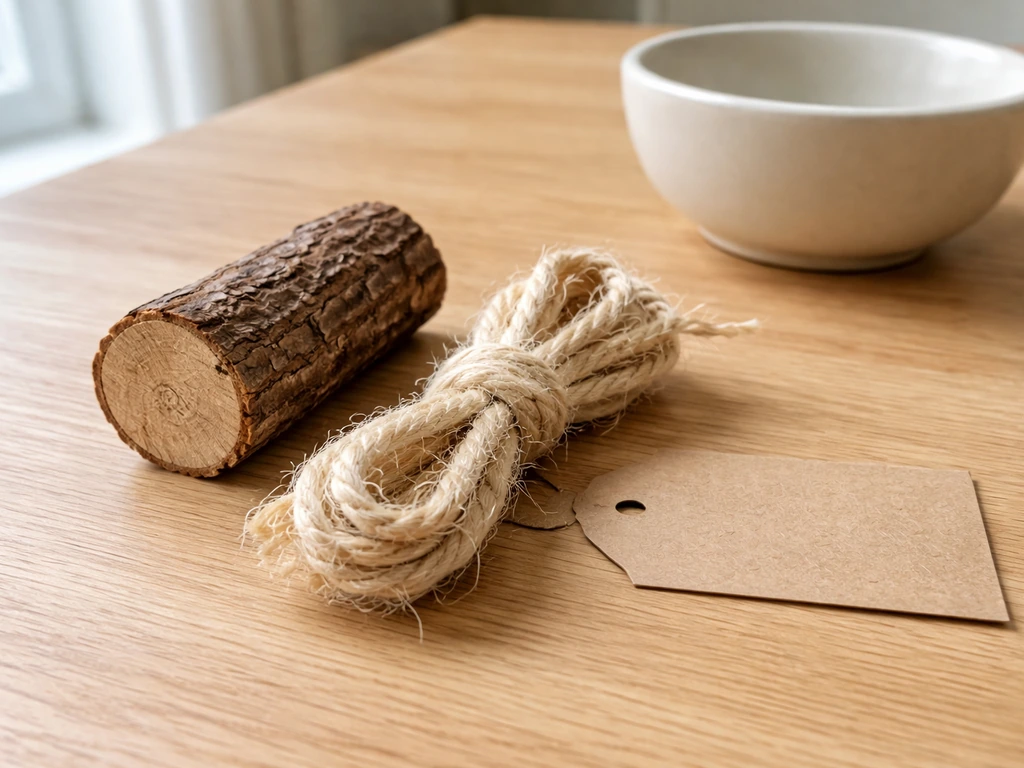
Material is the single most important factor, and it is also where the most dangerous shortcuts happen. blank" rel="noopener noreferrer">Lead and zinc are the two toxins that show up most often in cheap bird toys, usually hidden in metal hardware, galvanized chains, or flaking paint. Both are genuinely life-threatening if your bird chews on a coated surface and ingests chips. Avoid galvanized metal anywhere on a toy, including the hanging clip and chain links. The only metal hardware worth trusting is stainless steel, and specifically quick links rather than standard rings or chains with small gaps.
For the toy body itself, look for natural hardwood, food-grade acrylic, or vegetable-tanned leather. Lightweight plastics are a red flag because they fracture more easily than durable materials, and sharp broken plastic edges create injury risk on top of ingestion risk. If a toy feels flimsy in your hand, it will not survive a medium or large parrot's beak for more than a few days, and the broken pieces become the hazard.
Size matching is non-negotiable. A toy built for a budgie or parrotlet is not structurally designed to handle a cockatiel's or conure's beak pressure, and it will break into small swallowable bits fast. The rule of thumb from most avian safety sources is that no part of the toy should be small enough to swallow or break into a sharp fragment. Match the toy's durability rating to your bird's species and beak strength, not just their physical size.
- Hardware: stainless steel quick links only — no galvanized metal, no zinc-plated rings, no jingle bells with slits
- Body material: natural hardwood, food-grade acrylic, or vegetable-tanned leather
- No lightweight or brittle plastic that fractures under beak pressure
- No lead paint or non-robust coatings that can chip off
- Parts must be too large to swallow and must not break into sharp bits
- Toy size and durability matched to your bird's species and beak strength
Toy types that work well for birds, and what to avoid in a cat household
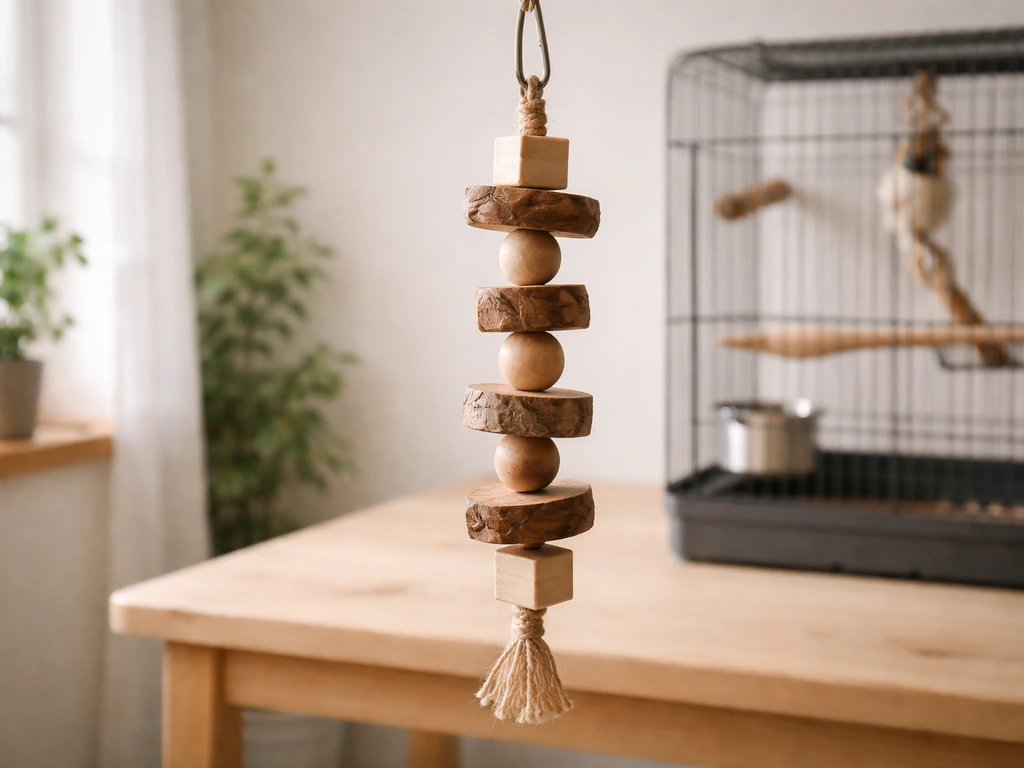
The toy types that consistently score well for bird safety are also, conveniently, the lowest-risk options in a home with a cat. Shredding toys made from palm fronds, paper, or soft untreated wood give birds the destructive chewing outlet they need without creating dangerous debris. Foraging toys that hide food inside hard acrylic or wooden chambers are excellent because the bird works for the reward and the toy itself has no loose strands or small parts. Foot toys, small smooth wooden blocks or shapes the bird holds and mouths, are great for enrichment and pose minimal cat hazard since they are solid and durable.
What you want to avoid, and this is important, is anything with rope, string, or long hanging fibers. I know rope perches and rope toys are everywhere in pet stores and they photograph beautifully, but the hazard profile is serious for birds: frayed fibers can cause crop and digestive tract obstructions if swallowed, and loose loops can entangle toes, legs, or even a neck. In a house with a cat, the problem compounds because a cat will absolutely chew on a rope toy hanging from or near a cage, accelerating the fraying and leaving loose strands on the floor.
Jingle bells are another one to skip entirely. The slit openings on standard jingle bells can trap a bird's beak or toe, and cats are drawn to the noise and will bat at them aggressively. If your bird's toy has a bell at all, it should be a solid-cast bell with no slit opening.
| Toy Type | Bird Enrichment Value | Risk in Cat Household | Recommendation |
|---|---|---|---|
| Natural hardwood shredding toy | High — satisfies chewing instinct | Low — solid parts, no strings | Best choice |
| Foraging toy (acrylic or hardwood) | High — mental stimulation | Low — enclosed design, no loose parts | Best choice |
| Solid foot toys (wooden blocks) | High — tactile enrichment | Low — durable, no fragments | Great choice |
| Rope or cotton fiber toys | Moderate | High — fraying, entanglement, ingestion risk for both animals | Avoid |
| Jingle bell toys (slit-style bells) | Low-moderate | High — slit traps beak/toe; cat attraction increases wear | Avoid |
| Lightweight plastic toys | Moderate | High — fractures into sharp/swallowable pieces | Avoid |
| Metal chain toys (small gaps) | Low | High — toe/beak entrapment, zinc risk | Avoid |
How to introduce toys safely when cats are in the home
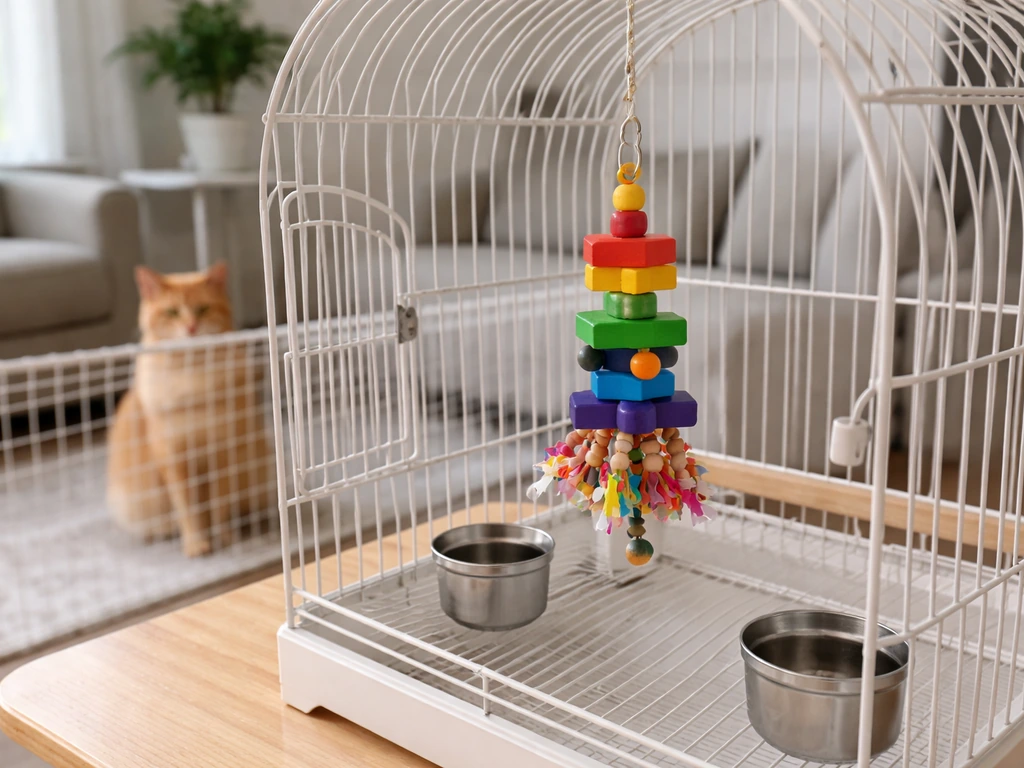
Never just hang a new toy in the cage and walk away. Supervise your bird with any new toy for at least the first several days. You are watching for two things: whether your bird is chewing and spitting (normal), or actually ingesting pieces (a problem). Birds that swallow toy fragments can develop serious crop or intestinal blockages, and catching it early is the only way to intervene effectively.
Placement matters more than most people realize. Keep the cage positioned so a cat cannot reach through the bars to bat at hanging toys or pull rope ends through. Most standard wire cages have bar spacing that a determined cat paw can navigate, especially at corners. Position toys in the center of the cage or toward the top rather than hanging them near the sides where a cat could grab them. If your cat regularly approaches the cage, consider a secondary barrier like a playpen or room divider during unsupervised hours.
Shared toys between cats and birds are not a good idea, full stop. Cat toys frequently contain feathers, strings, elastic bands, and small plastic pieces that are hazardous for birds. Bird toys are often made with materials, certain woods, dyes, and shapes, that are not tested for cat ingestion safety. Keep the toy inventories completely separate and do not allow either animal to access the other's toys.
If your bird has out-of-cage time, the cat needs to be in a separate, closed room for the entire session. If you are considering bird videos for your cat, keep any viewing supervised and limit it to short sessions so you can watch for overstimulation or attention-grabbing behavior how long should i let my cat watch bird videos. This is not about temperament, even the calmest cat has prey instincts that can activate instantly around a fluttering bird. A bird toy left on the floor or a playstand becomes a cat toy the moment your bird steps away from it, and a cat chewing on a damaged toy can accelerate wear into dangerous territory fast.
Common beginner mistakes when mixing cats and birds
The biggest mistake I see from new bird owners is assuming a toy is safe because it came from a pet store bird section. Pet store bird toys vary wildly in quality, and plenty of them include jingle bells with slits, lightweight plastic parts, galvanized hardware, and long rope tails that are all documented hazards. The source of the toy does not equal a safety certification. You still need to inspect every toy before it goes in the cage.
- Buying rope or fiber toys thinking they are 'natural' and therefore safe — fraying rope is one of the top hazard categories for birds
- Leaving the bird unsupervised with a brand-new toy before confirming they are chewing and not swallowing
- Letting the cat and bird share out-of-cage space, even briefly and even with 'supervision'
- Ignoring worn or damaged toys because 'the bird still likes it' — wear is when hazards actually appear
- Using toys sized for a smaller bird species when you have a larger, stronger-beaked bird
- Not checking metal hardware for zinc plating or galvanization before purchase
- Overcrowding the cage with toys, which increases entanglement risk and can cause stress
Another common one: assuming that because the cat ignores the cage most of the time, proximity is fine. Cats are opportunistic. A bird toy hanging near the cage bars can be batted at during the night when no one is watching, fraying rope in the process. You will not see it happen, but you will see the damage in the morning. Build your setup assuming the cat will interact with the cage exterior, because eventually they will.
How to inspect, rotate, and replace toys
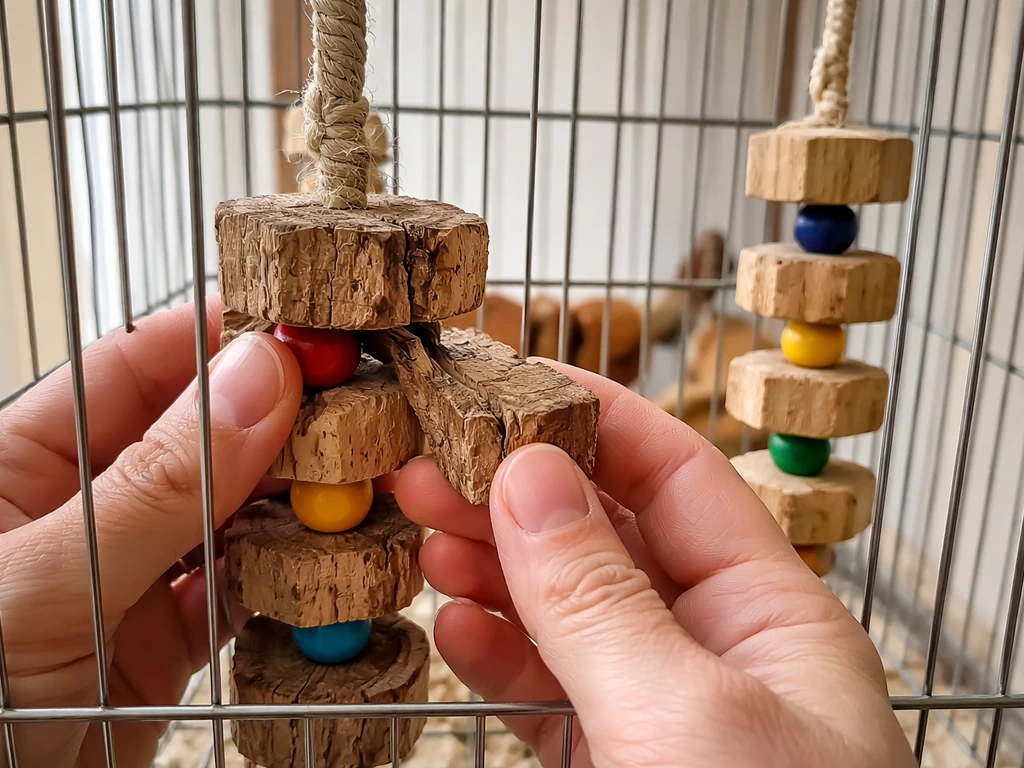
Toy maintenance is not optional and it is not a once-a-month job. Inspect every toy in your bird's cage at least twice a week. What you are looking for: cracked or splintered wood, fraying on any rope or fiber component, hardware that has shifted or shows chipping coating, and any part that has become small enough to swallow through normal wear. If you see fraying starting on a rope element, clip it back immediately with scissors. If the fraying is significant enough that clipping it back would change the toy's structural integrity, remove and replace the toy.
Rotation serves two purposes. It prevents boredom (birds are intelligent and lose interest in the same toy within a few weeks), and it extends the lifespan of individual toys by reducing constant wear. A simple rotation schedule is to swap one toy per week, cycling through four to six toys total. When a toy comes out of rotation, use that opportunity to do a thorough inspection before storing it for reuse.
Replace without hesitation when you see: cracked wood with sharp edges, rope fraying that cannot be safely trimmed back, chipped paint or coating on any surface, hardware that has bent or shows exposed base metal, or any part that has broken into a piece small enough to cause a choking risk. In a house with a cat, apply the same rule to any toy piece that has fallen to the cage floor, a cat may have already chewed on it outside the cage without your knowledge, and a pre-chewed toy accelerates into the hazard zone faster than an untouched one.
If you are ever unsure whether a toy is still safe, ask your avian vet. This is genuinely one of the situations where a quick question at a checkup, or even a phone call to the clinic, can save you a lot of anxiety and potentially save your bird from a serious injury.
Your next steps today
Here is what to actually do with all of this. First, pull out every toy currently in your bird's cage and check the hardware. Any galvanized metal or slit-style bells come out today. Second, assess any rope or fiber toys: if there is visible fraying, trim it back or remove the toy. Third, measure your remaining toys against your bird's species and beak strength, if anything is labeled for a smaller bird, retire it. Fourth, buy replacements in natural hardwood or food-grade acrylic with stainless steel hardware, sized for your bird. Fifth, set a twice-weekly inspection habit and a monthly rotation schedule. And finally, if your cat has regular access to the area around the cage, rethink the layout so toys hang toward the cage center rather than near the bars.
Getting this right is genuinely not complicated once you know what the hazards actually are. A hardwood shredder, a foraging box, and a couple of solid foot toys cover most birds' enrichment needs, cost very little, and create almost no risk in a multi-pet home. A top bright magnetic bird toy can be a fun addition, but make sure it is safe for your bird's beak and cannot shed or expose small parts a couple of solid foot toys. For indoor birds, choosing the best indoor bird toys starts with safe materials, correct sizing, and no risky extras like rope or slits hardwood shredder, a foraging box, and a couple of solid foot toys. Start there, watch your bird with each new toy before leaving them alone with it, and build from a baseline you actually trust.
FAQ
Can I use a cat toy that seems sturdy as the best bird toy for cats at the same time?
No. Cat-safe “chew toys” and bird-safe “chew toys” are built for different mouth mechanics and failure patterns. Even if the outside looks solid, cat toys are more likely to contain elastic, feathers, or small plastic parts that become swallowable for birds, and bird toys may include beak-damaging rope or hardware that a cat can chew through.
What if a bird toy falls to the floor when the cat is around?
If your cat can reach any area where a bird toy can fall, assume it can become hazardous. Put bird toys only inside the cage or in a bird-only play area that the cat cannot access, and treat toys that land on the floor as “potentially pre-chewed,” even if you did not see the cat interact with it.
What kind of metal hardware should I look for when choosing the best bird toy for cats?
For most households, stainless quick links are the safer choice. Avoid galvanized or other coated metals, and also avoid rings or chain styles that can create pinch points or allow the toy’s parts to separate into small pieces.
Are foraging toys safe if my cat might bat at the cage toys?
Yes, but only if it is built for birds and you remove any hazardous bits. For a foraging toy, confirm it is food-grade acrylic or untreated hardwood, that there are no removable small inserts, and that any moving sections cannot trap a beak or foot.
Is a bell toy ever okay if I’m trying to find the best bird toy for cats?
Jingle bells with slit openings should be removed. If you want a sound toy, choose a solid-cast bell without a slit, and keep the toy positioned so a cat cannot get leverage on it through the bars.
My bird’s toy has a tiny bit of fraying, can I just clip it and keep using it?
Treat any rope, string, or long fiber as a no. If you see fraying, you can only trim it if the toy remains structurally sound afterward. If you cannot trim safely without compromising strength, replace immediately.
How can I tell if a hardwood toy is truly safe and not coated or brittle?
Not all “hardwood” is equal. Check that the wood is untreated, unpainted, and not made from soft or splinter-prone species, because cracked edges can create sharp fragments. If the toy already has a coating that can chip, retire it when chips appear.
Is it safe if my cat ignores the bird cage most of the day?
No. Even if your cat never directly chews the cage toys, night-time attention can still cause damage that you only notice in the morning. Position toys away from bar sides, and assume the cat will eventually test gaps or corners.
How long should I supervise a new toy before I leave it in the cage?
Use a supervised “trial” every time. Watch your bird for chewing behavior for the first several days, and stop the trial immediately if you see any signs of swallowing fragments. After that, keep the twice-weekly inspection because new damage can appear between checks.
Do I need to separate toy storage too, or is cage separation enough?
Separate the toy inventories completely, but also separate storage. A cat can chew on bird toys outside the cage, and a bird can later find a pre-chewed piece. Store bird toys in a way the cat cannot access, and never let either animal borrow from the other’s bin.
Are magnetic bird toys safe in a multi-pet home with a cat?
If you plan to add a magnetic-style bird toy, it must be designed so your bird cannot access shed magnets or tiny components, and it must be sized so strong beaks do not break the frame. Inspect the toy frequently because magnet housings can crack or loosen over time.
How do I choose the right size and durability for the best bird toy for cats if I’m unsure about beak strength?
For one bird toy, the best indicator is durability under that bird’s beak strength, not just similar size. If a toy is labeled for smaller birds or looks light in your hand, it is more likely to break into swallowable pieces under a stronger beak.