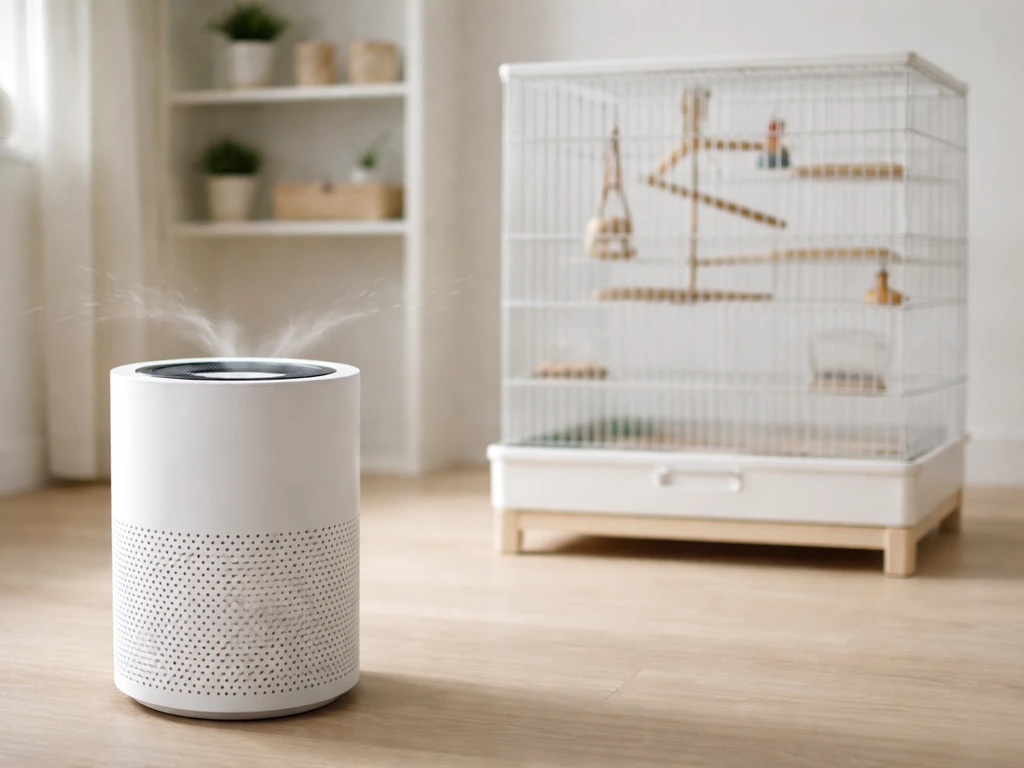
The best vacuum for bird owners is a fully sealed HEPA vacuum with strong suction, a crevice tool, and an upholstery attachment. Canister models tend to be the gold standard for bird households because they're quieter, maneuverable around cages, and easier to attach the right tool for the job. If you want one type to start with, go canister with a sealed HEPA filtration path. Cordless stick vacuums are useful as a quick daily grab, but they shouldn't be your only machine if you have a larger parrot or multiple birds.
Best Vacuum for Bird Owners: How to Choose Safely

Marcus Chen
3 May 2026
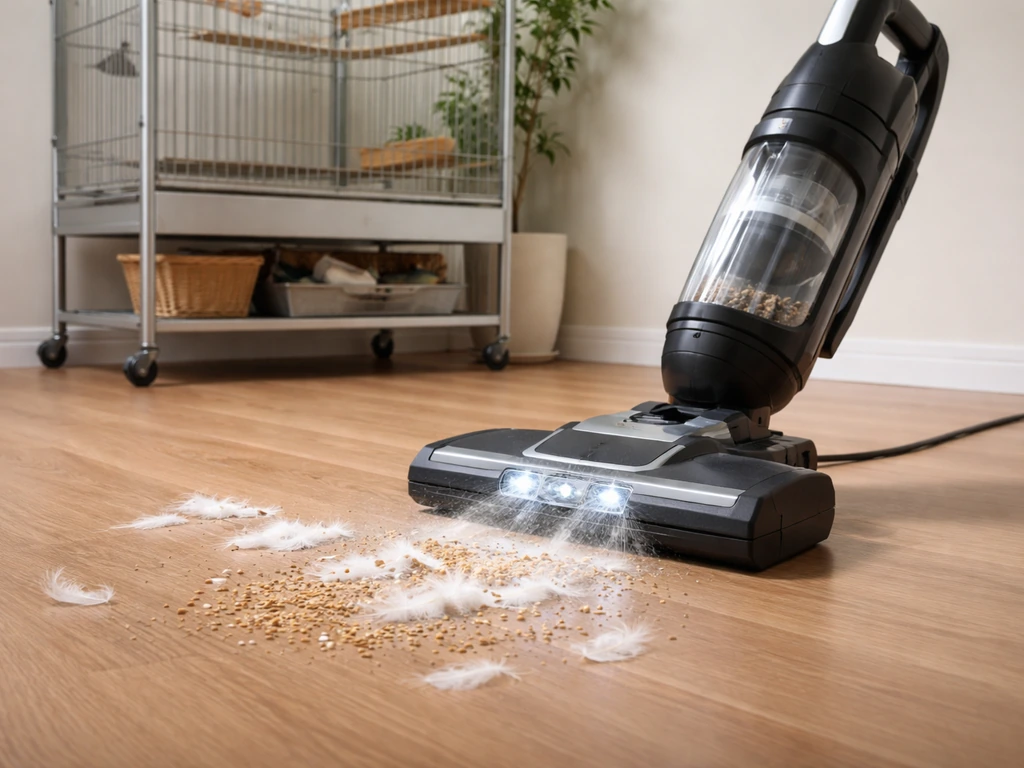
Why bird owners actually need a different kind of vacuum
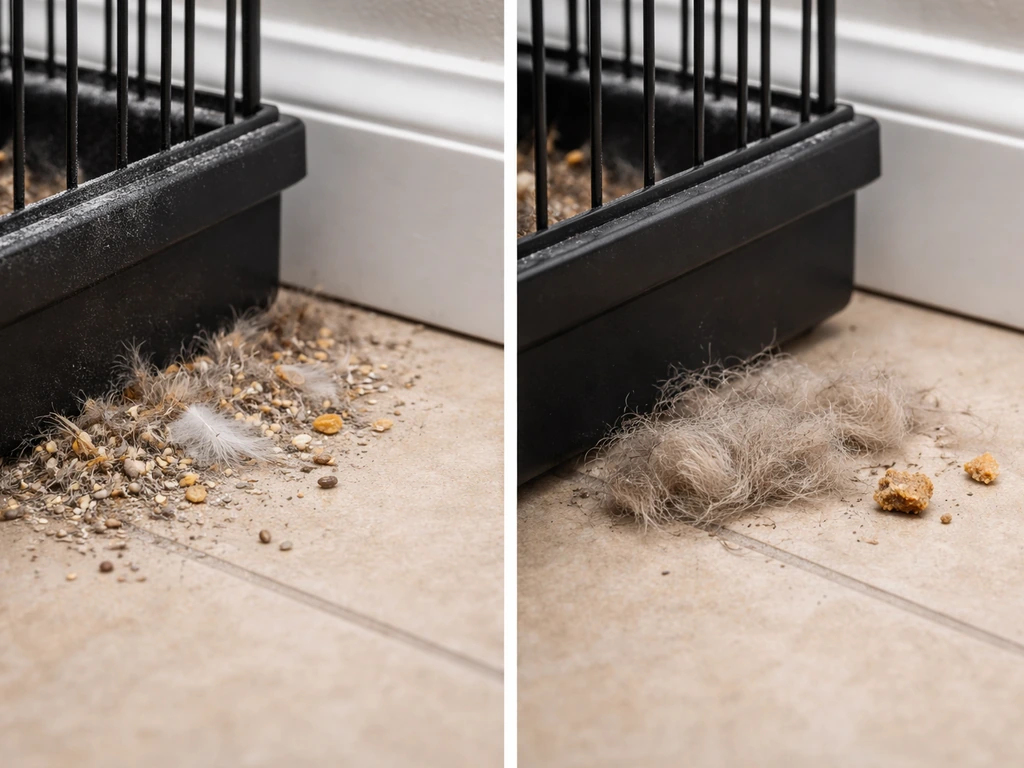
Bird mess is nothing like dog or cat mess, and that's the part most first-time bird owners don't realize until they've already made a few bad purchasing decisions. There are four main categories of debris you're dealing with: feather dust (the ultra-fine powder released when birds preen, especially from powder-down species like cockatiels, cockatoos, and African greys), seed hulls and husk fragments, droppings residue that tracks off cage bars or cage-bottom trays, and dander. Feather dust in particular is extremely fine, well below 10 microns in many cases, which means a cheap or unsealed vacuum can literally suck it in one side and blow it right back into the room air.
Standard vacuums are often designed around a basic filter that stops visible debris but lets fine particles pass through the exhaust. For a bird household, that's a real problem. You clean the floor, but now the air in the room is worse than before you started. If your bird is still in the room during that process, you're exposing them to re-aerosolized dander and dust, which can cause respiratory stress. Birds have extremely efficient respiratory systems, which also makes them uniquely sensitive to airborne particles. This is why choosing the right vacuum isn't just a comfort issue; it's genuinely a health issue for your bird.
The features that actually matter for a bird household
Sealed HEPA filtration (this is the big one)
blank" rel="noopener noreferrer">HEPA filter media captures 99. 97% of particles at 0. 3 microns, which is the most penetrating particle size. But here's the thing most vacuum marketing glosses over: just having a HEPA filter in the machine is not enough.
The entire system needs to be sealed so that all air drawn into the vacuum is forced through the filtration path before it exits. If there are gaps in the housing, leaky dustbin interfaces, or poorly fitted filter seals, fine particles escape right around the filter. The blank" rel="noopener noreferrer">US EPA's own guidance on HEPA vacuums specifically notes that retrofitting a HEPA filter into a machine doesn't guarantee proper sealing.
Allergy certification programs like Asthma and Allergy Friendly and ECARF both test for particle emissions from the whole machine, not just from the filter media in isolation, precisely because seal integrity is where most machines fail in real-world use.
When you're shopping, look for language like "fully sealed system" or "sealed filtration path," and check whether the brand has third-party allergy or HEPA certification. A certified sealed system is a meaningfully different product from a vacuum that just drops a HEPA-labeled filter into an otherwise unsealed housing.
Suction power and airflow
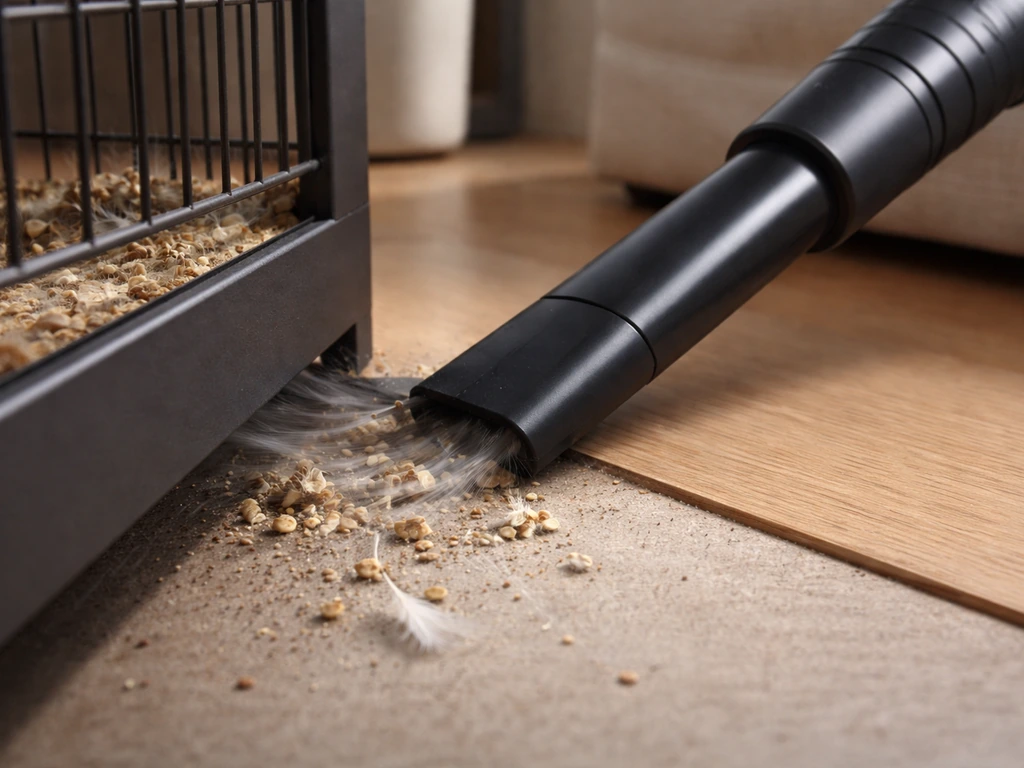
Bird messes are light but can get into tight spaces. Seed hulls pile up in cage-tray corners, feathers drift under furniture, and fine dust settles on cage bars and shelving. You need consistent, strong suction that doesn't fall off when filters load up. Bagged vacuums tend to maintain suction more consistently than bagless models as debris accumulates, which is a meaningful advantage for heavy daily bird-room cleaning. Bagless is more convenient for quick emptying, but the act of emptying a bagless dustbin can release a puff of fine particles right in your face and into the air. If you go bagless, empty it outdoors or into a bag you can seal immediately.
Attachments you'll actually use
A crevice tool is non-negotiable. Cage trays, cage bar gaps, baseboards, and corners behind cage stands all need a narrow nozzle. An upholstery or small brush attachment handles perch covers, play stands, and cage-adjacent furniture. A soft dusting brush is useful for cage bars if you're running the vacuum along them to remove loose debris before a wipe-down. Most vacuums come with these basics; the quality of the attachment seal to the hose is what varies. Cheap attachments that don't seat tightly let air bypass the filtration path.
Brush roll considerations
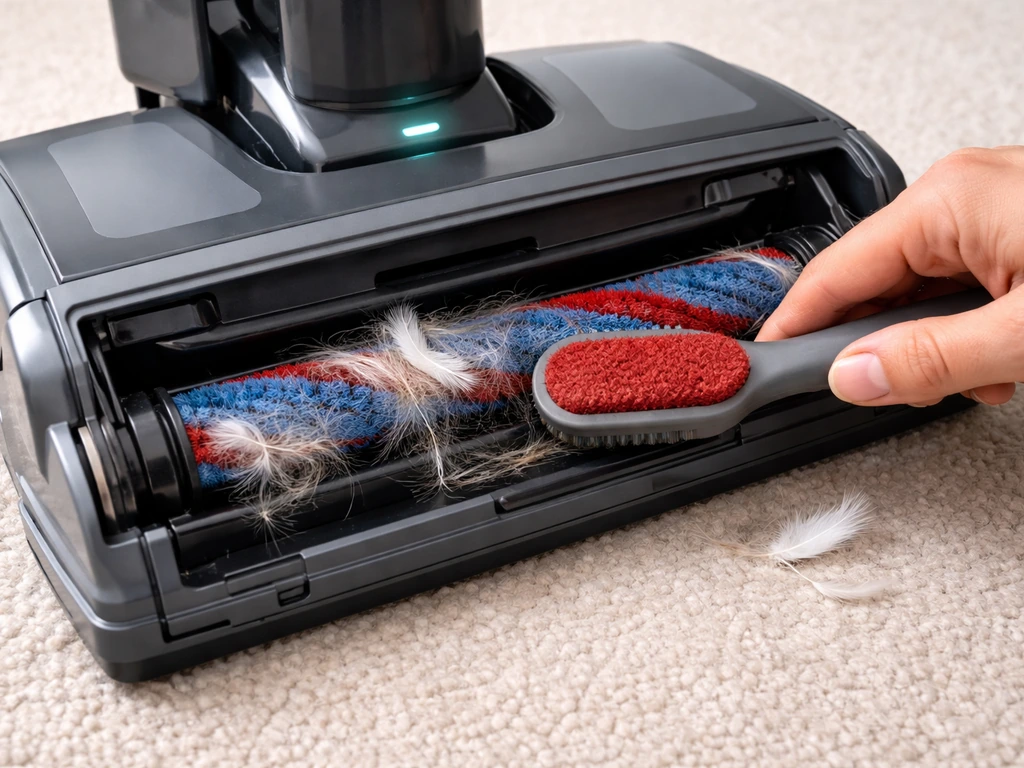
A motorized brush roll is great for carpet and deep-pile rugs, but feathers and long debris wrap around brush rolls quickly. Look for a model with an easy-access brush roll that you can clean without tools, or a tangle-free design. Some bird owners prefer to switch the brush roll off entirely when vacuuming hard floors in the bird room to avoid flinging feathers around. Canister vacuums with a bare-floor nozzle give you this flexibility naturally.
Noise level
Birds stress out at sudden loud noises. A vacuum running at 80+ dB right next to a cage is not a good situation. Canister vacuums tend to run quieter than uprights at similar power levels, and some models are specifically rated for lower decibels. Robot vacuums run very quietly, which is a genuine advantage. Whatever you choose, vacuum at a distance from your bird's space or remove the bird from the room first.
Which vacuum type works best for bird messes
| Vacuum Type | Best For | Limitations | Bird Household Rating |
|---|---|---|---|
| Canister (corded) | Whole-room cleaning, cage areas, varied attachments, quiet operation | Less convenient to pull out daily; cord management | Best overall |
| Upright (corded) | Large carpeted rooms, deep cleaning | Noisier, bulkier near cages, brush roll tangles feathers | Good supplemental, not ideal primary |
| Cordless stick | Quick daily pickups, small rooms, hard floors | Lower suction and filtration quality in most models; battery limits | Great secondary tool |
| Cordless handheld | Spot cleaning cage trays, perch areas, play stands | Not practical for room-level cleaning | Excellent for targeted spots |
| Robot vacuum | Daily maintenance to prevent buildup on hard floors | Struggles with seed hulls, can scatter feathers, no cage-area reach | Useful supplement, not primary |
The honest answer is that most bird owners end up with two tools: a sealed HEPA canister or upright for full cleaning sessions, and a cordless handheld or stick for daily quick passes. That combination covers most real-world situations without requiring you to drag out the big machine every single day. For the same reason you choose the best vacuum for sensitive lungs, it's also worth picking the best bird heater that keeps the room comfortably warm without creating extra airborne irritants.
A note on robot vacuums
Robot vacuums are tempting because bird rooms generate mess constantly, and daily floor cleaning would genuinely help. The problem is that most robot vacuums aren't sealed HEPA systems, they can scatter light debris like feather hulls and feathers instead of capturing them cleanly, and they can't reach cage trays or perch areas. They're useful for maintaining bare floors between deeper cleaning sessions but shouldn't be your primary or only tool.
Best picks by bird setup and room size
Small birds: budgies, parakeets, and finches
Budgies and finches produce a lot of seed hull debris and some feather dust, but significantly less powder-down dander than larger parrots. For a single small cage in a studio or bedroom, a quality cordless stick vacuum with a HEPA filter (not just a HEPA-labeled filter, but a reasonably sealed one) combined with a handheld for cage spot cleaning is often enough. The Dyson V15 Detect and the Shark Stratos cordless line both have better-than-average sealed filtration for cordless tools, though neither is as airtight as a proper canister system. For finch setups specifically, the crevice tool gets heavy use because those tiny seed hulls get everywhere.
Medium birds: cockatiels, conures, and lovebirds
Cockatiels are powder-down birds, which puts them in a different category from budgies even though they're similar in physical size. If you have a cockatiel or multiple conures, you really need a sealed HEPA canister or upright for your primary machine. Miele's C3 series with their AirClean filtration system is frequently recommended by allergy households and has a genuinely sealed system. SEBO canister models are another strong option with excellent build quality and HEPA sealing. For a single cockatiel in one room, a Miele C2 or C3 with a HEPA filter bag and the appropriate floor tool covers most needs well.
Large parrots: African greys, cockatoos, Amazons, and macaws
Large parrots, especially African greys and cockatoos, produce extraordinary amounts of feather dust and dander. Daily vacuuming is not overkill; it's genuinely necessary maintenance. For these setups, a premium sealed HEPA canister with a high-capacity bag is the right call. Miele C3 Complete with HEPA AirClean filtration is a common recommendation. Pair it with a dedicated cordless handheld (the Dyson V8 Animal or similar) for daily spot cleaning of perch areas and cage bars. You should also be thinking about air purification alongside vacuuming, because vacuuming alone won't address the constant particle load in the air between cleaning sessions.
Multi-bird households or dedicated bird rooms
If you have multiple birds or a dedicated bird room, treat it like a high-traffic allergen zone. A full-size canister with a large filter bag, daily cordless passes, and ideally a robot vacuum running on a schedule for floor maintenance gives you layered coverage. In this scenario, the robot vacuum earns its keep because you need something running every day, and the sealed HEPA canister handles the deep cleaning a few times a week.
How to vacuum safely around your birds
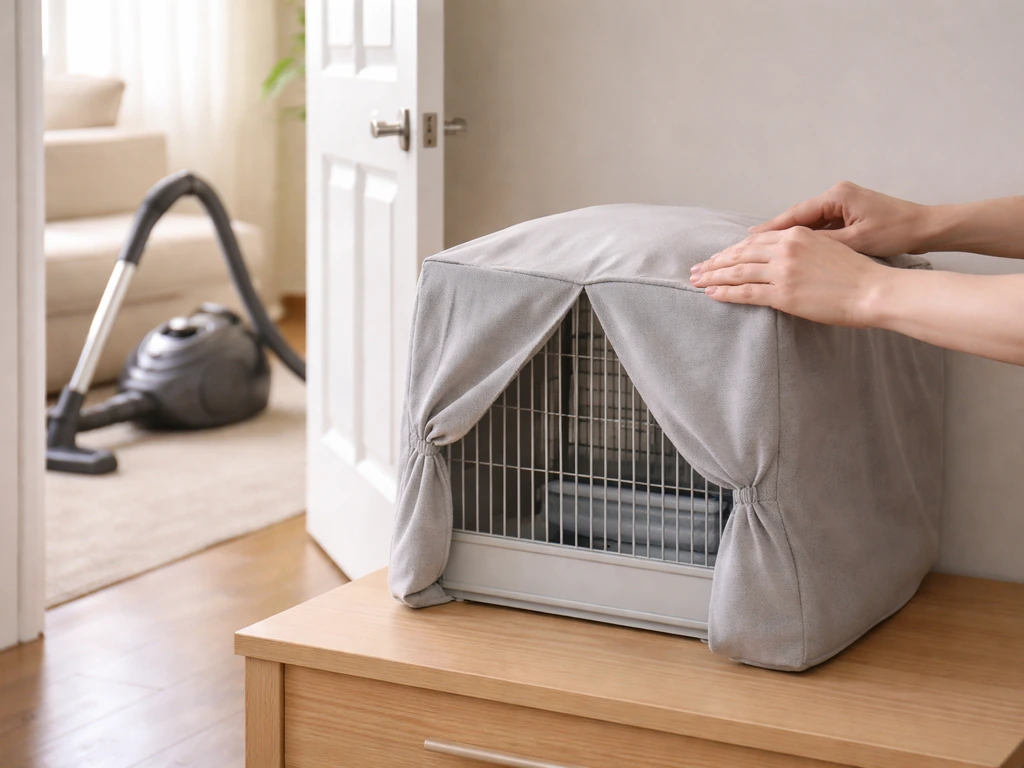
The safest approach is simple: move your bird out of the room before you vacuum, and don't bring them back in until the air has settled, ideally 15 to 30 minutes after you finish. Even a sealed HEPA vacuum stirs up some surface debris when it moves around, and air disturbance alone can briefly raise particle counts in the room before the particles settle or get captured. This is especially important if you have a powder-down species.
- Move birds to a different room or covered cage area away from where you're vacuuming before you start.
- Vacuum in the morning or early afternoon so there's maximum time for air to clear before your bird's active evening hours.
- Use your sealed HEPA vacuum rather than the cordless stick when doing a full bird-room clean, because filtration quality matters more when particle loads are high.
- Start vacuuming from the area farthest from the bird and work toward the door, so you're not walking stirred-up debris past your bird's space.
- Empty bagless dustbins outside or into a sealed bag, not in the bird room.
- Run an air purifier in the bird room during and after vacuuming to capture any particles disturbed by the cleaning process.
On the topic of air quality: vacuuming and air purification work as a team, not as substitutes for each other. For bird dander specifically, the best air purifiers are those that can capture fine particles consistently and are sized appropriately for your room best air purifiers for bird dander. Vacuuming removes what's already settled on surfaces. <a data-article-id="12DA2C8B-D453-4CFB-B012-E0A1B8A93B9F">An air purifier handles what's suspended in the air.
</a> For many bird owners, choosing the best <a data-article-id="79433F72-3C33-4645-94F6-731FBA923AEB">air purifier for bird owners can be just as important as picking the right vacuum. If you're dealing with a powder-down bird or a multi-bird household, running both is the baseline, not the premium option. The air purifier topics covered elsewhere on this site go deeper into which purifier types work best for feather dust and dander specifically, and they're worth reading alongside this guide.
If you want the same kind of air-quality focus for moisture and comfort, consider the best humidifier for your bird room best humidifier for bird room.
Keeping your vacuum working: maintenance and replacement schedule
A vacuum that isn't maintained degrades fast in a bird household. Filters load up faster than in a standard home, brush rolls tangle with feathers, and seals that aren't checked can develop gaps that undermine the whole point of buying a sealed HEPA machine in the first place.
| Component | Check/Clean Frequency | Replace Frequency |
|---|---|---|
| HEPA filter (bagged vacuum) | Check monthly, tap clean if washable type | Every 6–12 months depending on bird species and usage |
| HEPA filter (bagless vacuum) | Rinse or tap clean every 2–4 weeks | Every 6 months or when suction drops noticeably |
| Vacuum bag (bagged model) | Replace when 2/3 full | As needed; don't overfill or you lose suction and risk seal stress |
| Brush roll | Check for feather/debris wrapping after every use | Replace when bristles wear flat or bearings feel rough |
| Crevice and attachment tools | Rinse or wipe clean weekly | Replace if cracked or fitting loosely (affects seal) |
| Filter gaskets and seals | Inspect monthly for cracks or deformation | Replace immediately if damaged; do not continue using with a broken seal |
| Dustbin (bagless) O-rings | Clean at each emptying | Replace if visibly cracked or compressed permanently |
One thing that catches a lot of people off guard: with bagged vacuums, changing the bag before it's completely full is actually important for maintaining suction and protecting the motor filter. In a bird household where bags fill faster, this means buying extra bags in bulk makes both practical and financial sense. Running a bag past 80% full drops airflow, which drops filtration efficiency.
Budget vs premium: what you actually get for the money
You don't need to spend $800 on a vacuum to do a good job in a budgie owner's apartment. But if you have an African grey or a cockatoo, trying to get away with a $150 bagless upright is going to cost you in air quality and ultimately in vet bills. Here's an honest breakdown:
| Budget Range | What You Get | Best For | Trade-offs |
|---|---|---|---|
| Under $150 | Basic HEPA filter (often not fully sealed), adequate suction for light messes, limited attachments | Single small bird, minimal carpet, quick supplemental cleaning | Poor seal integrity likely, higher particle re-emission, shorter lifespan under heavy use |
| $150–$350 | Better sealed systems, quality HEPA bags or filters, more attachment options, some certified models | Small to medium birds, one or two cage setups, mixed floor types | May require closer inspection of sealing claims; brand matters a lot in this range |
| $350–$600 | Genuinely sealed HEPA systems (Miele C2/C3, SEBO), excellent build quality, large bag capacity, quiet motors | Medium to large parrots, dedicated bird rooms, allergy-sensitive households | Higher upfront cost; ongoing filter bag cost for bagged models |
| $600+ | Top-tier sealed HEPA canisters, premium cordless sticks with strong filtration, smart robot vacuums with HEPA | Multi-bird households, heavy daily use, maximum air quality control | Diminishing returns beyond $600 for most setups; spend the difference on an air purifier |
Your buying checklist before you order
- Confirmed sealed HEPA filtration path, not just a HEPA filter dropped into the machine
- Third-party allergy or HEPA certification (Asthma and Allergy Friendly, ECARF, or equivalent)
- Crevice tool and upholstery/brush attachment included
- Brush roll that is easy to clean or has a tangle-free design
- Noise level you can live with (look for under 70 dB for near-bird use; plan to remove bird regardless)
- Bag vs bagless decision made based on your willingness to handle dustbin emptying carefully
- Replacement filters and bags readily available and reasonably priced for that model
- Corded canister or upright as your primary machine, cordless as your daily spot tool
- Budget includes ongoing filter and bag costs, not just the upfront vacuum price
The most common mistake I see is bird owners buying a popular general-use vacuum that happens to mention HEPA on the box, then wondering why their bird room still smells dusty and their bird seems to be sneezing more. The filter label is not the same as a sealed system. American Lung Association states that air cleaners with [HEPA-rated filters are the most effective types of air cleaners](https://www. lung.
org/clean-air/indoor-air/protecting-from-air-pollution/air-cleaning? form=FUNRHPCFVTN) for particle removal. Buy the boring, well-reviewed canister from a brand with a reputation in allergy households, get the right attachments, vacuum with your bird out of the room, and run an air purifier the rest of the time. That combination does more for your bird's air quality than any single high-end gadget purchased in isolation.
FAQ
Is a vacuum with a “HEPA” label enough, or do I specifically need a “sealed HEPA system”?
Look for a sealed filtration path, not just HEPA media. If the housing, dustbin or bag compartment leaks, fine feather dust and dander can bypass filtration through gaps around the filter or interfaces even while the HEPA media is working correctly.
How long should I wait to let my bird back into the room after vacuuming, even with a sealed HEPA vacuum?
Aim for 15 to 30 minutes after you finish. Movement can stir up surface debris, and even a sealed unit can’t instantly eliminate particles already disturbed on floors, cage stands, and shelving.
Should I vacuum while my bird is in the room if I’m using a quiet canister?
It’s safer not to. Birds have very efficient respiratory systems and are sensitive to re-aerosolized fine dust. If you must be nearby, keep the vacuum far from the bird’s immediate space and avoid vacuuming directly around the cage tray.
Bagged or bagless, which is better for bird dust and odor control?
Bagged models usually hold up better for airflow and consistency because suction often stays stronger as the bag fills. For bagless vacuums, empty outdoors or into a sealable bag immediately, since bin emptying can release a visible and invisible dust puff.
How full should I let a bag get before changing it on a bird-room vacuum?
Don’t push it past about 80% full. In bird-heavy environments, a near-full bag can noticeably reduce airflow, which also reduces capture efficiency of fine particles that matter most for respiratory health.
What’s the biggest sign my vacuum is no longer “sealed properly” for bird use?
You notice more dust smell or visible fine dust puffing when you clean, or you see debris escaping from the exhaust area during operation. Also, if attachments don’t lock tightly to the hose, air can bypass the filtration path and defeat the HEPA advantage.
Do I need a crevice tool even if my bird cage is on a closed stand with a tray?
Yes. Seed hulls and feather dust collect in tray corners, behind stands, and in the small gaps around cage bars and baseboards. A narrow nozzle is usually the only way to pull material out without just pushing it deeper.
Is a motorized brush roll required for bird rooms?
Not necessarily. For hard floors and perch-adjacent areas, many bird owners prefer switching the brush roll off to avoid feather wrap and debris redistribution. Use motorized brushes only where you truly need deep carpet agitation, and clean the roller quickly to prevent tangle buildup.
How often should I clean or replace vacuum filters in a bird household?
Bird rooms usually load filters faster, so follow the manufacturer’s schedule but check more frequently than you would for a typical home. If suction drops noticeably or you see more fine dust escaping, replace filters or inspect seals sooner rather than waiting for the next “normal” interval.
Can a robot vacuum replace my main vacuum for bird mess?
Usually no as a primary tool. Many robots are not sealed HEPA systems and may scatter lightweight debris like feather fragments instead of trapping them. Use them only as supplemental bare-floor maintenance between deeper cleanings, and keep them away from cages and perch areas.
Which vacuum approach is most appropriate for finches and budgies versus African greys and cockatoos?
Smaller birds often do well with a quality, reasonably sealed HEPA cordless plus a handheld for cage spot cleaning. For African greys, cockatoos, and other powder-down birds, plan on a sealed HEPA canister as your main vacuum, because feather dust volume and fine powder load are much higher.
Next Article
Best Air Purifier for Bird Owners: Top Picks and Setup
Choose the best air purifier for bird owners with HEPA, carbon, sizing tips, safe placement, and low-noise setup.