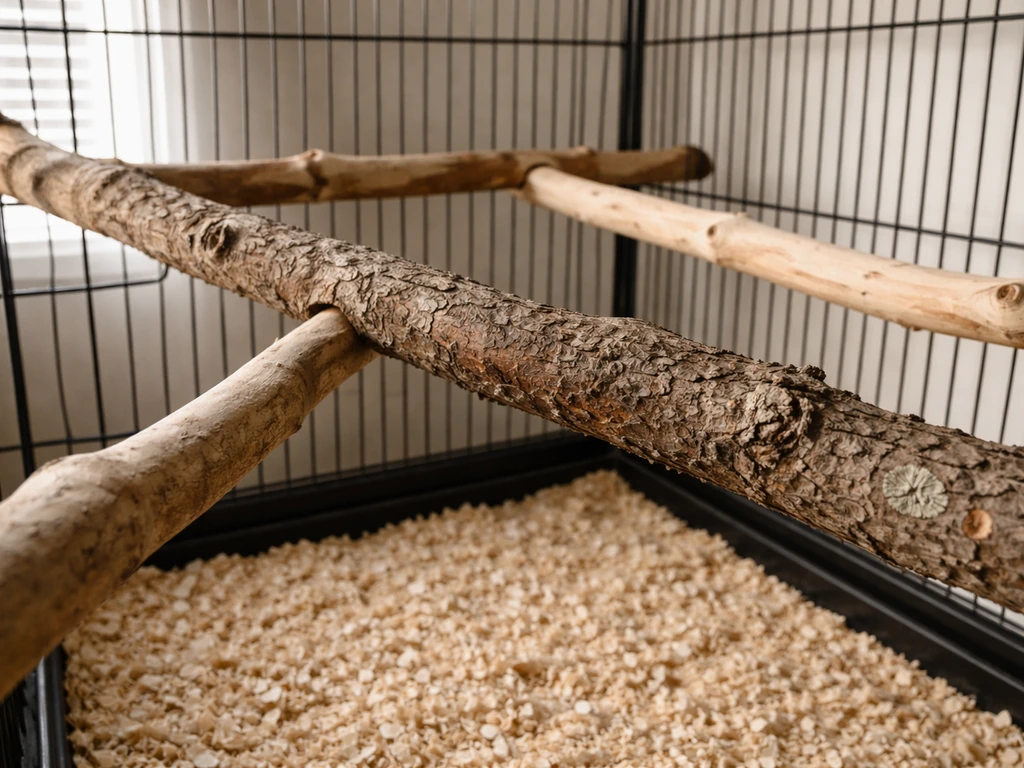
The best bird playground is the one your specific bird will actually use, in a space you can realistically supervise, built from materials that won't poison them. For most small birds like budgies and cockatiels, a cage-top play gym with 2-3 perch diameters, a swing, a few chew toys, and a foraging spot is everything they need. For medium to large parrots, you want a freestanding stand or tabletop gym with more real estate, heavier-duty hardware, and rotating toy sets to keep their busy brains occupied. The 'best' label means almost nothing without matching it to your bird's size, species temperament, and how much out-of-cage time your daily routine actually supports.
Best Bird Playground Guide: Setup, Safety, and Sizing

Marcus Chen
5 May 2026
What actually makes a bird playground the 'best' for your bird
Here's the mistake I see constantly: someone buys a huge, impressive-looking parrot gym for their cockatiel, or grabs a tiny tabletop perch for a green-cheeked conure who needs room to climb and forage. Size mismatch is the number one way a playground gets ignored. A playground that fits your bird's body, matches their activity level, and challenges them at the right difficulty level is worth ten times more than something that looks great on a shelf.
Think about four things before you buy anything: your bird's species and natural behavior (does it forage on the ground, climb, or swing?), its physical size (what perch diameter actually fits its feet?), the space you have at home, and how your bird's current routine works. A bird that only gets 30 minutes of out-of-cage time daily needs a different setup than one that free-roams for hours. Matching the playground to both the bird and the reality of your home life is what separates a genuinely useful purchase from something that collects dust.
Playground types and when each one makes sense
There are four main formats, and each has a legitimate use case. None is universally better than the others.
Cage-top play areas
These sit directly on top of an open-top cage and are the most space-efficient option. Your bird exits the cage, lands on familiar territory right above its home, and can retreat whenever it wants. This is my first recommendation for beginners because it keeps the bird in a known, comfortable zone while giving it out-of-cage enrichment. The downside is they're limited in size, and a bird that already ignores its cage may not feel stimulated enough. They work brilliantly for budgies, cockatiels, small conures, and lovebirds.
Freestanding floor stands
These are the tall T-bar or tree-shaped stands that sit independently on the floor, sometimes with wheels. They give medium and large parrots real climbing space and are the right call when your bird needs a dedicated 'out space' away from its cage. They're also useful when you move around the house and want the bird to come with you. The trade-off is footprint: a good stand for an African grey or cockatoo takes up meaningful floor space.
Tabletop play stands
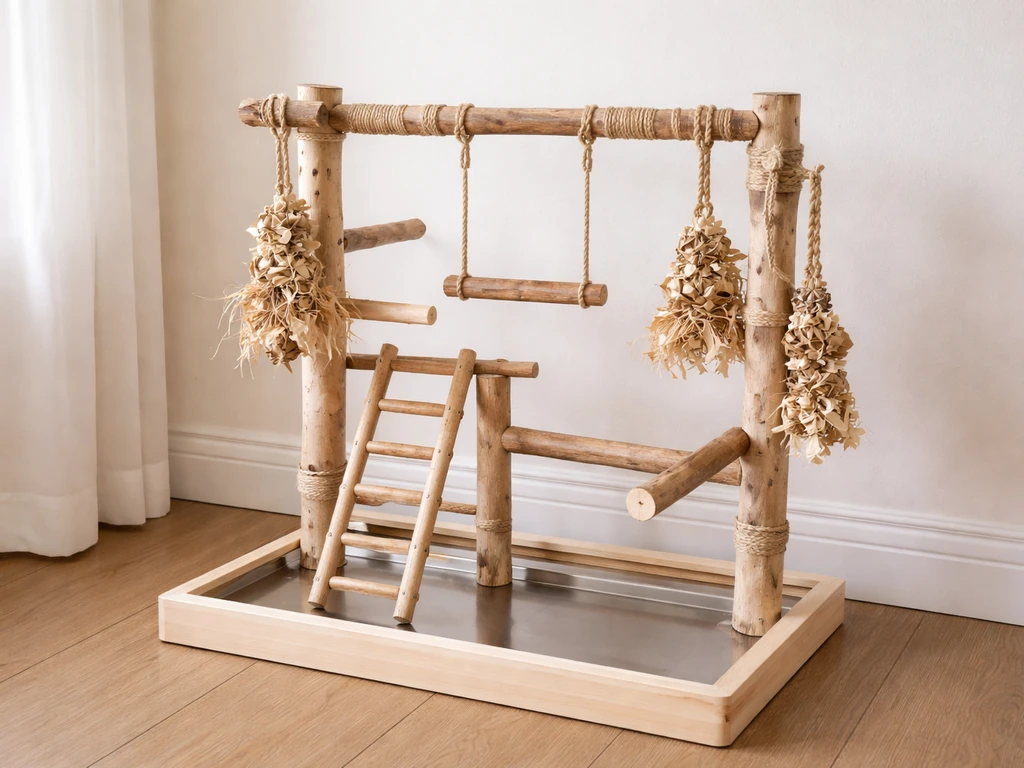
Compact and versatile, tabletop stands sit on a counter, desk, or table. They're excellent for small to medium birds and for people with limited floor space. If you work from home and want your cockatiel or conure close by without a floor stand taking up room, a tabletop gym is ideal. A tabletop bird stand is a great way to bring enrichment close by without giving up floor space tabletop gym. They tend to have less vertical climbing space than floor stands, which is fine for less active species but can feel cramped for a bird that loves to climb.
Wall-mounted and open-top configurations
Wall-mounted options free up floor and table space entirely and can create a really enriching 'bird zone' on a feature wall. They require more setup commitment and aren't easy to move, but for a dedicated bird room or a permanent play area for a confident, larger bird, they're worth considering. Open-top cage configurations (where the cage lid opens to become a platform) overlap with the cage-top category and are a good built-in option if your cage supports it.
Foraging-centered setups
These aren't a physical format so much as a design philosophy: the playground is built around food puzzles, hidden treats, shredding toys, and destructible elements rather than just perches and swings. Any of the above formats can be built into a foraging-centered setup. This approach is especially valuable for species with high intelligence and boredom risk, like caiques, African greys, amazons, and eclectus parrots. For a budgie or finch, one simple foraging toy is plenty.
Sizing, safety, and materials: what to look for and what to avoid
Perch diameter and sizing rules
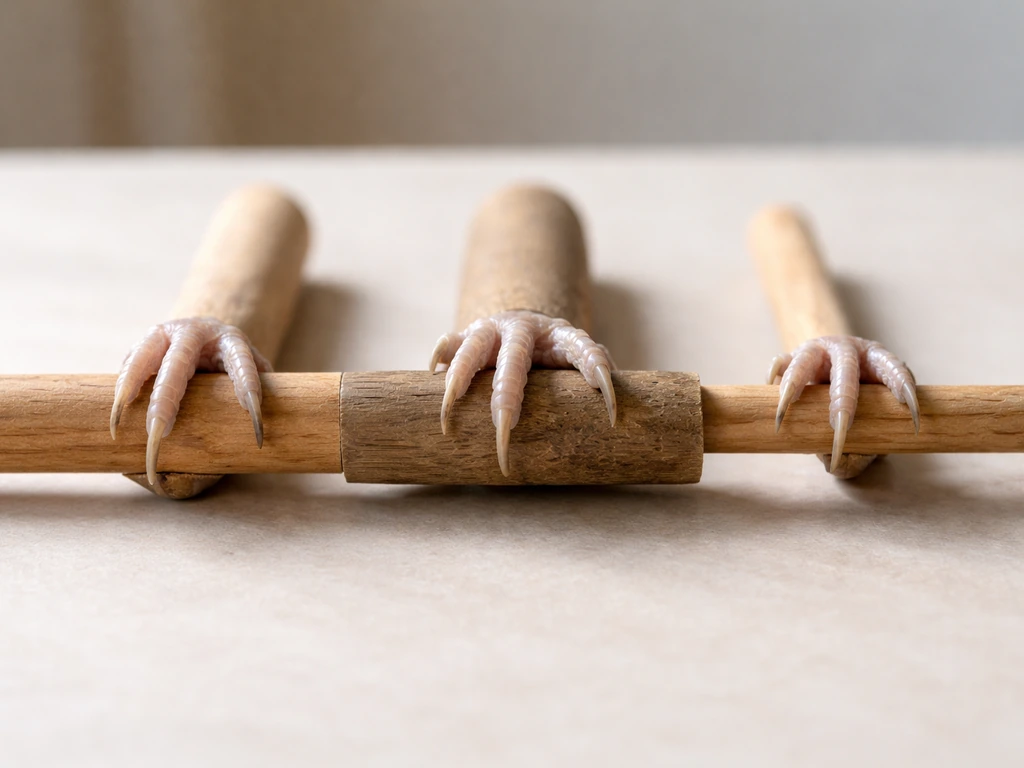
VCA Animal Hospitals recommends that a bird's toes should wrap about three-quarters of the way around the perch. If the toes wrap all the way around and overlap, the perch is too thin. If the foot sits flat on top without any wrap, it's too thick and the bird can slip and fall. Most playgrounds come with a single perch diameter, which is actually a problem: using multiple perch diameters on the same playground gives your bird exercise variation in its feet and prevents pressure sores. Aim for at least two different diameters on any playground you set up.
Safe and unsafe materials
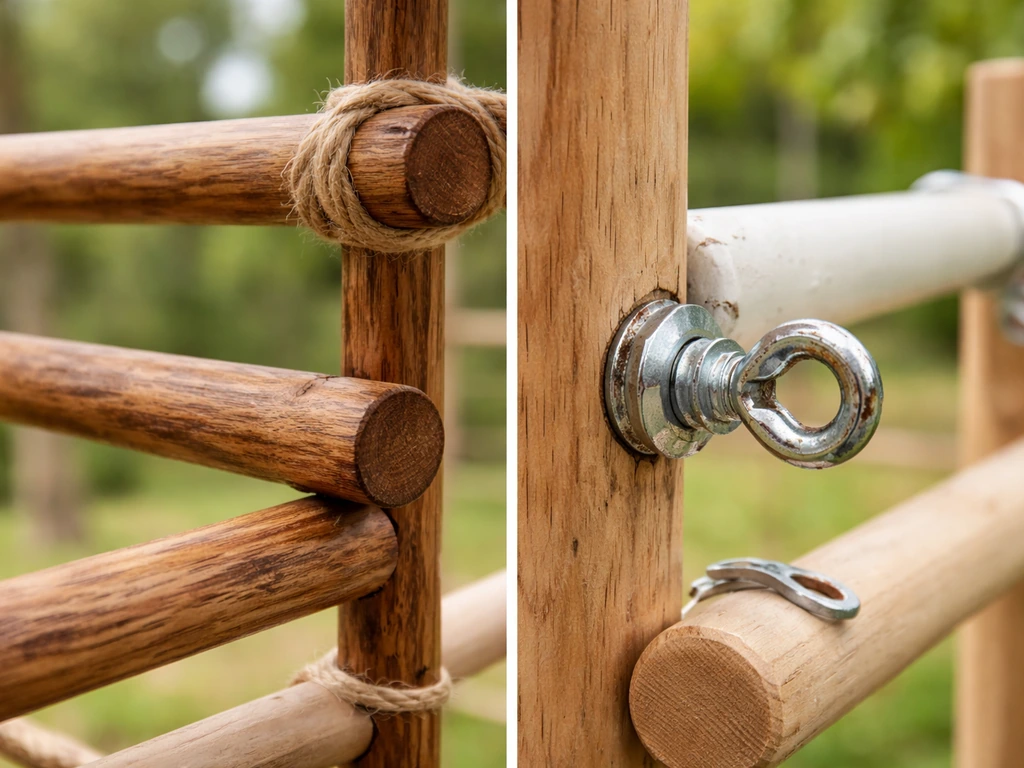
This is where beginners make costly mistakes. The two biggest material hazards in bird playgrounds are zinc and lead. PetMD confirms that both are common sources of heavy metal poisoning in birds. Galvanized metal hardware (chains, bolts, wire mesh on some stands) is a zinc risk: the MSD Veterinary Manual specifically lists galvanized metal cages, coated birdcages, galvanized hardware, and zinc-coated toys as zinc toxicosis sources. Hot-dipped galvanized wire is not safe for pet birds, per the Pet Poison Helpline. Stick to stainless steel hardware wherever possible. Avoid any painted or coated metal components unless explicitly confirmed lead-free and bird-safe.
For the frame and perches, untreated natural wood (apple, willow, manzanita, birch) is safe and chewable in a good way. Avoid pressure-treated lumber, cedar, and redwood, which contain compounds harmful to birds. Rope toys and perches should be natural cotton or sisal, not synthetic fibers that can fray into dangerous loose threads. Check all quick-links and clips: stainless steel snap hooks are safer than the zinc-plated versions that look similar but aren't.
Spacing and fall/escape risks
Bar spacing on any cage-top gym should match the bar spacing guidelines for your bird's size. Small birds can get their heads stuck in gaps that are too wide. For playgrounds that are elevated, consider placing a soft mat or folded towel underneath for younger or older birds that might slip. Clip-on toys and hanging elements should all be checked for loose wires or sharp edges before letting your bird near them.
Essential components every playground needs
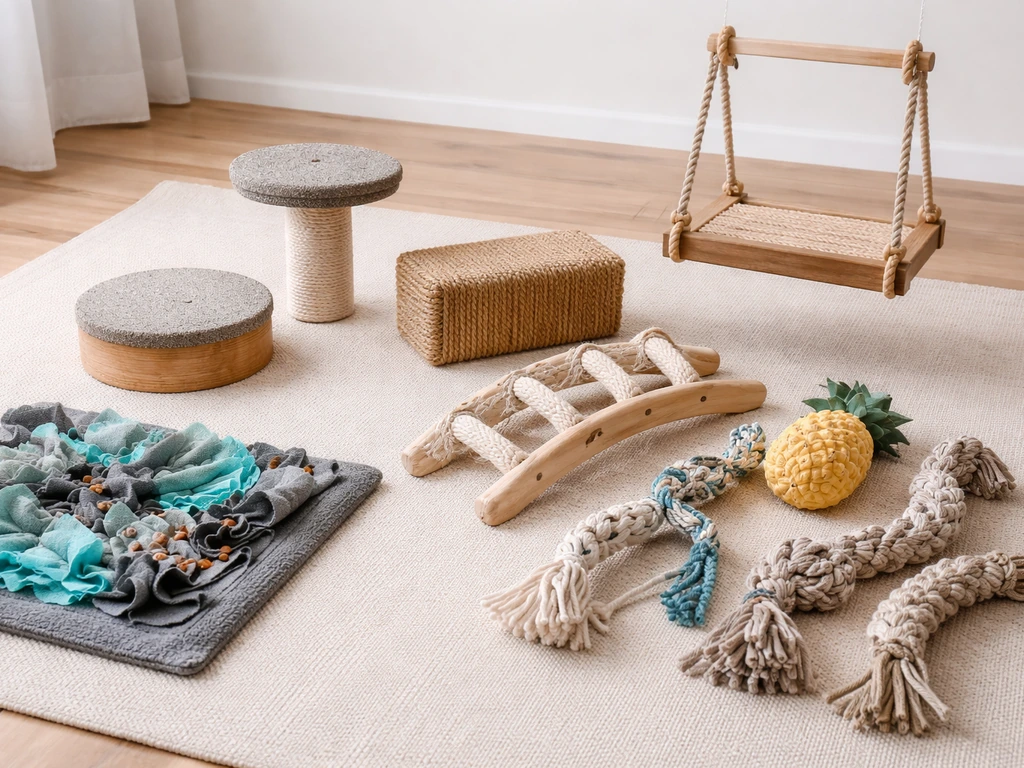
A playground that only has a flat perch and a mirror is basically just a shelf. Here's what a properly stocked setup should include, regardless of format.
Perches
Include at least two perches at different heights and diameters. A natural wood perch with irregular diameter (like a real branch or a manzanita perch) is better than a perfectly round dowel because the variation works the foot muscles and mimics real roosting. A rope perch or cotton bungee perch adds a different tactile experience and is gentler on arthritic or older birds.
Swings and ladders
Swings give birds vestibular stimulation (balance and movement feedback) that's genuinely enriching, not just decorative. Most birds enjoy them once they're comfortable on the playground. Ladders are excellent for species that like to climb and create a vertical movement path. For small birds, a wooden rung ladder in a comfortable width is plenty. For larger parrots, rope ladders or wide wooden climbing nets give more challenge.
Activity toys and chew options
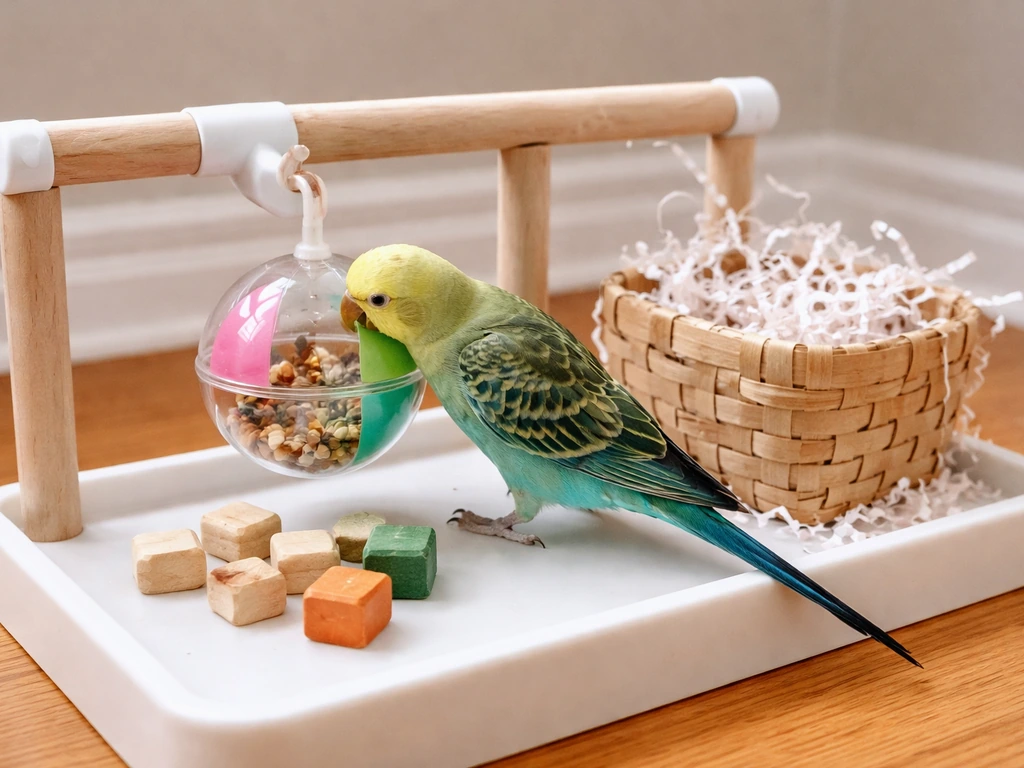
Toys should match the bird's size and beak strength. A budgie doesn't need a toy rated for a macaw, and a cockatoo will destroy a budgie toy in seconds. Chew toys (soft wood blocks, palm frond strips, corn husk toys) satisfy a bird's natural need to destroy things and keep beaks in good condition. Rotate toys every one to two weeks: birds are novelty-seeking and will lose interest in static setups. A good rule of thumb is to own twice as many toys as you display at once, swapping half of them out weekly.
Foraging and treat systems
Foraging is probably the single most important enrichment element you can add, and it's also one of the most underused by beginners. Foraging toys require the bird to work for a reward, which mirrors wild feeding behavior and combats boredom and feather-destructive behaviors. Start simple: a small foraging cup with treats covered by paper strips or a kabob skewer loaded with vegetables and fruit pieces. Work up to puzzle feeders and harder foraging challenges as your bird gets more confident. Even a piece of millet tucked into a rope perch knot counts.
Placement, setup, and daily routine
Where to put it
Place the playground in a room where your bird can see you and interact socially, since most pet birds are flock animals and isolation defeats the purpose. Avoid placing it near the kitchen (cooking fumes, PTFE/Teflon off-gassing from non-stick pans is acutely toxic to birds), near exterior doors that open to the outside, and away from air vents, drafts, or windows with direct afternoon sun. The Merck Veterinary Manual and VCA both flag household cleaners, aerosols, and smoke as significant air quality hazards for birds, so keep the playground well away from cleaning activity and never use it in a freshly painted or recently sprayed room.
How to introduce the playground without stressing your bird
Don't just put your bird on the playground and expect enthusiasm on day one. Place the playground near the cage for a few days so the bird can observe it from safety. Then open the cage and let the bird explore at its own pace. Use a favorite treat placed on the nearest perch to create a positive first association. Don't force the bird onto it by hand-placing it there, especially if it's not yet hand-tamed. Patience here pays off: a bird that discovered the playground on its own terms will use it far more consistently than one that was scared onto it.
Daily use routine
Consistency matters more than duration. Even 20-30 minutes of supervised out-of-cage time on a playground daily is genuinely enriching if it's regular. Make it part of a predictable schedule: morning or evening works well because birds are naturally more active at those times. While the bird is out, stay in the room. This is supervised time, not unattended time. Check the playground weekly for wear on rope perches (fray buildup is a strangulation risk), loose hardware, splintered wood, and soiled toys that need replacing.
Matching the playground to your specific bird species
One framework does not fit all birds. Here's how to think about it by species group.
| Species | Playground Type | Perch Diameter | Enrichment Priority | Notes |
|---|---|---|---|---|
| Budgies (parakeets) | Cage-top or small tabletop | 3/8 to 1/2 inch | Climbing, mirrors (with caution), shreddables | Very social; do well with mirrors but watch for obsession |
| Cockatiels | Cage-top or tabletop gym | 1/2 to 3/4 inch | Swings, foraging, chew wood | Enjoy music and interaction; moderate activity level |
| Finches / canaries | Cage-top or aviary-style | 1/4 to 3/8 inch | Flight space, natural perches | Not handleable; playground = enrichment inside a flight cage |
| Lovebirds | Cage-top or tabletop | 1/2 inch | Chew toys, shreddables, climbing | High energy; need robust toys they can't easily destroy unsafely |
| Small conures (GCC, PCC) | Tabletop or small floor stand | 5/8 to 3/4 inch | Foraging, swings, ladders, noise toys | Very active and curious; rotate toys frequently |
| Cockatiels to mid-size parrots (Caique, Pionus) | Tabletop or medium floor stand | 3/4 to 1 inch | Foraging puzzles, climbing, chew blocks | High boredom risk; foraging essential |
| African greys, Amazons, Eclectus | Large floor stand or wall-mounted | 1 to 1.5 inch | Complex foraging, problem-solving toys, varied perches | Intelligence demands daily novelty; toy rotation critical |
| Cockatoos, Macaws | Heavy-duty floor stand | 1.5 to 2+ inches | Destruction toys, heavy chew, social interaction | Needs steel hardware; light stands will not hold up |
Finches and canaries are a special case worth calling out: they're not handleable birds and don't do playground time the way hookbills do. Their enrichment comes from flight space, natural branch perches inside a large flight cage, and varied food presentations. If you have finches, your 'playground' is really the cage interior itself, designed with multiple perch levels and foraging stations.
Your buying checklist and how to evaluate brands and models
Before you buy, run through this list. It takes five minutes and saves you from a frustrating return or, worse, an unsafe product.
- Confirm the playground is sized for your specific bird (perch diameter, platform size, spacing between elements)
- Check all metal hardware: is it stainless steel or clearly labeled bird-safe? Avoid anything described as 'galvanized' without explicit safety confirmation
- Inspect rope and fabric perches: should be natural cotton or sisal, not synthetic fibers or metallic thread
- Look for sharp edges, exposed wire ends, or any quick-links that could pinch a toe or beak
- Verify the base is stable: a floor stand should not tip if a medium parrot lands hard on one side
- Check whether the wood components are untreated or specifically labeled bird-safe (no pressure treatment, no cedar, no redwood)
- Read reviews specifically for durability and for reports of injury or chewed hardware, not just aesthetics
- Check if the playground can be expanded or reconfigured, which helps as your bird's confidence and enrichment needs grow
- Confirm replacement parts (toys, perches) are widely available for the brand so you can rotate and replace without replacing the whole unit
When comparing brands, focus less on visual appeal and more on hardware quality and modular design. Mid-range brands that use stainless steel hardware and natural wood components consistently outperform cheap imports that use zinc-plated clips and painted dowels. A playground costing $40-60 with stainless fittings is a far better investment than a $25 option with unknown metal coatings. For large parrots, budget at least $80-150 for a floor stand that will actually hold up to daily use and a 500-gram bird launching itself at the toy hook.
Common beginner mistakes and how to fix them
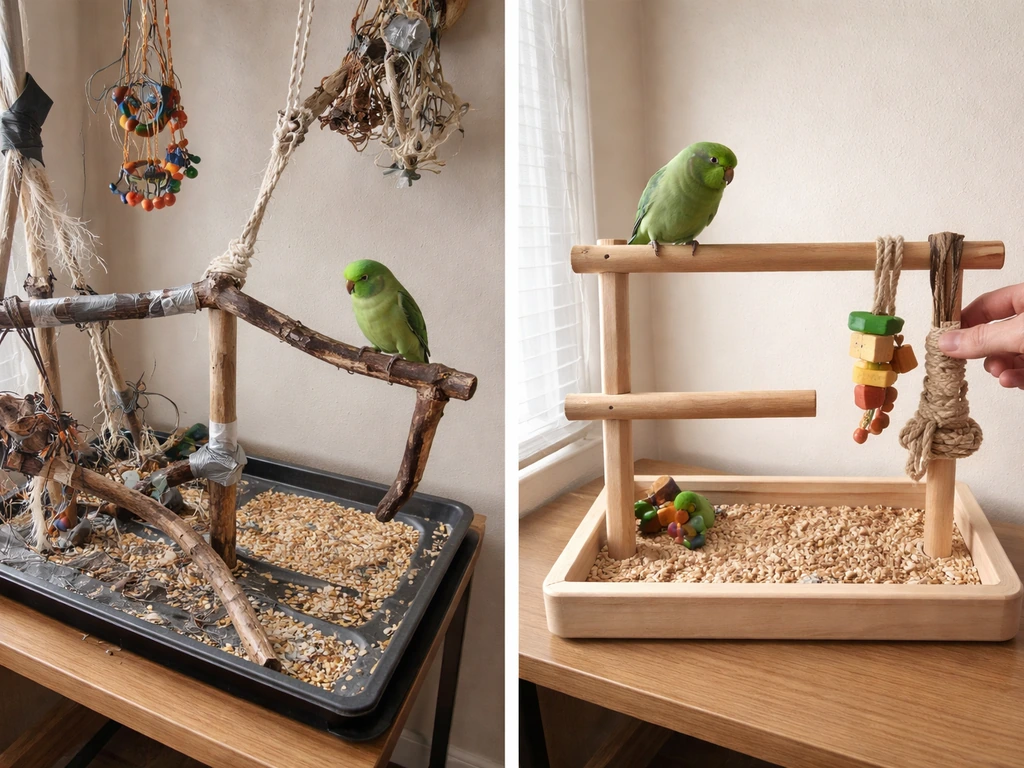
Buying the wrong size
The most common issue. If your bird looks cramped or keeps stepping off the perch, the platform is too small. If it looks lost on a huge stand and never ventures past the top perch, it may be overwhelmed. Fix: match the playground format to the species table above and start with a smaller, well-stocked option rather than a large empty one.
Using unsafe or unknown materials
Galvanized wire, zinc-plated clips, mystery wood, and painted hardware are common hazards in budget playgrounds. Heavy metal poisoning from zinc and lead is a real and serious risk, not a theoretical one. If you've already bought something and aren't sure about the hardware, replace the metal clips and chains with verified stainless steel alternatives from a bird supply store. This is a $10-15 fix that matters.
Leaving the bird unsupervised on the playground
Playgrounds are supervised enrichment time, not babysitters. A bird left alone out of the cage can fly into a window, chew through a power cord, land on a hot stove burner, or fall and injure itself. If you can't be in the room, put the bird back in the cage. This isn't optional.
Never rotating toys
A static playground is a boring playground. Birds habituate quickly to unchanging environments, which is a driver of feather plucking, screaming, and other stress behaviors. Rotate at least half the toys weekly. Keep a small storage box of 'off-rotation' toys so you always have something to swap in. This is cheap, easy, and one of the highest-impact enrichment habits you can build.
Poor placement near air hazards
Placing a playground near the kitchen, next to an air freshener plug-in, or in a room where candles burn regularly is a real hazard. VCA warns that smoke exposure and aerosols are dangerous to birds. Essential oils, including diffusers, are a toxicosis risk per both the Merck Veterinary Manual and VCA. Keep the playground in a clean-air zone: no fragrances, no cooking proximity, no scented candles in the same room.
Territorial aggression and playground ownership
Some birds, especially hormonal parrots, will become aggressively territorial about a playground placed too close to their cage. If your bird starts lunging, biting, or refusing to leave the playground, try moving it to a different room or at least further from the cage. A bird that sees the playground as its territory extension isn't getting enrichment, it's getting a second cage to guard. Distance and a neutral location usually resolves this quickly.
Expecting the bird to love it immediately
New things are scary for birds. A bird that won't go near the playground after two days hasn't failed and neither have you. Use the gradual introduction method described earlier, add treats, and give it one to two weeks before worrying. If the bird still won't engage after two weeks of patient encouragement, check whether a toy or element is frightening it (shiny objects, unusual shapes, or loud rattling toys can spook nervous birds) and simplify the setup to just one perch and a familiar treat first.
FAQ
My bird seems to slip or step off immediately. How do I troubleshoot perch fit and layout?
If your bird keeps stepping off or hanging awkwardly, the perch diameter may be off or the playground may be too high for safe balance. Use the toe-fit check (about three-quarters wrap, no overlap) and then add a lower “landing” option, like a second perch closer to the cage floor, so your bird can choose a safer route.
How should I introduce a new bird playground if my bird is nervous?
Start with the easiest entry point: place the playground so your bird can reach it from the cage with a confident hop, then add a single favorite treat on the nearest perch. Once it explores on its own, expand to the second perch and then toys over several days, instead of loading everything at once.
What counts as normal engagement versus a playground that your bird ignores?
Do not judge “interest” by time alone. A bird may investigate briefly and then return later, which is normal. Look for use signs like perching, climbing, preening, chewing, or foraging. If you see zero engagement for 2 weeks despite treats, simplify to one perch and one foraging element.
Can I leave the playground out permanently, or is it safer to store it when not supervised?
Yes, but do it carefully. Replace any rope that shows fraying with new rope, and avoid any hanging components that can twist into loops. Also check that all fasteners are stainless and tight, and that chewable parts are not producing splinters or sharp fragments before reintroducing it.
Is it ever a bad idea to include a mirror on a bird playground?
Mirrors can be stimulating for some birds, but many birds interpret them as a competing partner, especially during breeding or hormonal periods. If you notice pacing, screaming at the image, or aggression, remove the mirror and switch to foraging toys or shredding options instead.
How can I tell if a playground’s hardware is actually bird-safe, not just “looks sturdy”?
Even stainless setups need a “no unknown coatings” rule. Avoid painted metal, plated hardware, or plastic parts that smell strongly or feel tacky when new. If a product does not explicitly state lead-free, zinc-free, and bird-safe for hardware, assume you should replace the metal components or choose a different unit.
What wood, ropes, and chew materials should I avoid even if the brand says they’re “natural”?
As a safety baseline, use only untreated natural wood you know is intended for birds, and avoid any wood that is oily, resinous, or from pressure-treated lumber. For stringy or fibrous items, use cotton or sisal designed for pet use, and remove any toy that starts shedding threads.
How long should playground time be, and what should I do if my bird gets overstimulated?
Keep sessions short and predictable, then build up gradually. Most birds do well with 20 to 30 minutes daily, but if your bird is stressed or flapping heavily, reduce time and focus on one perch plus foraging rewards. Consistency matters more than marathon sessions.
My bird is plucking or acting more stressed after getting a playground. What adjustments help first?
Feather damage is a safety signal. If you see feather plucking or intense fixation on one toy, rotate away from that item and add more foraging and chewing options to reduce boredom. Also confirm the playground is not causing stress by being too close to cage territory.
Can I put the playground in a living room near the kitchen or use air fresheners nearby?
If it’s in the same room as cooking, air fresheners, candles, or aerosols, treat it as a risk until the source is removed. Birds are extremely sensitive to airborne contaminants, including non-stick fumes, smoke, and fragrances, so move the playground to a clean-air zone and avoid using it in freshly painted or sprayed rooms.
I bought a big stand, and my bird only stays at the very top. What can I change?
Larger stands can still be useful if you make the lower and mid levels “valuable” to your bird. Add a foraging station at reachable heights and include a comfortable ladder or swing near mid-level so the bird has a reason to explore beyond the top perch.
Is it okay to move a floor stand around the house, and what are the safety considerations?
You can, but plan for safe access. Make sure the playground is stable, use only secure stainless attachment points, and keep it away from curtains, ceiling fans, and windows that can cause startling. Use it in the same “supervised window” of time, then remove it if you cannot monitor closely.
If I already bought a playground and suspect zinc or lead hardware, what’s the fastest safe fix?
For toxic metal concerns, the safest approach is replacement rather than patching. Replace zinc-plated clips, coated chains, and any questionable hardware with verified stainless steel parts, then inspect the setup again after a few days of chewing to ensure nothing new is shedding or deteriorating.
Next Article
Best Wood for Bird Perches: Safe Picks and What to Avoid
Safe wood guide for bird perches: what to buy, what to avoid, and how size shape affect foot health and cleaning.