Bird watching is genuinely good for most cats. It gives them a low-stakes outlet for their natural predatory instincts, keeps them mentally stimulated, and can reduce boredom-related behavior problems. That said, "good" comes with real conditions: the setup matters, the cat's individual temperament matters, and if you happen to keep pet birds in the same home, you need a clear safety plan before the cat ever lays eyes on the cage. Done right, a bird-watching station is one of the easiest and cheapest enrichment wins you can give an indoor cat. Done carelessly, it can escalate into stress, injury, or a dead bird.
Is Bird Watching Good for Cats? Safety and Setup Guide
Marcus Chen
23 Apr 2026
Do cats actually like bird watching?
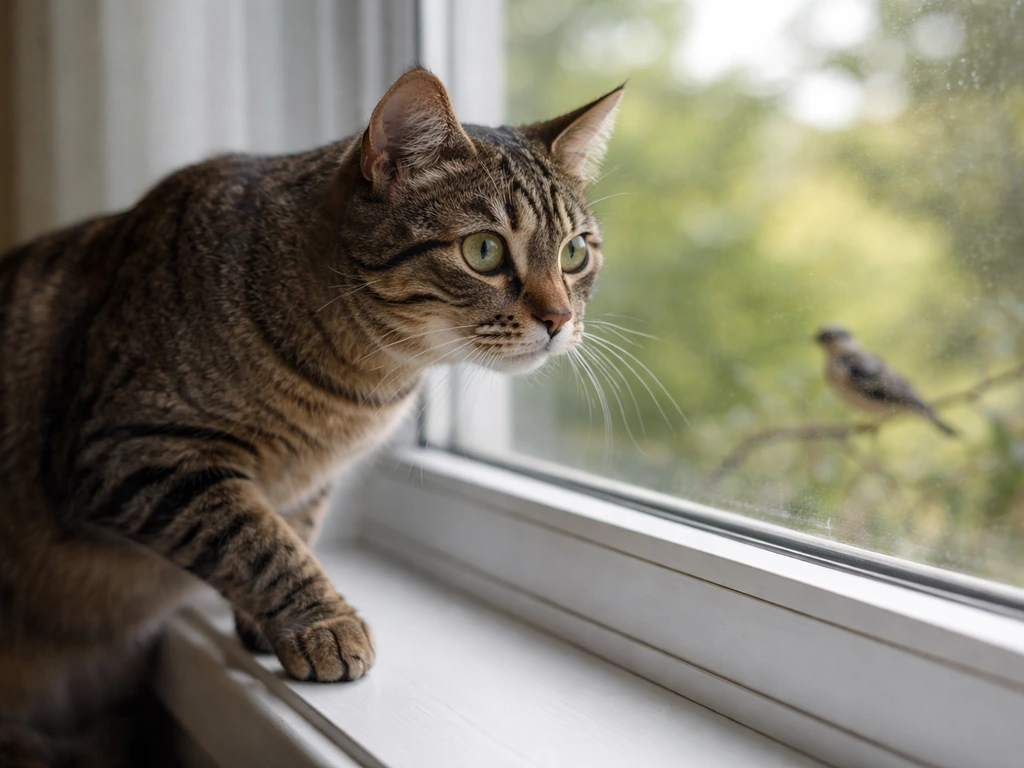
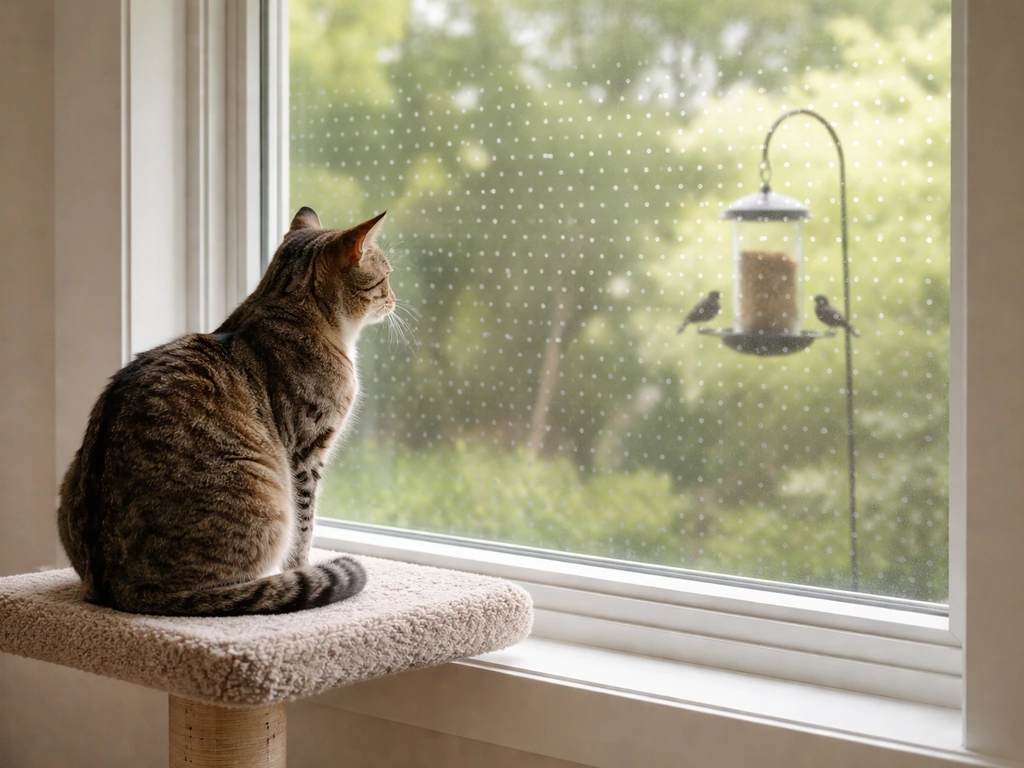
Yes, most of them love it. The behavior is hardwired. Cats are obligate hunters, and anything small, fast, and unpredictable triggers their predatory sequence: stalk, chase, pounce, bite. Birds hit every one of those cues. The flickering movement, the sound of wings, even bird song through a window is enough to get most cats locked in at the glass like they're watching live TV.
What's actually happening in your cat's brain is a mix of curiosity and predatory drive, and the two look similar from across the room. A cat who's calmly watching birds at a feeder with relaxed posture, slow tail movement, and chittering (that odd jaw-chattering sound cats make at birds) is engaged and entertained. That's the sweet spot. The instinct is there, but the barrier is doing its job as a safe outlet. The problem comes when the stimulation tips from interest into fixation or frustration, which I'll cover in the behavior section below.
Is bird watching safe for cats? A real risk check
For the cat watching birds through a window, the main physical risks are less obvious than you'd think. The biggest one is window collision injury, not from the cat but from birds flying into the glass, which can result in stunned or injured birds landing near the base of the window. If a cat can access that area, the predatory drive kicks into high gear and the situation becomes both unsafe for the bird and potentially injurious for the cat (claws, bites, escaped animals causing chaos indoors). You can reduce window collisions dramatically by applying visual markers to the glass, such as decals, UV-reflective tape, or film, spaced no more than 2 inches apart vertically and 4 inches horizontally.
If you keep pet birds indoors, the risk profile changes completely. A cat watching a caged bird is not a harmless scene. Even through cage bars, a cat's persistent presence creates chronic stress for the bird. Birds are prey animals and they register a predator staring at them as a real threat, even if nothing ever happens physically. Beyond stress, if the cage has any weakness, a motivated cat will find it. The bird's safety should be the non-negotiable starting point of your setup.
There are also disease and contamination risks worth knowing. The CDC advises keeping pets away from outdoor bird feeders and birdbaths because bird droppings and feathers can carry pathogens. Psittacosis (parrot fever), caused by Chlamydia psittaci, is transmissible via aerosolized particles from infected birds' feces, eye secretions, and respiratory secretions. Cats can be exposed if they access areas near bird droppings indoors or outside. Separately, toxoplasmosis is a zoonotic risk in the reverse direction: cat feces can contain Toxoplasma oocysts that become infective after about 24 hours, which matters if you're cleaning up near a bird habitat. Removing cat feces daily keeps that risk low.
Outdoor bird watching, meaning letting a cat roam outside to watch or chase birds freely, carries much higher risks: traffic, other animals, disease exposure, and real harm to wild bird populations. That's a separate and much harder question to answer favorably. This guide focuses on controlled indoor or contained viewing.
How to set up bird watching safely at home
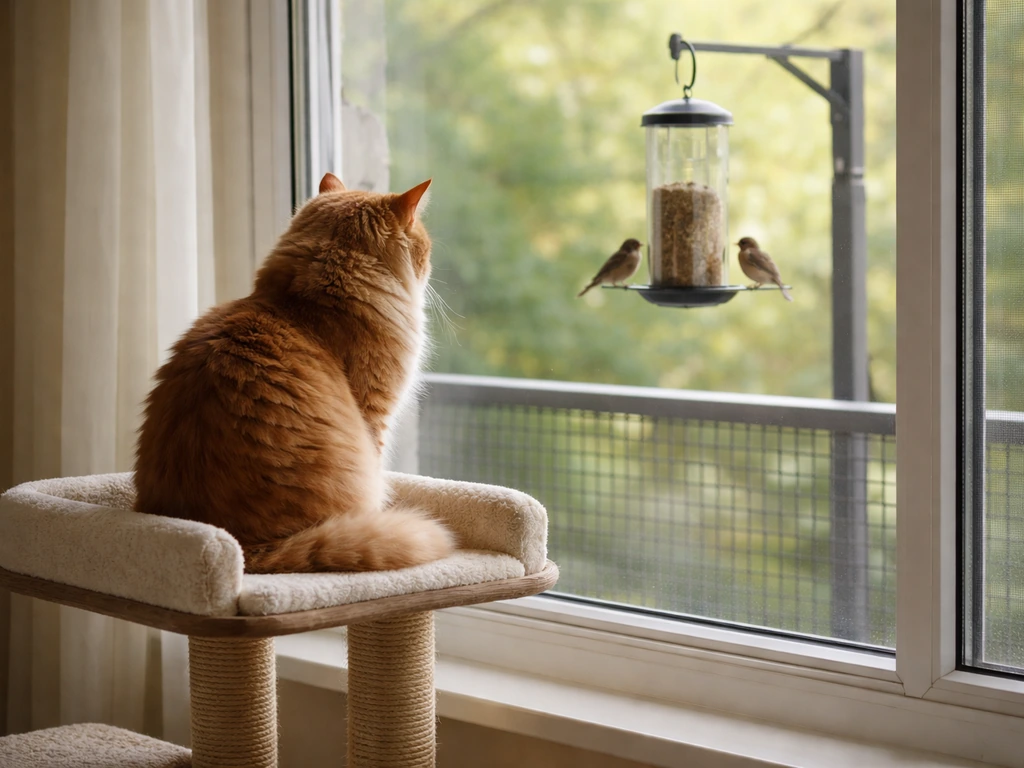
Window feeder or outdoor feeder setup
The goal is to give your cat a clear view with a physical barrier between them and the birds. A window perch or cat tree placed at window height works well. If you're placing a feeder outside, position it either very close to the glass (within about 3 feet) or more than 30 feet away. This reduces the chance of birds building enough speed to injure themselves if they do fly into the glass, and it puts the action close enough to keep your cat visually engaged without them attempting to bat at the window repeatedly.
- Apply window decals or anti-collision film to the glass before setting up any feeder, spaced 2 inches vertically and 4 inches horizontally.
- Place the cat's perch a foot or two back from the glass rather than directly against it, so the cat isn't nose-to-beak with birds and can't reach the window ledge to lunge.
- Keep the area directly outside the window inaccessible to the cat, especially if you have a cat door or accessible balcony.
- Supervise the first several sessions to assess how your cat is responding before leaving them unsupervised.
- Don't allow access to areas where bird droppings accumulate, whether from feeders, birdbaths, or outdoor bird activity.
If you have pet birds in the same home
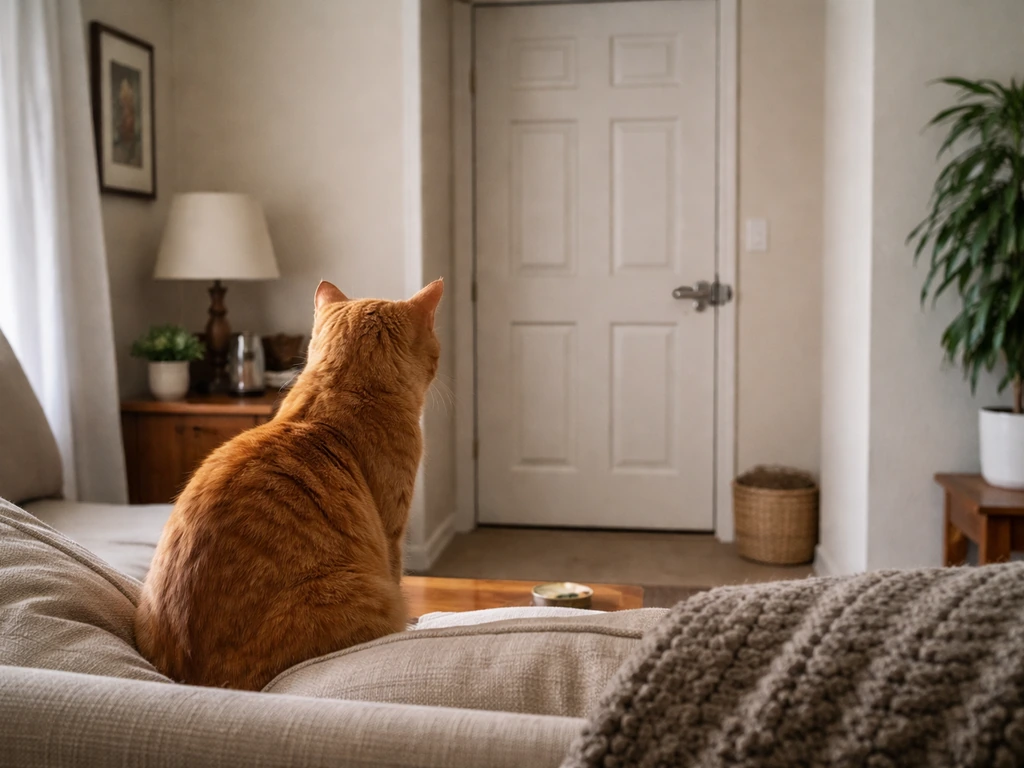
This is where you need a real separation plan, not just good intentions. The cat and bird should never share unsupervised space. The bird's room should have a door that latches securely and that the cat cannot open. Cage placement matters too: put the cage on a surface the cat cannot reach or jump to, and choose a cage with secure bar spacing and a cat-proof latch. Do not allow the cat to sit near the cage and stare at the bird, even if nothing seems to happen. The chronic stress on the bird from a predator's presence is a welfare concern in itself.
If you want to let the cat observe the bird from a safe distance (say, from a doorway with a baby gate or mesh barrier), brief supervised sessions can sometimes work with calm cats and species that are not particularly skittish. But be honest with yourself about your cat's arousal level. If the cat is chattering, tail-lashing, or pacing, the bird can see that too, and it is not a benign experience for the bird.
Watch for stress, predatory drive, and behavior that tells you to stop
Reading your cat's body during bird watching is the single most important skill here. There is a clear line between "pleasantly stimulated" and "about to do something you'll regret." You want the first one and need to intervene before the second one takes over.
Calm, engaged watching looks like: relaxed or slightly forward ears, slow or still tail, relaxed body, occasional chittering, and the cat returning to normal behavior when the birds leave. This is enrichment working as intended.
Escalating arousal or stress looks different. Ohio State's Indoor Pet Initiative describes the pre-attack posture as a straight-forward body position, narrowed pupils, and ears pulled back or flat. Preventive Vet notes that the hunting sequence in cats follows a pattern: stalk, chase, pounce, then a kill bite, and physical signs like an arched back or side-stepping appear as arousal builds. If you see your cat's tail lashing fast, body low and still (stalking), ears rotating backward, or pupils going fully dilated, that is not relaxed observation. That is a cat preparing to act on their instincts, and there's nothing for them to act on except the glass, a nearby pet bird, or you.
Stress and fear look different again. A cat who is distressed rather than predatory may show withdrawal, a crouched or tucked posture, ears low and to the side, and they may try to leave the area entirely. This happens with timid cats who are overwhelmed by the stimulation rather than excited by it. The University of Edinburgh's feline behavior guidance and Merck's veterinary behavior resources both emphasize reading posture, tail, and ears together, not in isolation. A single flattened ear means nothing. All three cues together mean something.
| What you see | What it means | What to do |
|---|---|---|
| Relaxed posture, slow tail, chittering, calm between bird visits | Engaged, content watching | Let the session continue, check in periodically |
| Fast tail-lashing, low stalking posture, dilated pupils, ears back | High predatory arousal, escalating | End the session, redirect with a wand toy or treat puzzle |
| Crouched/tucked body, ears low/sideways, trying to leave the area | Stressed or fearful, overwhelmed | Remove the cat from the viewing area, don't force sessions |
| Lunging or pawing repeatedly at the window | Frustration aggression building | Reduce session length, add more distance from glass |
| Normal behavior returns quickly after birds leave | Good sign, healthy engagement | Setup is working well |
Health and environmental things to sort out first
If you keep pet birds indoors, bird dander and feather dust are real airborne allergens. The American Lung Association lists pet dander (which includes bird feathers and dander) as a common trigger for asthma and respiratory allergies in people. If anyone in your household has respiratory sensitivities, this matters before you commit to a bird-watching setup that involves indoor birds. Good ventilation, HEPA air filtration, and regular cleaning of surfaces near the bird's area help keep airborne particulates down.
On the pathogen side, psittacosis is transmitted via aerosolized particles from infected birds' droppings, eye secretions, and respiratory secretions, according to StatPearls. This isn't a reason to panic, but it is a reason to maintain clean conditions around any bird housing and to wash hands after handling bird-related items. If you're cleaning bird feeders indoors, the CDC recommends disinfecting the area thoroughly afterward. Cats sniffing around feeder-cleaning areas or bird droppings are a vector for tracking contaminants through the home.
During periods of bird flu (H5N1) activity, the CDC specifically advises keeping domestic cats indoors and limiting their exposure to wild birds and bird habitats. This is worth checking seasonally if you're in an area with active outbreaks, as it directly affects whether your outdoor bird-feeder setup is appropriate.
Noise is a less-discussed factor. Bird vocalization in an enclosed space can be loud, and persistent loud sounds are a stressor for cats. If your cat-watching setup involves indoor birds making a lot of noise in close quarters, monitor whether your cat's behavior or stress indicators are affected over time. Some cats acclimate; others don't.
If bird watching isn't a good fit, here are the alternatives that actually work
Not every cat is a good candidate for bird watching. Cats with very high predatory drive can spend an entire session in a state of frustrated arousal without ever settling into calm viewing. Flapping bird cat toys can be a fun, movement-focused substitute if bird watching turns into frustration, so it is worth comparing that option too. Cats who are anxious or reactive can find the visual stimulation overwhelming. And if you have pet birds who are visibly stressed by any cat presence in the same home, the right call is to keep them fully separated and find other enrichment for the cat.
The most direct replacement for bird watching is interactive wand toy play. A fishing-pole style wand toy moved in short, erratic bursts mimics prey movement and engages the same predatory sequence (stalk, chase, pounce) in a controlled way. The HSHV notes that wand toys also keep some physical distance between the cat's claws and your hands, which matters during high-arousal play. Keep sessions to 10 to 15 minutes and always end with the cat "catching" the toy so the sequence feels complete, not frustrated.
Food puzzles are a strong second option. A 2016 paper cited in the Journal of Feline Medicine and Surgery describes puzzle feeders as "biologically relevant enrichment" because they mimic the cognitive and physical work of hunting. Research published in PMC shows that food puzzles contribute to emotional wellbeing and can reduce stress signs. Start simple, use your cat's regular food, and increase difficulty as they get comfortable. <a data-article-id="32F789AD-1994-4860-A841-D49889A440D0"><a data-article-id="B7261946-BB25-426E-B7A5-EEC2D9E86E28">Flapping bird cat toys and flying bird cat toys</a></a> are another category worth exploring, as they combine movement-based predatory play with a bird-like shape and action.
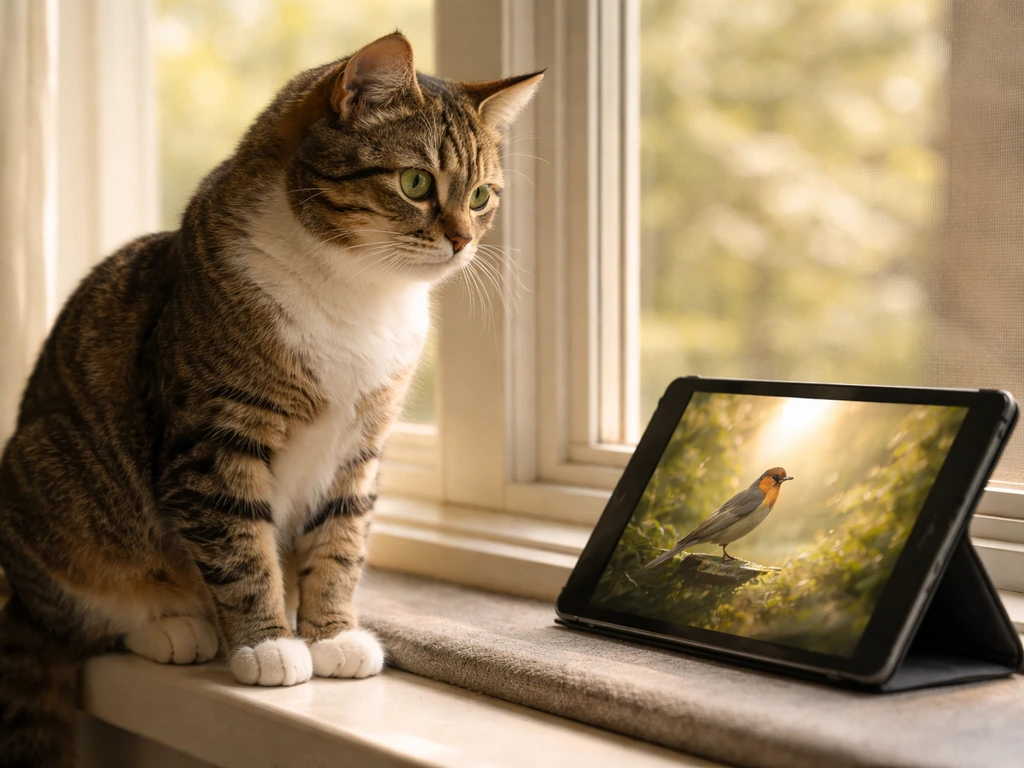
<a data-article-id="51D93F9F-2898-4391-A112-3C9D2A3A55B1">Bird videos on a tablet or TV</a> are another option some cats respond to well, especially if they're not responsive to outdoor feeders or you live somewhere without bird traffic outside. The response varies a lot by cat, and some lose interest quickly once they realize there's no scent, but for the right cat it's a low-effort setup. If you want another option, this pairs well with <anchortext>best bird videos for cats</anchor_text> for indoor viewing when live birds are not ideal. If you want another option for indoor enrichment, this pairs well with best bird videos for cats as a comparison point to bird watching when a bird can fox kitten planter style setup is too risky. If you're curious about this route, it's worth comparing how your cat responds to video versus live birds before investing in a feeder setup.
The broader principle: what a cat needs from bird watching is predatory stimulation and mental engagement. Any enrichment that provides those things, whether it's a puzzle feeder, a wand toy session, or a window perch with a good view, is a valid substitute. The goal is a cat who is tired, satisfied, and behaviorally settled, not one who spent the afternoon frustrated at glass.
Quick-reference checklist before you start
- Apply anti-collision window markers before placing any outdoor feeder near glass.
- Position the cat's perch 1 to 2 feet from the window, not directly against the glass.
- If you have pet birds, establish a hard separation plan: locked room, secure cage, no unsupervised contact.
- Supervise the first several bird-watching sessions and assess body language before leaving the cat alone.
- Stop any session where you see fast tail-lashing, low stalking posture, dilated pupils, or lunging.
- Keep cat away from areas with bird droppings, both indoors and out, and disinfect feeder-cleaning areas.
- If anyone in the home has respiratory sensitivities, use HEPA filtration and ventilate well around any indoor birds.
- Have a wand toy or puzzle feeder ready to redirect high-arousal behavior when you end a session.
- During bird flu activity periods, check CDC guidance on keeping cats indoors and limiting feeder access.
FAQ
How often should I let my cat watch birds, and for how long?
If your cat stays in calm viewing, it’s generally fine to do it regularly. If you notice stalking posture, tail-lashing, pacing, or you can’t get them to relax when the birds leave, reduce the session length or stop and switch to a controlled substitute like a wand toy session or food puzzle. A practical rule is to end the session before arousal peaks, not after.
Is bird watching safe if my cat can’t reach the window glass but can reach the area below it?
Yes for most window setups, but you should never allow physical access to the area where birds land. If your feeder placement means birds frequently drop or perch close to the base of the window, relocate the feeder closer to the glass (within about 3 feet) or far away (more than 30 feet) and block the cat from that collision-risk zone.
Does “bird watching” mean safe even if I have a pet bird in the home too?
It depends on what you’re calling “bird watching.” If the bird is indoors in a cage or aviary, the risks include chronic stress and possible cage escape, so avoid unsupervised co-location entirely. If you mean your cat watching wild birds through a barrier (window, porch screen, or controlled distance), the main risks are bird collisions and cat escalation, so focus on barriers and session monitoring.
What feeder distance from the window actually helps, and why?
Use the bird feeder as the control point. For outdoor feeders, the “cat-safe” window is about reducing bird speed before impact, because that’s what causes many injuries to birds. Place feeders very close to the glass (within about 3 feet) or more than 30 feet away, and add window markers so birds are less likely to try to fly through the glass.
My cat stares silently at the window, is that still a problem?
Do not rely on “the cat seems bored” signals. Some cats go through predatory cycles quietly until the moment they lunge or escalate. Watch for the full set of cues together (ears position, tail speed, body posture, and pupil dilation) and intervene at the first signs of fixation, not after the first swipe.
Will bird watching work for kittens or very high-energy cats?
Even with a barrier, kittens, high-energy cats, and breeds or individuals with very high hunting drive are more likely to stay locked on until frustrated. If your cat is already a persistent window hunter, start with very short, supervised sessions and be ready to replace the activity with wand play or puzzle feeding instead.
Can I set up a baby gate or mesh barrier so my cat watches birds while I’m busy?
You should treat bird-viewing as a supervised enrichment, especially at first. If you want to use a baby gate or mesh barrier, confirm the cat cannot squeeze through, climb over, or paw at the barrier to reach the bird source. The key is a physical separation plan plus monitoring until you’re confident your cat can settle.
What should I do if my cat looks scared rather than interested?
If your cat is showing fear or withdrawal, adding more time typically worsens it. In that case, use the principle of lower intensity exposure, for example shifting to a farther viewing position, adding a visual blocker on part of the window, or switching enrichment to non-reactive activities like puzzle feeders or a calm indoor play routine.
My cat gets more intense over time, should I push through or switch to something else?
If you’re seeing stress signs that build over weeks (more pacing, vocalizing, irritability, or inability to settle after the birds leave), stop the bird-viewing setup and pivot to enrichment that still provides predatory stimulation without prolonged frustration. A good substitution is 10 to 15 minutes of wand play with short erratic bursts, ending in a “successful catch” so the hunting sequence feels complete.
How do I reduce disease and contamination risk when using bird feeders (especially if my cat sniffs near the area)?
Bird-associated mess can matter for both you and your cat. Wash hands after cleaning bird areas, avoid letting your cat roam in droppings-contaminated spaces, and keep cleaning tools and waste contained. If you also clean feeders indoors, disinfect the area thoroughly so cats do not track dried residue around the home.
What if someone in my home has asthma or bird-related allergies, can they still do bird watching?
If anyone in your household has asthma or respiratory allergies, don’t assume “a little bird watching” is harmless if you also keep indoor birds. Airborne particulates and bird dander from feathers and dander can trigger symptoms, so use good ventilation and consider HEPA filtration, plus regular cleaning of the surfaces near the bird area.
Should I change my bird-feeder setup during bird flu or seasonal outbreak times?
Yes, seasonal disease risk can change what “safe” means. During periods of avian outbreak activity, follow public health guidance that often includes keeping domestic cats indoors and limiting access to wild birds and their habitats, since exposure risk can shift by region and season.
Next Article
Are Bird Videos Good for Cats? Safety, Benefits, Risks
Find out if bird videos are good for cats, how to use safely, and spot stress, fixation, or aggression risks.