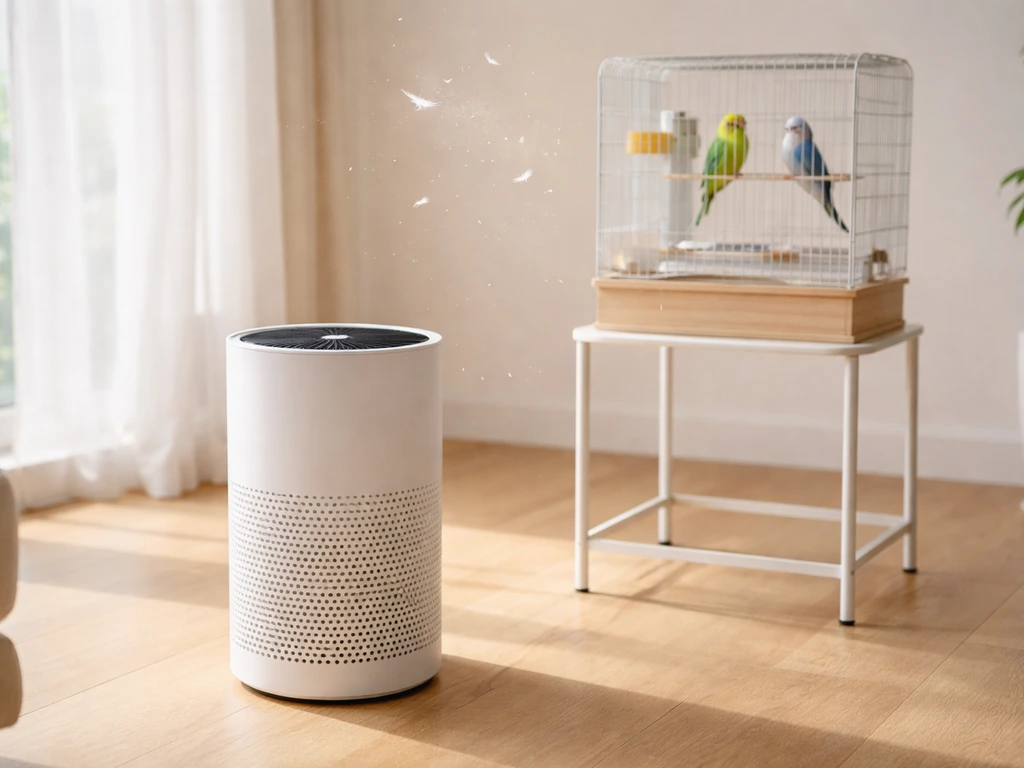
For bird dust, you want a true HEPA air purifier sized to at least 1.5x your room's square footage rating, placed 3 to 6 feet from the cage but never blowing air directly onto your bird. That combination alone will handle the vast majority of feather particulates, dander, and fine powder-down dust that make bird rooms so rough on sinuses and lungs. If you have a cockatoo, cockatiel, or African grey in a medium-to-large room, prioritize a unit with a CADR of at least 200 to 250 CFM and a quiet nighttime mode under 35 dB. That's the short version. Everything below explains how to pick the right unit for your room, your bird species, and your budget, and how to keep it actually working.
Best Air Purifier for Bird Dust: Buyer and Setup Guide

Marcus Chen
6 May 2026
Why bird dust is actually a serious problem
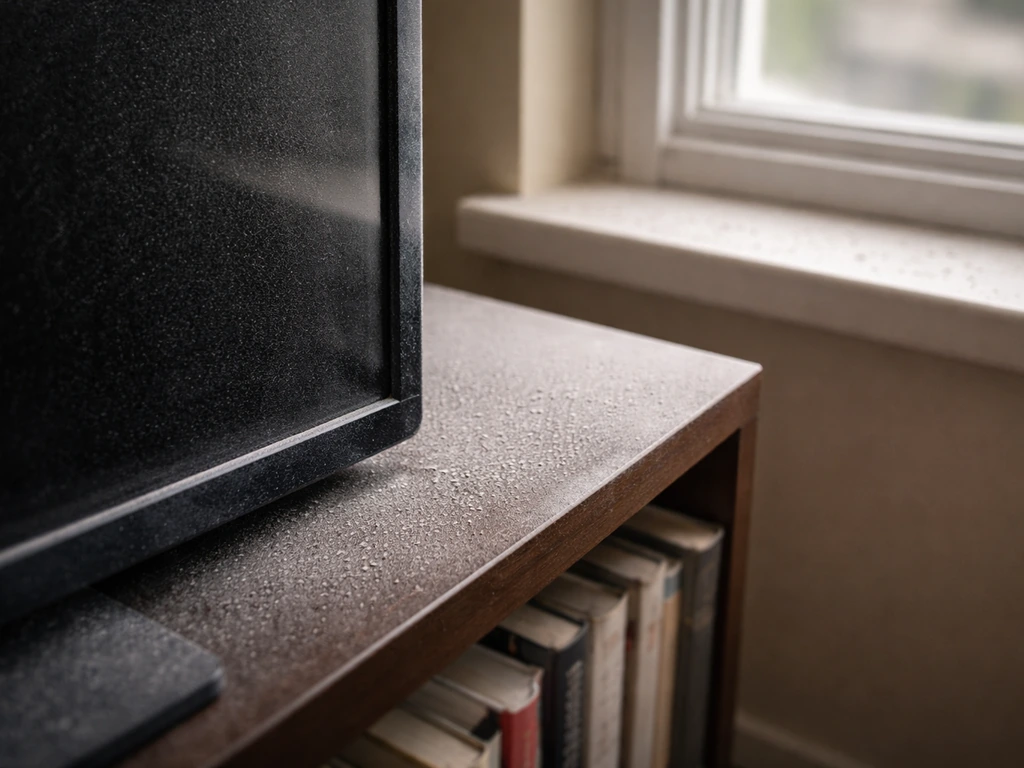
Most new bird owners aren't warned about this. You bring home a cockatiel or cockatoo and within a few weeks you notice a fine gray film on your TV, bookshelves, and windowsills. That's powder down, a fine keratin dust produced by specialized feathers near the skin. It's not just dusty. It carries proteins from dried droppings, feather fragments, and other biological material that become airborne and stay suspended for hours. For people, chronic exposure to these particles can trigger everything from mild sneezing and itchy eyes to something far more serious called bird fancier's lung, a form of hypersensitivity pneumonitis caused by an acquired immune response to inhaled avian antigens from feathers, droppings, and proteinaceous dust. The American Thoracic Society identifies pet bird dust specifically as a trigger category for hypersensitivity pneumonitis. In plain terms, your lungs can build up a reaction over time even if you felt fine at first.
If anyone in your home has asthma or allergies, this matters even more urgently. But even in otherwise healthy households, bird dust accumulates fast and makes the air feel stale and irritating. The good news is a well-chosen air purifier makes a dramatic, noticeable difference. If you want a shortcut, look for the best air purifier for bird owners with true HEPA filtration and the right CADR for your room a well-chosen air purifier. I've seen bird rooms go from visibly hazy to genuinely fresh air within a few days of running the right unit continuously.
What to look for when buying an air purifier for bird dust
Not all air purifiers are built for this job. Here's what actually matters when you're shopping for a bird household specifically.
True HEPA filtration is non-negotiable
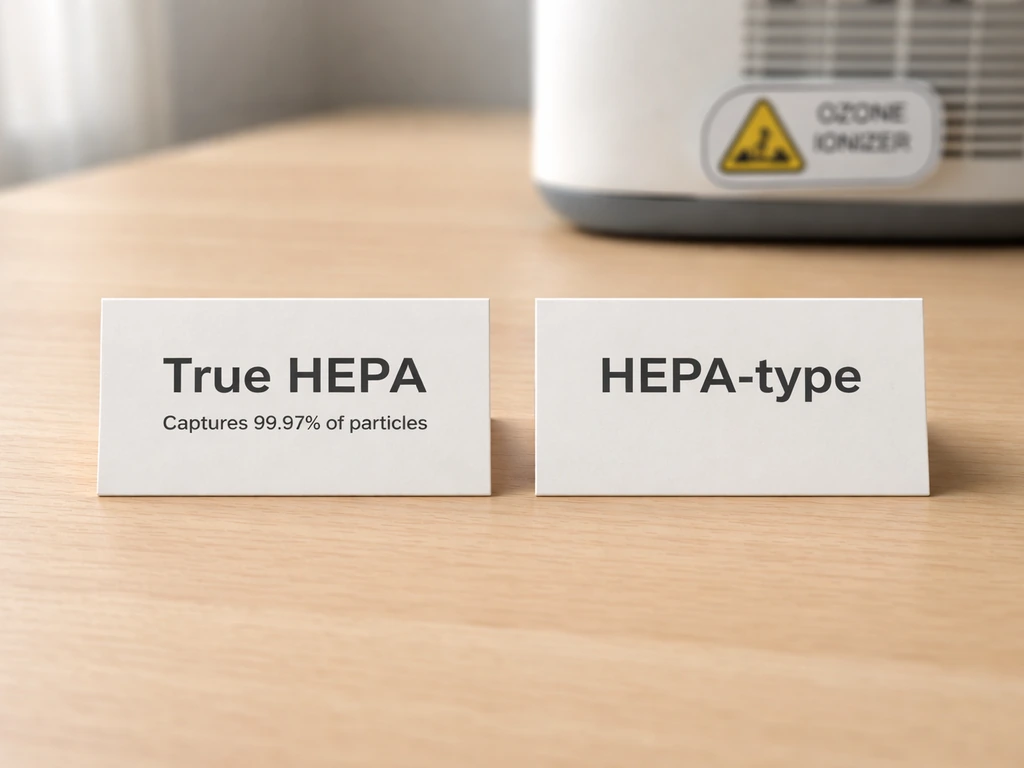
The label matters here. True HEPA filters capture 99.97% of particles at 0.3 microns, which covers feather dust, dander, and dried dropping particulates. "HEPA-type" or "HEPA-style" filters are not the same and often miss a significant fraction of the finest, most lung-irritating particles. Always check the product specs for the phrase "True HEPA" or "H13 HEPA" before buying. H13 HEPA is a slightly higher standard and worth the modest price premium if you're sensitive or if you have a heavy dust producer like an umbrella cockatoo.
Avoid ozone generators and ionizers
This is where a lot of first-time buyers go wrong. Ionizers and ozone-generating purifiers are sometimes marketed for pet odors, but ozone is a respiratory irritant that is genuinely dangerous for birds. Birds have an extremely sensitive respiratory system and even low concentrations of ozone can cause serious harm. Stick to purifiers that are filtration-only, meaning true HEPA plus a pre-filter and optionally an activated carbon layer for odors. If a unit advertises an ionizer as a feature, make sure you can turn it off, and honestly just avoid it entirely in a bird room.
Noise level matters for birds and sleep
Birds are sensitive to sound and disrupted sleep patterns affect their health and behavior. Look for a unit that runs at 50 dB or less on medium speed, and ideally 30 to 35 dB on its lowest setting. This also matters for your sleep if the purifier runs in or near a bedroom. Most reputable brands publish decibel ratings for each fan speed in their spec sheets, so check before buying rather than guessing.
Other features worth having
- Auto mode with a particle sensor: adjusts fan speed in real time when dust levels spike (like during preening or cage cleaning), so you're not manually changing settings constantly
- Filter replacement indicators: bird dust loads filters faster than the manufacturer's baseline assumes, so a visual indicator helps you track actual filter life
- 360-degree air intake or front-and-side intake: pulls dusty air from more directions, especially useful near a cage
- No UV-C lights that generate ozone: some UV-C lamps are ozone-free and safe, but verify this in the specs before trusting the label
- Sealed system design: ensures all air passes through the filter rather than leaking around it
Best filter types and CADR explained for bird owners
CADR stands for Clean Air Delivery Rate and it's measured in cubic feet per minute (CFM). It tells you how quickly the purifier cleans a volume of air. For bird rooms, the general rule of thumb is to match the purifier's recommended room size to 1.5 times your actual room square footage. So if your bird room is 150 square feet, shop for a unit rated for at least 200 to 225 square feet. Bird dust is heavier and more persistent than typical household dust, and this headroom means your purifier isn't running at maximum constantly just to keep up.
For air changes per hour (ACH), you want at least 4 to 5 complete air changes per hour in a bird room. In a room with heavy dust producers like cockatoos or African greys, 5 to 6 ACH is better. You can calculate this yourself: take the purifier's CADR in CFM, multiply by 60 (minutes per hour), then divide by the room's cubic footage (length x width x ceiling height). If that number is above 4, you're in good shape.
| Filter Type | Best For | Bird-Safe? | Notes |
|---|---|---|---|
| True HEPA (H11/H12) | General dust, dander, feather particles | Yes | Good baseline choice for most bird species |
| H13 HEPA | Heavy dust producers, allergies, asthma | Yes | Higher capture efficiency; worth the cost for cockatoos/greys |
| Activated Carbon + HEPA combo | Dust plus odor control | Yes | Carbon layer handles ammonia from droppings; look for at least 1 lb of carbon |
| HEPA-type / HEPA-style | Light household dust | Yes (but suboptimal) | Not recommended for bird rooms; misses fine particles |
| Ionizer / Ozone generator | Not appropriate for bird rooms | No | Ozone is dangerous for birds; avoid entirely in bird spaces |
| UV-C only units | Pathogens (limited dust capture) | Check specs carefully | Only safe if ozone-free; does not replace HEPA for particulates |
Where to put the purifier in a bird room
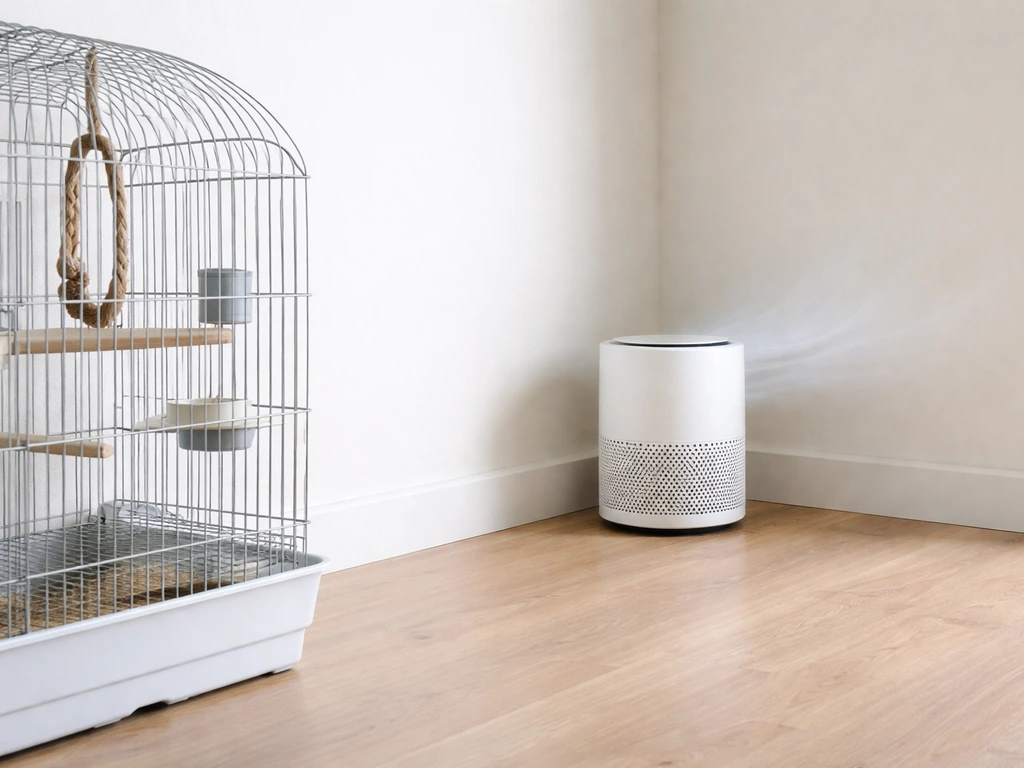
Placement makes or breaks how well your purifier performs. The most common mistake is tucking the unit into a corner far from the cage. Bird dust is generated at the cage and spreads outward, so you want to intercept it as early as possible.
Position the purifier 3 to 6 feet from the cage, off to the side or slightly behind it, never directly in front. The goal is to pull dusty air toward the intake without creating a draft that blows air directly onto your bird. Drafts are stressful and potentially harmful to birds, especially smaller species. If your unit has a directional outlet, angle it away from the cage toward the center of the room so the clean exhaust circulates without hitting the bird.
Elevate the purifier if you can. Bird dust and dander are light enough to stay airborne at multiple heights, but placing the unit on a low table or stand (12 to 24 inches off the floor) helps it capture particles at the height they're most concentrated during flapping and preening. Floor placement still works, but elevated placement is modestly better in taller rooms.
Keep the door to the bird room closed when the purifier is running, or at least partially closed. Running a purifier in a wide-open space just lets dusty air flow in from the rest of the house and overwhelms the unit. If you have a dedicated bird room, keeping it reasonably sealed makes a meaningful difference in how quickly air quality improves. That said, bird rooms still need good ventilation for the bird's health, so don't seal the space completely. A partially open door or passive vent is fine.
Run the purifier continuously on low or auto, not just when you notice dust. Bird dust accumulates constantly during waking hours, especially during preening. Cycling the unit on and off lets particulate levels build back up between sessions. If you're worried about electricity, modern HEPA purifiers at low speeds use 15 to 40 watts, similar to a few LED light bulbs, so 24/7 operation is affordable.
Top air purifier picks by room size and budget
Rather than just naming brands, here's how to match a unit to your actual setup. These recommendations reflect the features and performance specs that matter for bird dust as of 2026, grouped by room size and budget tier. If you want the best bird heater for your setup, use these criteria to narrow down the right purifier for dust control and clean airflow air purifier picks.
Small rooms up to 150 sq ft (bedroom, small apartment space)
Look for a unit with a CADR of at least 100 to 130 CFM and a true HEPA filter. At this size, noise is usually the biggest factor since the unit will be close to where you sleep or sit. The Levoit Core 300-S and Coway AP-1512HH are strong picks in the budget-to-mid range (roughly $80 to $130). Both run true HEPA, have particle sensors, and hit around 24 dB on their lowest setting. For a small room with a single small bird like a cockatiel or budgie, either of these handles the dust load comfortably when run continuously.
Medium rooms 150 to 300 sq ft (standard bedroom or living room)
This is the most common scenario for bird owners. You want a CADR in the 200 to 250 CFM range. The Winix 5500-2, Blueair Blue Pure 211i Max, and Levoit Core 400-S all hit this range with true HEPA and activated carbon layers, and all run quietly enough for bedroom use. Budget is typically $150 to $250. If you have a heavy dust producer like an African grey or medium cockatoo in this size room, lean toward the higher CADR end of this range and prioritize the activated carbon layer for odor alongside dust control.
Large rooms or open-plan spaces 300 to 600 sq ft
This is where you need serious hardware. Look for units with a CADR of 300 CFM or higher. The Coway Airmega 400S, Rabbit Air MinusA2, and Blueair 605 are all proven performers in this category, ranging from $300 to $550. If you have an umbrella cockatoo or multiple birds and an open living area, two mid-sized units placed strategically often outperform one large unit, because you can position one near the cage and one on the other side of the room for better circulation coverage.
If you have allergies or asthma
Go up one room-size tier from your actual room. If you're in a 200 sq ft space, buy a unit rated for 300+ sq ft. Also prioritize H13 HEPA over standard HEPA, and make sure the unit has a sealed system so air actually passes through the filter rather than leaking around it. The Rabbit Air MinusA2 and IQAir HealthPro Compact are particularly well-regarded for allergy and asthma sufferers. The IQAir is expensive ($500 to $700+) but uses a HyperHEPA filter that captures particles down to 0.003 microns, which is far finer than standard HEPA. Worth it if bird fancier's lung or severe allergic response is a real concern in your household.
Maintenance: filter changes, cleaning, and cage hygiene
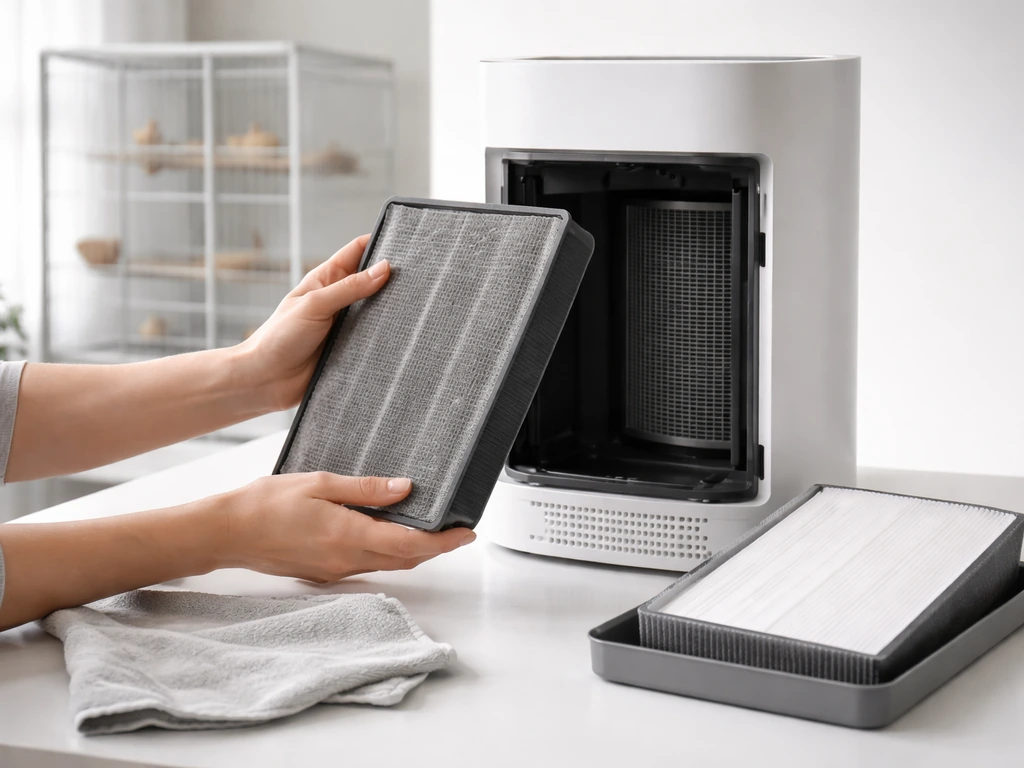
An air purifier is only as good as its filter, and bird dust destroys filters faster than most manufacturers assume. Most HEPA filter replacement schedules are written for average households with cats or dogs. In a bird room, especially with a cockatoo or grey, plan to replace your HEPA filter every 4 to 6 months instead of the typical 12-month recommendation. Pre-filters (the washable outer layer that catches larger particles) should be rinsed or vacuumed every 2 to 4 weeks. Skipping this clogs the pre-filter and makes the main HEPA work harder, shortening its life and dropping airflow.
When cleaning the unit, wipe down the exterior weekly with a lightly damp cloth. Never use aerosol sprays or chemical cleaners near the unit or anywhere in the bird room. Many cleaning products are toxic to birds, and spraying anything near an air purifier's intake can pull fumes directly through and concentrate them. For the same reason, avoid scented candles and plug-in air fresheners in any room a bird occupies.
The purifier is only one piece of the puzzle. Reducing dust at the source is what makes the whole system actually work well, and skipping this is the single biggest mistake I see bird owners make. The US EPA notes that improving indoor air works best by reducing or removing pollutant sources and ventilating with clean outdoor air, alongside using air cleaners and filters Reducing dust at the source. Even the best air purifier will be overwhelmed if you're not keeping the cage clean and managing dust output directly.
- Line the cage bottom with cage liners or paper that you swap daily or every other day to prevent dried droppings from becoming airborne dust
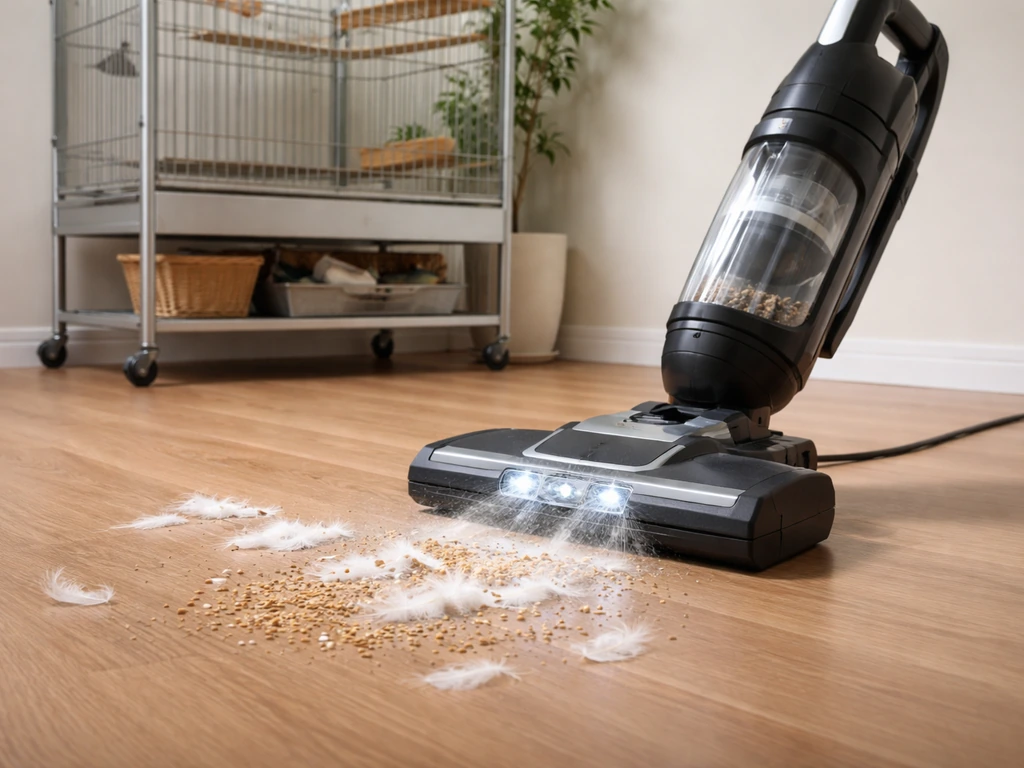
- Vacuum the area around the cage at least twice a week using a vacuum with a HEPA filter (a regular vacuum without HEPA just redistributes fine particles into the air)
- Place a mat or tray under and around the cage to contain scattered seed hulls, feathers, and dropped food before they spread across the floor
- Mist your bird lightly 2 to 3 times per week if your species tolerates it (cockatiels and greys often do), which temporarily weighs down powder dust and makes it easier for the purifier to capture
- Don't shake out perches, cage covers, or liners inside the house; take them outside or into a garage to avoid a dust cloud in the room
- Change your HVAC air filter on the same schedule as your bird room purifier, since bird dust travels through the whole house via your HVAC system
If you're setting up a full bird room environment, it's worth thinking about air quality as a system rather than a single gadget. The right air purifier handles particulates, but pairing it with a proper vacuuming routine, good cage hygiene, and possibly the right humidity level (neither too dry nor too damp) will get you results that feel genuinely different to live with. When you also control humidity, the air can feel easier to breathe, which makes many keepers look for the best humidifier for bird room setups humidity level. If you want the best vacuum for bird owners, combine HEPA filtration with a routine that targets feathers, seed husks, and droppings from day one. That interplay between equipment and habits is what separates a bird room that feels comfortable from one that feels perpetually dusty no matter what you buy. If you want the quickest path to results, see our picks for the best air filters for bird rooms based on room size and noise.
FAQ
Can I use an air purifier that has an ionizer or “odor” mode for bird dust?
Yes, if you can keep ozone completely off. Some purifiers include ionization or “air freshening” modes that still generate ozone or reactive byproducts, even at low levels. If the unit has an ionizer, turn it off via a dedicated switch, not just a setting menu, and confirm there is no ozone-generating function listed.
What if the purifier seems to create a draft near the cage?
If you cannot keep the bird away from the intake and the airflow is adjustable, avoid it. Even when the purifier is not aimed at the bird, strong intake drafts can still blow fine dust into areas your bird occupies. Use low or auto speed and keep a 3 to 6 foot buffer from the cage, with the outlet angled away from the bird.
Should I run the air purifier on high all the time to control bird dust?
For severe bird dust loads, it is often better to run the purifier continuously but not always at full speed. Start on low or auto, then bump to medium for 1 to 3 hours after heavy preening periods or when dust film becomes noticeable. If CADR is correctly sized, you should not need high speed all day.
Will an air purifier work the same if my bird room is open to the rest of the house?
Do not rely on a “room air cleaner” in open-plan living spaces. If the bird area is connected to the rest of the house, dust-laden air can spread and the purifier will be forced to clean a much larger effective volume. Best practice is a dedicated bird room, or at minimum closing doors and using a purifier positioned to pull air toward its intake near the cage.
How do I calculate the right CADR if my ceilings are higher than average?
Use the measured room height and apply the ACH formula to the CADR you are buying, not the filter size. For accurate calculations, measure ceiling height from floor to ceiling and multiply length, width, and height to get cubic footage. Then compute (CADR CFM x 60) divided by cubic footage, aiming for at least 4.
What should I troubleshoot if the dust film on surfaces comes back fast?
If you see a gray film returning quickly, the issue is usually filter capacity or dust source hygiene, not placement alone. Check three things in order: pre-filter cleaning frequency (rinsed or vacuumed every 2 to 4 weeks), HEPA replacement timing (4 to 6 months for many bird rooms), and whether the purifier is close enough (3 to 6 feet) and angled away from the bird.
Is it safe to keep the bird room door closed, and how much ventilation should I allow?
Keep the bird room ventilated, but ventilate intelligently. Instead of sealing everything shut, use partial door closure or a passive vent, and avoid adding cross-drafts that pull dust away from the purifier’s intake. If you use exhaust fans, run them at times when the purifier can maintain control on low or auto.
Does elevating the purifier change the risk of airflow hitting my bird?
It depends on your unit’s airflow direction and whether your bird can access the outlet area. If the purifier is elevated and the clean exhaust is angled toward the center of the room, most birds tolerate it well. Keep the exhaust away from perches and never place the purifier so air jets can hit the bird during flapping or bathing.
Can I put the purifier on a shelf or stand above my bird cage?
You can, but do it carefully. Place the purifier on a stable stand, not near loose papers or items it could tip onto, and avoid blocking the intake or outlet vents. Also, if the stand is too low, dust distribution may be less effective; 12 to 24 inches off the floor is a useful target mentioned for better capture during flapping.
Do I still need vacuuming if I have a high-quality HEPA air purifier?
Yes, but only if the vacuum is truly dust-aware. Choose a vacuum with strong filtration and minimize stirring debris, since bird dust and droppings particles can become airborne if you use the wrong tools or patterns. Pair vacuuming with HEPA filtration in the purifier, and avoid harsh aerosols or scented products during cleaning.
When should I stop troubleshooting and get my bird checked by a vet?
Monitor both performance and health indicators. If you notice persistent coughing, wheezing, or allergy flare-ups, do not assume a purifier alone will solve it, even with correct sizing. Consider contacting an avian vet for respiratory symptoms, and review filter schedule plus any household sources of irritants like cleaners or candles.
Next Article
Best Vacuum for Bird Owners: How to Choose Safely
Pick the best vacuum for bird owners with HEPA filtration, safe airflow, brush tips for seed and dander, plus setup and