
The safest bright magnetic bird toy for your bird is one where the magnets are fully encapsulated inside durable, bird-proof housing, sized correctly for your bird's beak strength, and placed in the cage away from food and water. Brightness and movement are genuinely useful for enrichment, but "bright" does not automatically mean safe, and magnetic components specifically carry a serious ingestion risk if the toy breaks down. Here's how to choose one confidently and use it without worrying every time your bird plays with it.
Top Bright Magnetic Bird Toy Guide for Safe Use

Marcus Chen
24 May 2026
What a bright magnetic bird toy actually is (and why birds love them)
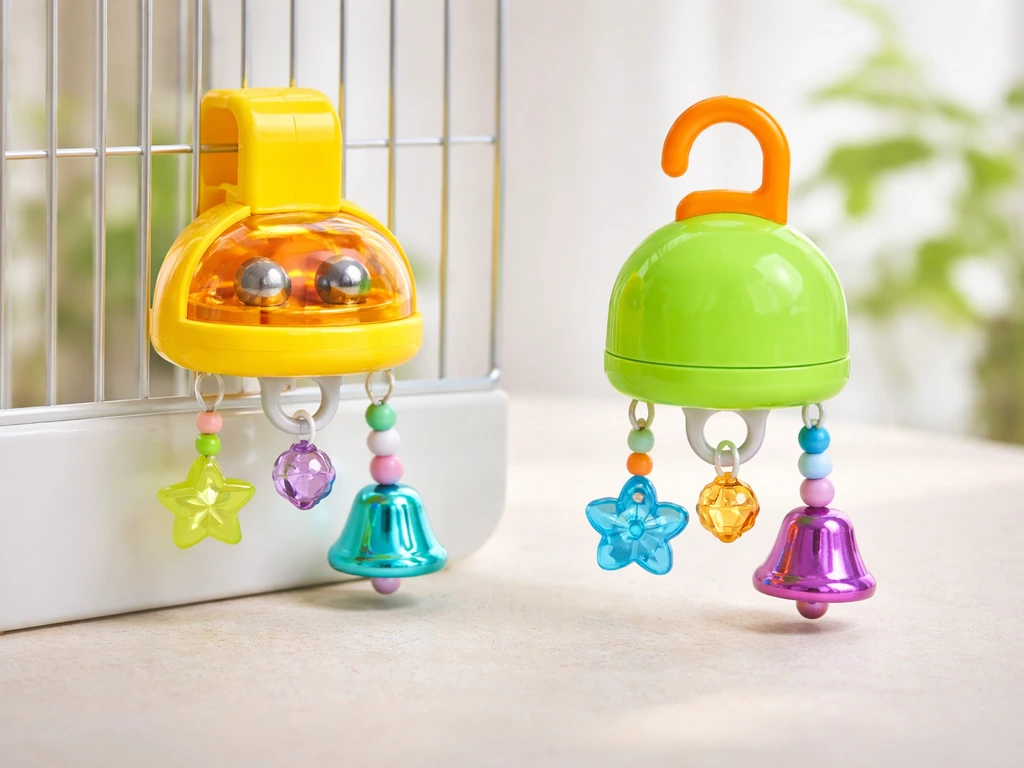
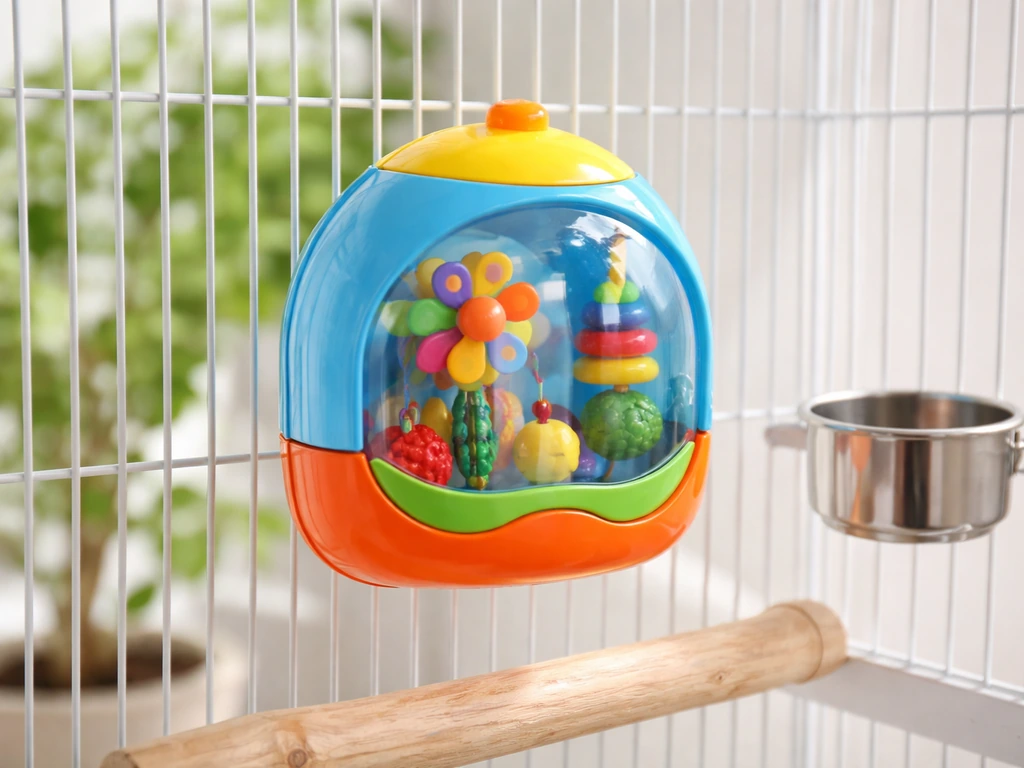
"Bright magnetic bird toy" is not a regulated product category with a strict definition. In practice, these toys typically fall into two types: cage-mounted toys where embedded magnets create motion or resistance when the bird pecks and pushes at them, and wand-style interactive toys where a magnet in the wand attracts a magnetic target piece that the bird chases or grabs. The "bright" part just means vivid colors, which isn't decoration for decoration's sake. Birds have excellent color vision, and high-contrast, saturated colors genuinely grab their attention and encourage engagement with a new object. The movement side of the equation matters just as much. When a bird touches a magnetically activated toy and it moves or snaps back, that cause-and-effect response is exactly the kind of mental stimulation that prevents boredom and destructive behavior.
That said, because this category is not formally regulated, manufacturers use the term loosely. You'll see everything from well-constructed, durable toys with deeply embedded magnets to flimsy products where the magnetic components are barely secured. The burden is on you to verify safety for your specific bird before it ever goes in the cage.
The safety checklist every magnetic toy has to pass first
Magnetic components are where these toys can get genuinely dangerous. If a bird chews through the outer casing and dislodges a magnet, ingesting even one small magnet can cause serious internal damage. Ingesting two magnets is worse, because they can attract each other through intestinal walls and cause perforations. Early symptoms are easy to miss, which means by the time you notice something is wrong, the situation may already be serious. That is not a reason to avoid magnetic toys entirely, but it absolutely is a reason to inspect them carefully before use and monitor them daily.
Under ASTM F963 (the mandatory toy safety standard in the U.S. since 2012), magnetic components in toys are supposed to be reliably contained within the toy or come with explicit warnings about ingestion hazards. That standard applies to children's toys, not bird toys specifically, since there are no equivalent quality controls or regulations for the bird toy manufacturing industry. So you cannot assume a toy passed any safety test just because it's sold as a bird toy.
Before putting any magnetic bird toy in your cage, run through this checklist physically in your hands:
- Magnet encapsulation: Press firmly on every surface of the toy. Magnets should feel completely buried in hard, non-flexible material with no give, no rattling, and no detectable seams near the magnetic area that a beak could pry open.
- Chew-resistance of the outer shell: If the casing is thin plastic, assume your bird will breach it. For small birds, ABS-style hard plastic with no obvious stress points is acceptable. For medium to large parrots, the casing needs to be genuinely thick or wrapped in bird-safe rope/wood that the bird will destroy before reaching the magnet.
- No breakable shards: Birds should not be able to crack plastic into sharp fragments. If the toy flexes or feels brittle, skip it.
- No gap hazards: Check every hinge, link, and connector. Any opening large enough to catch a toe, beak tip, or neck is a trap. Avoid open chain links entirely.
- No easily removable small parts: Tug on every bead, clasp, cap, or decorative element. If anything comes off with moderate force, it will come off in your bird's beak.
- Hardware check: Avoid snaps and carabiners with gaps. Quick-links (c-clips) that close fully are safer for attachment.
- Strings and fibers: If the toy includes rope elements, check fiber length and tightness. Loose or long fibers can tangle toes and legs.
Matching the toy to your bird's size and chewing power
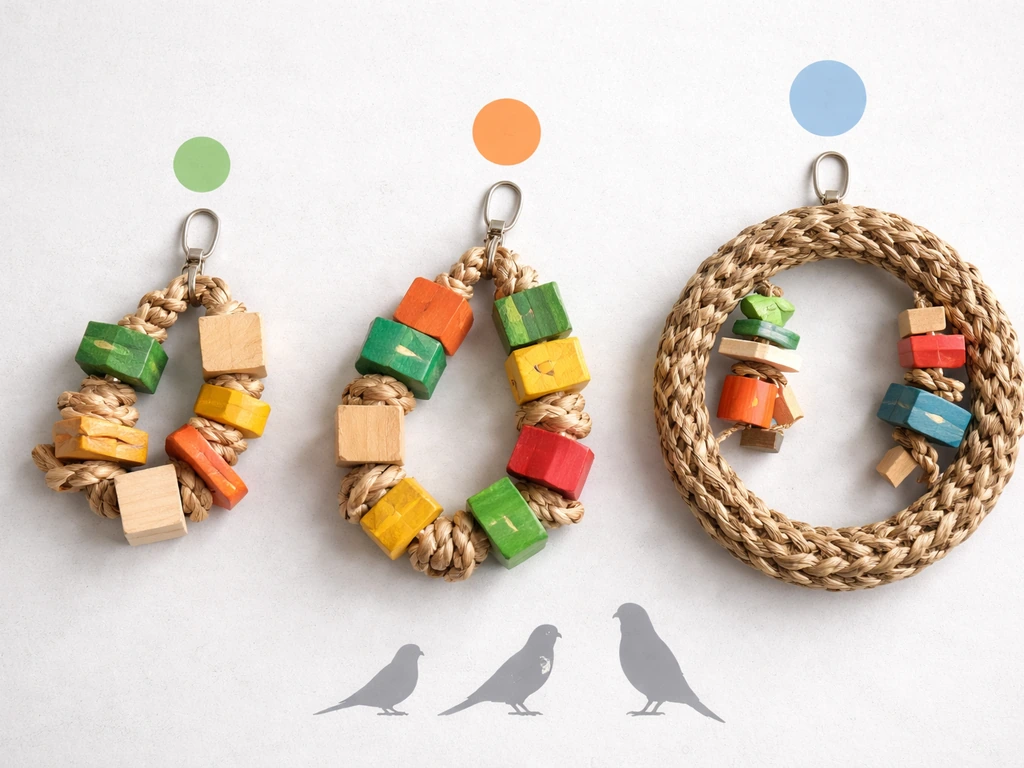
This is where a lot of first-time owners go wrong. A toy labeled "small" by one manufacturer might be sized for a cockatiel but marketed to budgie owners, or vice versa. Size and beak strength need to match both the toy's dimensions and its structural durability. A toy that's safe for a parakeet will not survive an hour with a conure, and a toy sized for a macaw is a foot-entanglement risk for a small finch.
| Bird Type | Beak Strength | Toy Size/Durability Needed | Magnet Encapsulation Priority |
|---|---|---|---|
| Finches, canaries | Very light | Small, lightweight; soft materials fine | Moderate (low destruction rate but still inspect) |
| Budgies, parrotlets | Light to moderate | Small; hard plastic or soft wood; avoid anything with gaps small beaks can pry | High (small beaks are persistent) |
| Cockatiels, lovebirds | Moderate | Small-medium; hardwood or thick plastic; magnets must be deeply embedded | High |
| Conures, caiques | Moderate to strong | Medium; very thick plastic or hardwood; expect fast destruction | Critical (rotate and inspect frequently) |
| African greys, Amazons | Strong | Medium-large; heavy-duty hardwood or metal-wrapped; lightweight plastic will be breached quickly | Critical |
| Cockatoos, macaws | Very strong | Large; stainless steel hardware; hardwood only; avoid plastic magnetic housings entirely | Avoid plastic magnetic housings entirely |
The core principle here comes from veterinary guidance that describes toys as having "planned obsolescence": your bird is going to destroy the toy, and that's fine. The question is whether the destruction is safe. Choose toys where the failure mode is shredded wood, frayed rope, or scattered beads you can see and remove, not a cracked plastic casing that exposes a small magnet. To narrow it down, look for the best flying bird cat toy for indoor cats that is built to reduce bite-and-ingestion risk while still keeping your cat engaged scattered beads you can see and remove. For larger, more powerful chewers, I'd honestly consider skipping any toy where the magnetic element is housed in plastic at all and looking for designs where the magnet is recessed inside a wooden block or thick rubber.
Where and how to hang it in the cage
Placement matters more than most people realize. The obvious rule is to keep toys away from food and water dishes. Pieces that break off can contaminate water, and a toy hanging directly above a dish creates a hygiene problem even without breakage. As a general practice, keep the toy zone and the feeding zone on separate sides or levels of the cage.
For attachment, use a blank" rel="noopener noreferrer">quick-link (a fully-closing c-clip) rather than a snap or open hook. Position the toy at a height where your bird can interact with it comfortably without stretching or straining, typically at perch level or slightly above. Avoid hanging it so close to the cage wall that the bird gets trapped between the toy and the bars while playing. If it's an interactive wand-style magnetic toy, that's a supervised-out-of-cage activity, not something you leave in the cage unattended. If you're looking for another form of enrichment, check how long should i let my cat watch bird videos so you can keep their attention in a safe, supervised range.
For the first few days with any new toy, plan to watch your bird actively. Don't just glance in from across the room. Sit close and observe how they're interacting with it, whether they're trying to pry at specific parts, whether their feet are getting near loops or openings, and how aggressively they're chewing. This initial supervision period is when you'll catch problems before they become emergencies.
How to introduce it without freaking your bird out
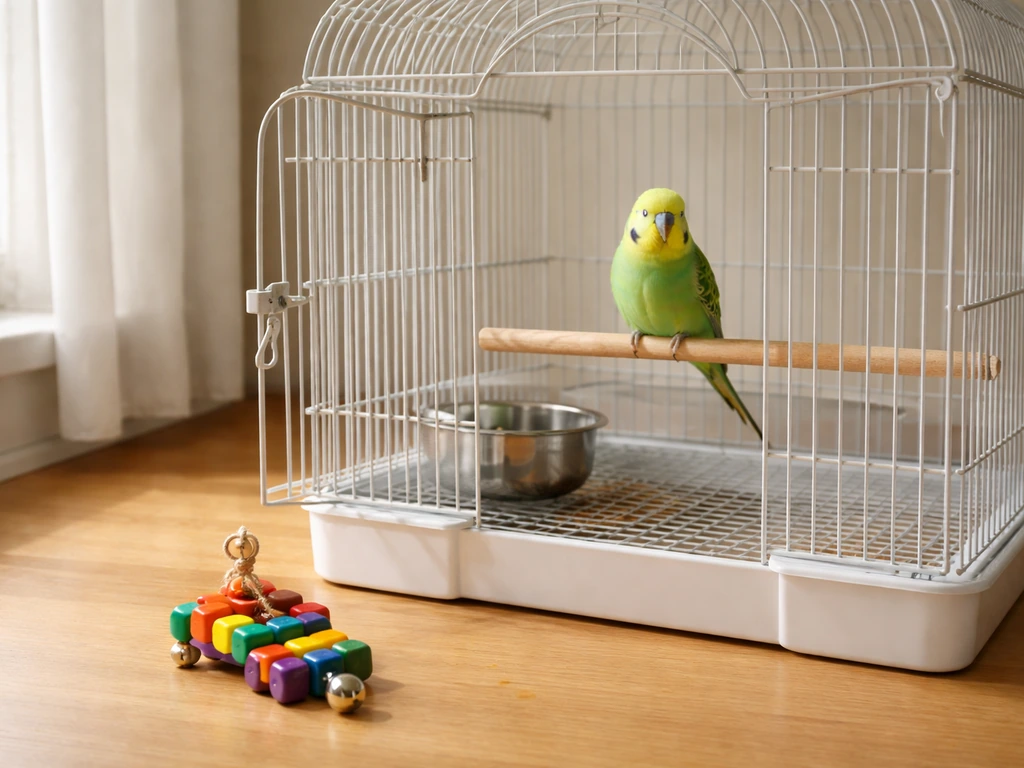
Some birds, especially those who haven't had many toys, will be genuinely scared of a new object in or near their cage. This isn't a personality flaw; it's a normal prey-animal response to novelty. If your bird backs away from the toy, fluffs up, or alarm-calls when you bring it near, don't force the introduction.
- Set the toy beside the cage (outside, not in) for two to four days. Let the bird observe it, get used to its colors and any light reflections, and realize it isn't a threat.
- Move it to hang on the outside of the cage bars for another few days. The bird can investigate through the bars without feeling cornered.
- Once the bird is clearly curious and approaching the toy voluntarily, hang it inside the cage at the far end from where the bird spends most of its time.
- Move it progressively closer to the bird's main perch area as comfort increases.
Once the toy is inside and accepted, don't leave it there permanently. Rotating toys is one of the most effective and underused enrichment strategies. A good baseline: keep six to twelve toys in total, offer three to five at a time inside the cage, and swap one or two out every few days to a week depending on how quickly your bird is destroying or ignoring them. Swapping prevents habituation, keeps things novel, and also gives you a natural inspection cycle for wear and damage.
Beginner mistakes that can turn a fun toy into a hazard
The biggest mistake I see is assuming that if a toy is sold as a bird toy, it's been vetted for safety. There are no mandatory quality controls or regulations specific to bird toy manufacturing. You are the safety check. A toy with a bright package and a parakeet photo on the label has passed exactly zero independent safety tests to get to the shelf.
- Buying by color alone: Bright is good for attracting bird interest, but brightness doesn't tell you anything about magnet encapsulation, material durability, or part security. Evaluate the construction, not the packaging.
- Wrong size for the bird: A toy with parts too small for your bird's species is a swallowing hazard. A toy too large can be a trap. Match size to your specific bird, not to a vague size category on the label.
- Skipping daily inspections: Check every toy in the cage every day. Look for cracked housing, frayed rope, missing parts, or any sign that the magnetic casing has been compromised. If you find a piece of the toy on the cage floor and can't identify what it came from, remove the toy immediately.
- Hanging toys above food and water: Debris, dust, and bacteria accumulate on toys. Keep them out of the feeding zone.
- Leaving a damaged toy in the cage: The moment a magnetic toy shows signs of cracking, breaching, or structural compromise, it comes out. Not "in a day or two" once you order a replacement. Right now.
- Treating interactive wand toys as cage toys: Magnetic wand toys are for supervised, active play sessions. They are not designed to be clipped inside a cage and left while you're at work.
- Ignoring slow habituation signs: If your bird has stopped interacting with a toy entirely, that's your signal to rotate it out. A bird staring at an ignored toy isn't benefiting from enrichment.
One more thing worth flagging: if you ever suspect your bird has ingested a magnet or a foreign piece of a toy, contact an avian vet immediately. Symptoms can be subtle early on, and waiting to see if things improve is the wrong call.
Your shopping and setup checklist for today
If you're ready to buy a bright magnetic bird toy today, here's everything in one place so you can move quickly without missing anything important. If you want the best bird toy for cats, compare durability, safety, and how easy it is to inspect for damage before each play session.
Before you buy
- Confirm the toy is sized for your specific bird species, not just a generic size bracket.
- Check that magnets are described as fully encapsulated or embedded, not surface-mounted or in snap-together housings.
- Verify no open chain links, snaps with gaps, or easily removable small parts are present.
- For medium to large parrots: confirm the outer casing is hardwood or metal, not standard plastic.
- If the listing has no material or construction details, skip it and find one that does.
When the toy arrives
- Inspect physically before anything else: press the magnetic areas firmly, tug every component, check every seam.
- Wash with warm water and bird-safe soap; rinse thoroughly and let dry completely.
- Place beside the cage for a few days before introducing it inside.
- Use a fully-closing quick-link to hang it inside the cage when ready.
- Position away from food and water dishes.
- Supervise actively for the first several play sessions.
Ongoing maintenance
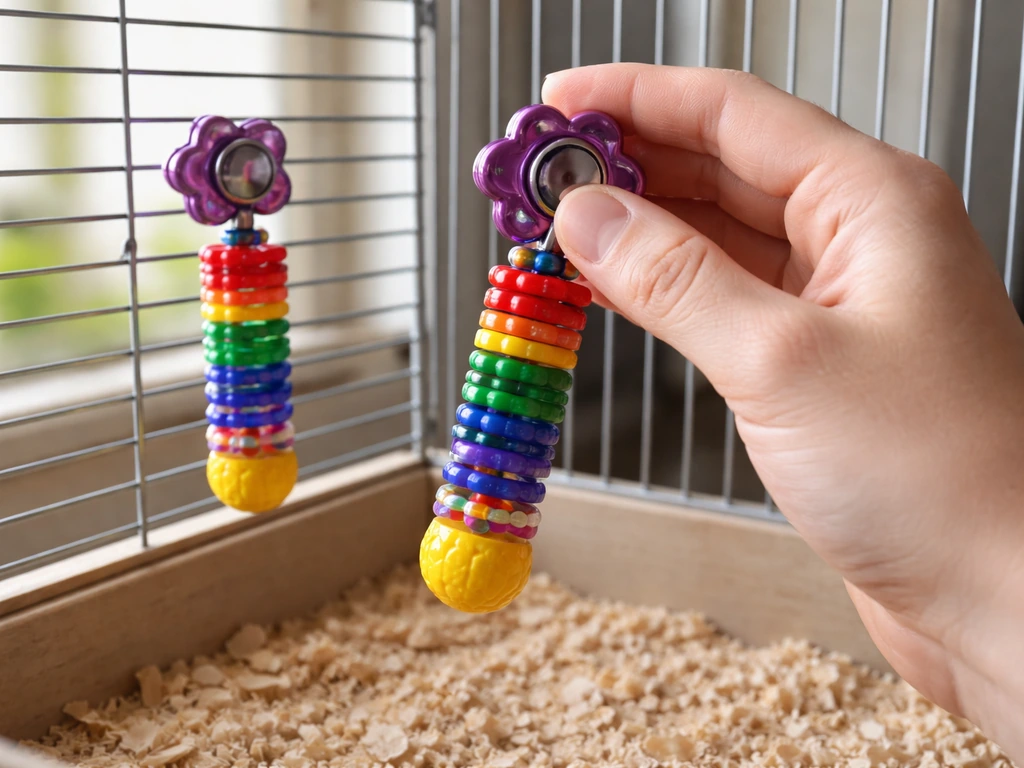
- Inspect every toy in the cage daily for cracks, fraying, missing parts, or exposed magnetic housing.
- Rotate one or two toys out every few days to a week; keep fresh options in reserve.
- Remove any toy immediately if the magnetic casing shows any sign of compromise.
- Replace toys on a planned schedule; expect and budget for destruction.
- Keep a small stock of backup toys so a same-day swap is always possible.
Done right, a bright magnetic toy is one of the better enrichment tools you can add to a bird's environment. If you want more ideas beyond toys, also compare what makes the best indoor bird setup for safety and enrichment, not just a single product better indoor bird. The movement and color combination genuinely engages birds in a way that static toys often don't. The magnetic component just requires you to be a little more deliberate about inspection than you would be with a simple wooden chew toy. Get the safety fundamentals right, rotate consistently, and you'll have a bird that's more stimulated, less destructive, and a lot more fun to watch.
FAQ
How often should I inspect a top bright magnetic bird toy for damage after it’s in use?
Check it daily during the first week, then at every toy rotation. Look specifically for micro-cracks, loosened seams, fraying around any housing openings, and any magnet movement when you gently press the casing. If the toy ever exposes hard plastic edges, a gap around the magnet, or any part that can be swallowed in one bite, remove it immediately.
What’s the safest way to clean a bright magnetic bird toy?
Use hot water and bird-safe soap only, then rinse thoroughly and dry fully before returning it. Avoid soaking for long periods, especially for wand targets with moving parts, because moisture can weaken adhesives and worsen casing failure. If a toy has been chewed into crumbs or has internal residue you cannot fully remove, replace it rather than reusing.
Can I use a bright magnetic bird toy with multiple birds in the same cage?
Only if you can prevent competitive guarding and rapid chewing by the most aggressive chewer. If one bird repeatedly steals access or chews the toy more aggressively, separate toys by cage zones or switch to non-magnetic enrichment for the dominant bird. With shared access, you also need stricter supervision during the initial acceptance period.
My bird seems to love the toy but keeps prying at one specific spot. Is that normal?
It can be normal, but repeated focus on the same seam or corner is a warning sign. Birds often target weak points, so a “favorite pry spot” can quickly become a casing failure. When you notice targeted destruction at a single location, switch the toy out sooner and inspect that area for bulging, peeling, or any magnet-adjacent wear.
What should I do if I find a magnet in the cage or suspect ingestion?
Treat it as urgent. Remove any remaining magnetic parts safely, and contact an avian veterinarian right away. Do not wait for obvious symptoms, and do not try to induce vomiting. If possible, bring the suspected toy pieces or a photo of the damage to help the vet judge the magnet type and size.
How can I tell the difference between a safe toy failure and a dangerous one?
A safer failure leaves large, visible chewable materials you can remove easily, like shredded wood or frayed rope fibers. A dangerous failure includes cracking casing that shows any hard core, any loose magnet-y piece, magnet dust or grit that doesn’t clean off, or any part small enough to swallow whole. When in doubt, replace the toy rather than trying to “patch” it.
Should I leave a cage-mounted interactive magnetic toy in all day?
Use a time-limited approach, not permanent placement. Even if it seems safe, leaving it continuously available increases wear and habituation, and you lose your chance to inspect regularly. Offer it in a scheduled window with supervision, then rotate it out so you catch damage while it’s still early.
Is a wand-style top bright magnetic bird toy safe in the cage?
Typically no. Wand-style magnetic setups are meant for controlled, out-of-cage or tightly supervised sessions because the target pieces can fall, roll, or be grabbed and carried in ways you cannot monitor. If any wand target can be left loose in the cage environment, switch to a fully encapsulated cage toy instead.
What size mistakes happen most often with magnetic toys, and how do I avoid them?
Common mistakes include choosing a “small” toy that still contains components too tough for a smaller beak, or choosing a toy that’s physically too large so the bird tries to wedge it and increases breakage. Avoid it by matching the toy’s dimensions to your bird’s typical bite size and ensuring the casing is thick enough that the bird cannot reach any internal components in one or two aggressive bites.
Next Articles
Best Indoor Bird for Beginners: Choose Your Match Fast
Find the best indoor bird for beginners with species picks, noise, diet, setup, daily care, and a quick decision checkli
Best Bird Toy for Cats: Safe Choices for Bird Owners
Pick the best bird toy for cats safely: bird-safe materials, size checks, supervision tips, and avoid choking risks.
How Long Should I Let My Cat Watch Bird Videos?
Learn safe bird-video session times for cats, what to watch for, when to stop, and how to prevent predatory stress.