The most important lovebird care tips boil down to this: get the right bird for your lifestyle (probably a peach-faced, probably hand-raised), house it in a cage that's actually big enough, feed it a varied diet beyond just seeds, and spend real time with it every single day. Do those four things consistently and you'll avoid 90% of the problems beginners run into. Everything below tells you exactly how to do each one.
Love Bird Care Tips: Beginner Guide for Healthy, Happy Lovebirds
Marcus Chen
14 Jun 2026
Choosing the right lovebird and pairing basics
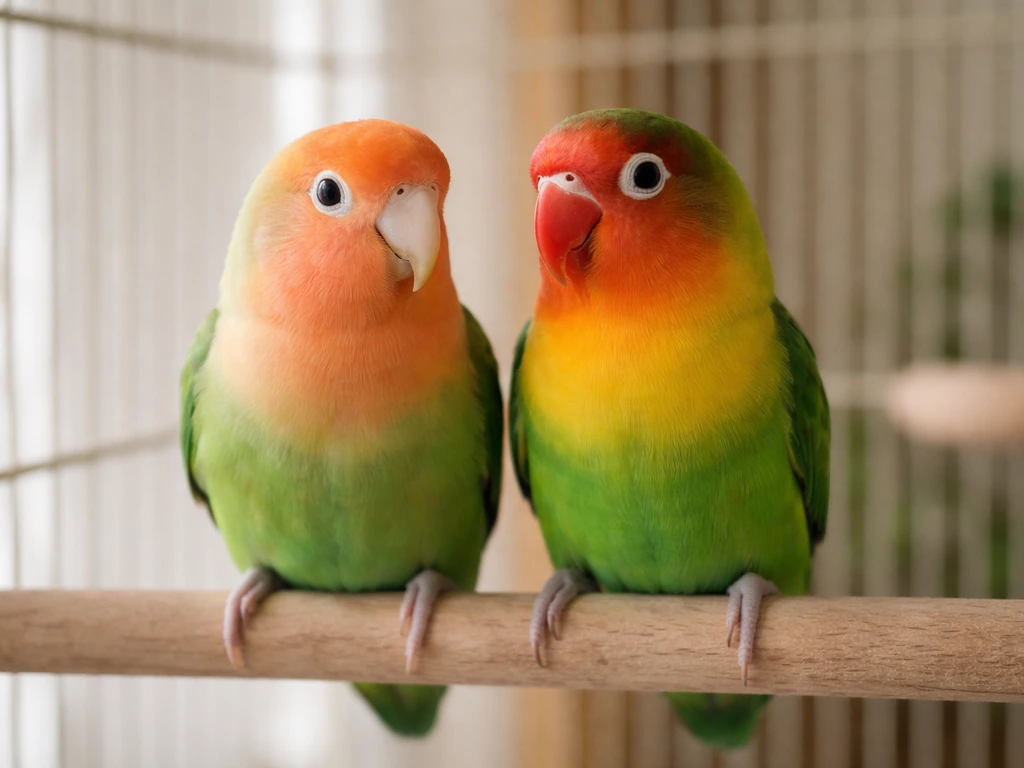
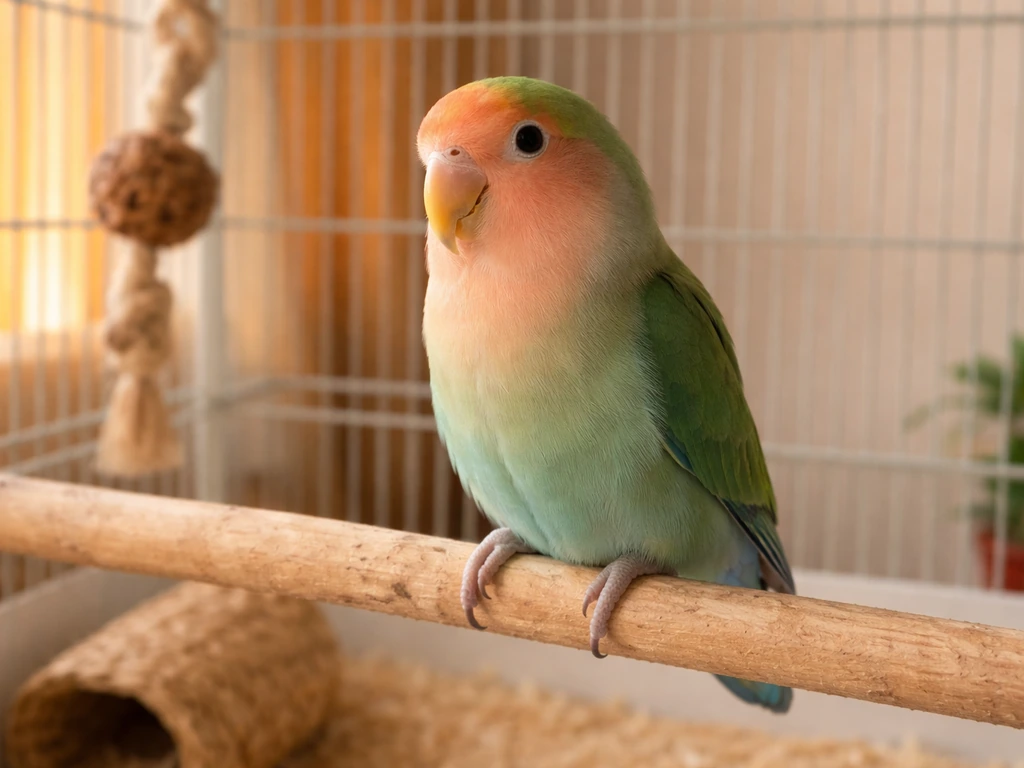
blank" rel="noopener noreferrer">There are nine lovebird species in the genus Agapornis, but realistically you'll encounter three at most pet shops and breeders: the peach-faced lovebird (Agapornis roseicollis), the masked lovebird (Agapornis personata), and Fischer's lovebird (Agapornis fischeri). For a first-time owner, the peach-faced is the one I'd point you toward every time. blank" rel="noopener noreferrer">They're the most common in the pet trade, generally the hardiest, and usually the least expensive, especially if you go with a normal green bird rather than a color mutation. The fancy lutino and cinnamon morphs are pretty, but those are sex-linked recessive mutations, which means sexing them visually is unreliable and breeders sometimes charge a premium for the uncertainty.
If you're considering Fischer's lovebirds, know going in that breeders consistently describe them as more aggressive than peach-faced birds. That doesn't make them bad pets, but it does matter if you're new to bird handling or you're thinking about housing multiple birds together. Masked lovebirds fall somewhere in the middle temperament-wise. Whichever species you choose, always buy from a breeder or rescue where the bird has been hand-raised and socialized with humans. A bird that grew up being handled is a completely different experience from one that wasn't.
The biggest question beginners wrestle with is whether to get one lovebird or two. The honest answer: if you have several hours a day to interact with a single bird, one is fine and will often bond more deeply with you. If your schedule is unpredictable, get a pair. But understand that a bonded pair will prioritize each other over you, which is natural and not a problem, it just changes what kind of pet relationship you're building. Never house two males together if you're unsure of sex; they often fight seriously. Two females can also be territorial. A male-female pair is the most stable combination, though it does risk eggs if you're not prepared for that.
Essential supplies and what to buy first
Before your bird comes home, have everything set up and ready. Running out to buy a water dish after the bird arrives is stressful for both of you. Here's what actually matters on day one versus what can wait.
- Cage: At minimum 24 inches wide by 24 inches deep by 24 inches tall for a single bird, bigger for a pair. Bar spacing must be no wider than 5/8 inch to prevent head entrapment.
- Perches: Get at least three different textures and diameters — natural wood branches, a rope perch, and one calcium/mineral perch. Avoid the sandpaper-covered ones; they damage feet.
- Food dishes: At minimum two stainless steel or ceramic crocks, one for pellets/seed mix and one for fresh foods. A third for water is ideal.
- Water bottle or dish: A sipper bottle keeps water cleaner, but some birds take time to learn it. A heavy ceramic dish works fine and is easier to clean thoroughly.
- High-quality pellet food: Brands like Harrison's Bird Foods or Zupreem Natural are solid starting points. Pellets should make up roughly 60–70% of the diet.
- Fresh food staples: Leafy greens, carrots, bell peppers, and cooked grains are safe everyday options. Have these ready before your bird arrives.
- A few safe toys: Rotate toys to prevent boredom. Start simple: a foraging toy, a chew toy made from bird-safe wood, and a hanging shredder.
- A travel/carrier cage: You need this for vet visits on day one, not eventually.
One thing I'd skip on day one: anything with mirrors. Lovebirds can become obsessed with their reflection and it interferes with bonding to you, especially in the first few weeks. Also skip any fabric-based 'snuggle huts' or tents for now, they can trigger hormonal behavior and are a chewing hazard. A plain hide box or half-open nest box is safer if your bird needs a retreat spot.
Cage setup, placement, and air quality
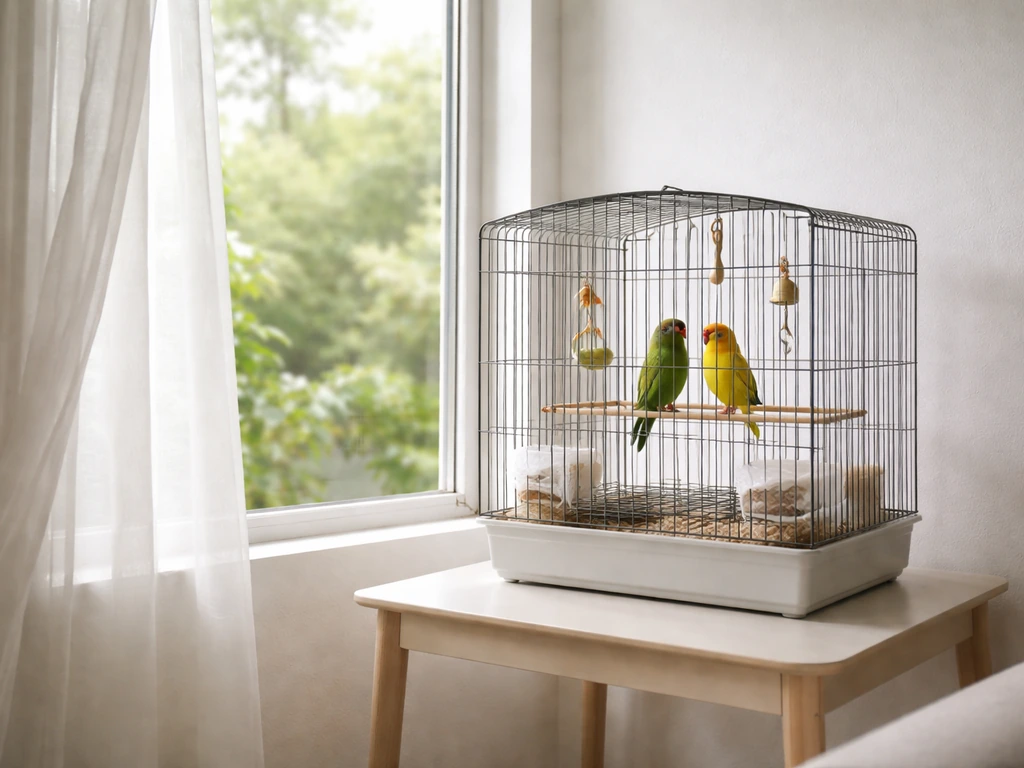
Where you put the cage matters almost as much as what's in it. Lovebirds are social and need to feel like part of household activity, so a corner of the living room or a busy common area works well. Avoid the kitchen entirely, cooking fumes, especially from non-stick (PTFE/Teflon) cookware at high heat, can kill a bird within minutes. This is not an exaggeration. Even if your kitchen is a room away, keep the bird out of that airspace if you're regularly using non-stick pans.
Air quality in general is something most beginners underestimate. Scented candles, air fresheners, plug-in diffusers, and aerosol sprays are all potential hazards. A bird's respiratory system is far more sensitive than a dog's or cat's. If you want to improve air quality around the cage, a HEPA air purifier nearby is genuinely useful, it handles dust from feathers and dander, which can build up fast.
Temperature should stay between 65 and 80 degrees Fahrenheit. Avoid placing the cage near windows where direct afternoon sun can overheat the bird with no escape route, near air conditioning vents that create cold drafts, or near exterior doors that open frequently in winter. A cover for the cage at night is useful, it signals bedtime and keeps the temperature stable. Lovebirds do best with 10 to 12 hours of darkness per night.
Escape prevention is another thing to think through before the bird arrives. Check that the cage latch is secure, lovebirds are clever and will figure out simple latches. During out-of-cage time, ceiling fans must be off, windows and exterior doors closed, and toilets lidded. Other pets, particularly cats, need to be completely separated. Even a single swipe from a cat claw carries bacteria that can cause fatal infection in birds.
Your daily care routine
A consistent daily routine keeps your lovebird healthy and makes problems easy to spot early. This doesn't have to be complicated, but it does have to be daily.
Morning (10–15 minutes)
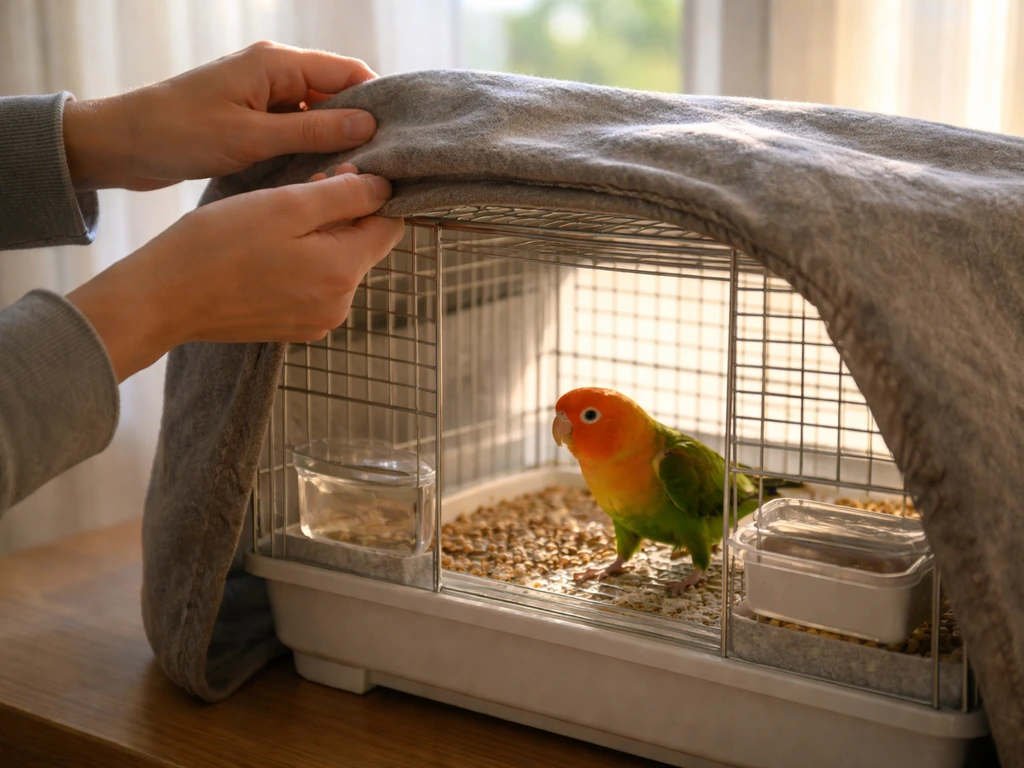
- Remove the cage cover and greet your bird. This matters — birds that are ignored in the morning become anxious and loud.
- Discard any uneaten fresh food from the previous evening before it spoils.
- Refill water completely. Don't just top it off; dump and refill with fresh water every morning.
- Add fresh food: a small piece of leafy green, a slice of bell pepper, some cooked grain, or whatever you're rotating that day.
- Do a quick visual health check while you interact (see below).
Evening (10–20 minutes)
- Spot-clean the cage tray: remove droppings and soiled paper. Line the tray with plain newsprint or cage liner paper — avoid scented or printed papers with heavy ink.
- Remove any remaining fresh food before it sits overnight.
- Check that pellets or seed mix are available for the night.
- Spend out-of-cage time here if mornings are rushed — lovebirds need at least 1 to 2 hours outside the cage per day.
- Cover the cage at the same time each evening to establish a sleep rhythm.
Weekly and monthly tasks
- Full cage scrub weekly: wash all bars, perches, and dishes with hot water and bird-safe disinfectant (diluted white vinegar works well, just rinse thoroughly).
- Rotate toys every 1 to 2 weeks so the bird stays stimulated.
- Trim nails as needed — usually every 4 to 6 weeks, depending on perch variety.
- Schedule an avian vet checkup at least once a year, twice if your bird is older or shows any health changes.
Daily health checks
You don't need to handle the bird to do a health check, just watch it for a minute or two. A healthy lovebird is alert, active, vocal, and holds its feathers sleek against its body (not puffed up). Droppings should be relatively firm with a white urate portion. Runny droppings, puffed feathers at room temperature, tail bobbing with each breath, discharge from the nostrils, or a bird sitting on the cage floor are all signs to call an avian vet the same day, not wait and see.
Enrichment, exercise, and bonding
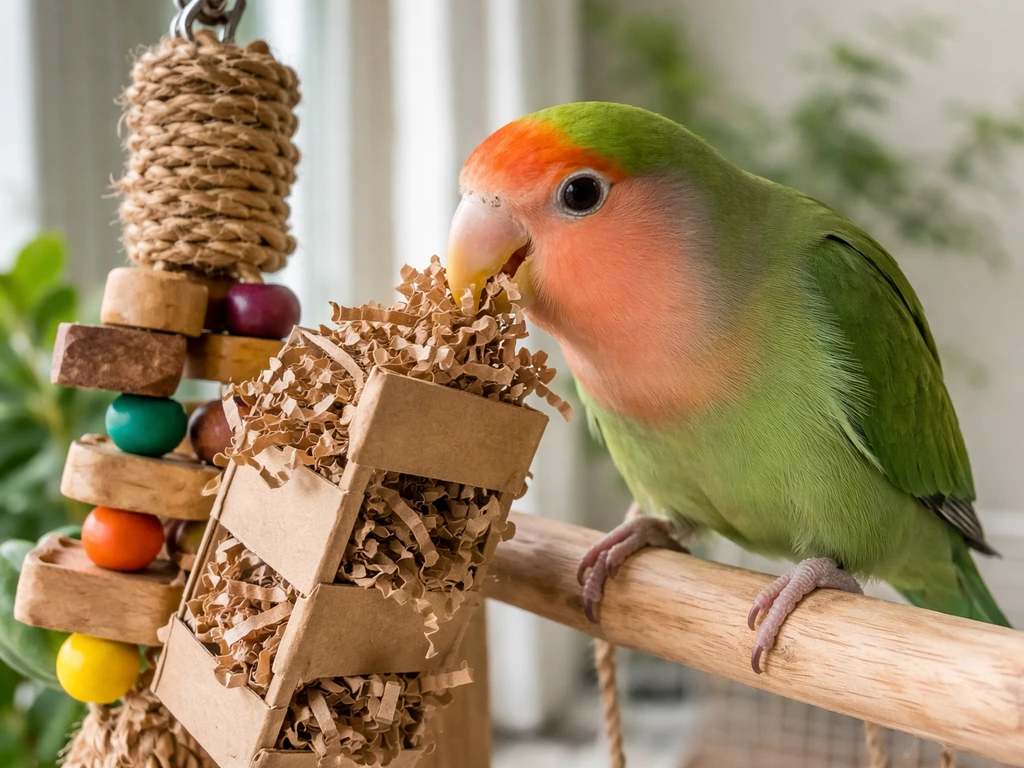
Lovebirds are smart, active, and easily bored. A bored lovebird screams, feather-picks, or becomes nippy, none of which is a personality flaw, all of which is a care signal. The solution is foraging and chewing opportunities inside the cage plus regular out-of-cage interaction with you.
Foraging toys are the single best enrichment investment you can make. These are toys that require the bird to work for food, hiding pellets inside a rolled paper cup, weaving treats into a foot toy, or using a commercial foraging wheel. Wild lovebirds spend most of their day searching for food, and your pet has the same drive. Giving them an outlet for it dramatically reduces problem behaviors.
Chewing is equally important. Lovebirds' beaks grow continuously and they need to chew to keep them in condition. Bird-safe wood toys (like balsa, pine, or willow), corn husk items, and woven palm toys are all good options. Rotate these so there's always something 'new' to destroy. The shredding and dismantling process is genuinely satisfying for them.
For bonding, especially with a newly acquired bird, let the bird set the pace. Sit near the cage and talk to it, let it observe you, and offer treats by hand through the cage bars before you attempt to handle it. For hand-raised birds this process is fast, sometimes a few days. For a bird with less socialization experience it might take weeks. Never force handling. Trust built slowly is much more durable than trust forced quickly.
Bathing is also enrichment. Most lovebirds love a shallow dish of lukewarm water to splash in, or a gentle misting from a spray bottle. Offer a bath 2 to 3 times per week. It keeps feathers healthy and most birds find it genuinely enjoyable. Do this earlier in the day so they can dry before the cooler evening temperatures.
Common beginner mistakes and how to fix them
Most of the problems beginners run into with lovebirds aren't mysterious, they're predictable and fixable. Knowing what to watch for saves a lot of stress. If you want to avoid the 12 common mistakes that bird owners make, start by learning these warning signs early Knowing what to watch for saves a lot of stress..
| Mistake | Why it happens | What to do instead |
|---|---|---|
| Feeding mostly seeds | Seeds are cheap and birds love them, so it feels like a win | Transition to 60–70% pellets; use seeds as training treats rather than staple food |
| Cage is too small | Pet store cages are often undersized for the price point | Minimum 24x24x24 inches for one bird; bigger is always better |
| No avian vet lined up | Owners assume any vet can treat birds | Find a certified avian vet before you need one urgently |
| Toxic fumes from cooking or cleaning | Bird owners don't realize how sensitive avian respiratory systems are | No non-stick cookware at high heat; no aerosols or scented plugins near the bird |
| Skipping out-of-cage time | Busy schedule, or the bird seems content in the cage | Minimum 1–2 hours of supervised out-of-cage time daily; set a schedule |
| Getting a single bird and ignoring it | Thought lovebirds were low-maintenance compared to other birds | Single lovebirds need daily active interaction; if your schedule can't allow it, get a pair |
| Using fabric snuggle huts or tents | They look cozy and seem like enrichment | Remove them; they cause hormonal behavior and are a chewing/entanglement hazard |
One mistake that's worth calling out specifically: assuming a lovebird is 'mean' because it bites. Biting is almost always communication, the bird is overstimulated, scared, or telling you it's done being handled. Read the body language (pinned eyes, fanned tail, crouching posture) and give the bird space before it escalates. Most lovebirds that get labeled as aggressive are just birds whose signals were repeatedly ignored.
If you want to go deeper on general bird-keeping habits and where lovebird care fits into broader routines, the same principles around environment, enrichment, and common owner mistakes apply across most small parrot species. If you want a complete guide to learn bird care, follow the steps in this routine and keep a close eye on your lovebird’s health and behavior. If you are also dealing with bird taxidermy for beginners, make sure you understand the legal, hygienic, and safety considerations before you start any project bird-keeping habits. Building good habits early makes everything easier as your bird settles in and as you take on more of its care with confidence.
FAQ
How much daily time do lovebirds really need for good bonding, especially if I work full-time?
For a single lovebird, plan on at least 2 to 3 focused interaction blocks daily (talking, gentle hand-feeding, training, or supervised play), because “daily time” should include consistent bonding moments, not just being in the same room. If you cannot reliably meet that, a pair is usually easier than getting a single and leaving it unattended for long stretches.
What should I set up first in the cage when my lovebird comes home, and what can wait?
A common mistake is adding toys and accessories immediately and then wondering why the bird becomes stressed or hormoney. On week one, keep it simple: water, food, a retreat hide box, and a couple of shredding options. Introduce foraging toys and new chew items gradually (one change at a time every few days) so the bird can adapt without obsessing or escalating.
If I choose a male-female pair, how do I prepare for breeding and egg issues safely?
If you use a pair, “preparing for eggs” means having a plan before breeding behavior starts: a nest box you can remove promptly if you do not want breeding, correct diet (avoid unnecessary high-fat treats), and an avian vet you can contact for egg-related emergencies. Also note that two females may still show nesting behavior, even if they are less reliably “egg-ready.”
Will a bonded pair ignore me, and is handling still possible?
No, a bonded pair can still be handled occasionally, but you should expect priorities to shift toward each other. Schedule training and health checks when you can minimize interruptions, use short sessions, and reward calm behavior. If the pair repeatedly regroups and you keep forcing time with one bird, bites and stress can increase.
What symptoms mean “same day vet,” and when is it okay to monitor at home for a day?
Runny droppings, tail bobbing, puffed feathers at normal room temperature, and nostril discharge are all “call the same day” signs because lovebirds can deteriorate quickly. If symptoms are mild but persistent (for example, reduced appetite for 24 hours or quiet, fluffed behavior that does not settle after warming), contact an avian vet rather than waiting a few days.
Can I feed a pellet-based diet instead of seeds, and how should I transition a lovebird safely?
Not all pellet diets are equal. Choose a formulated pellet intended for small parrots, introduce pellets gradually by mixing with familiar food, and avoid sudden diet switches. Also keep an eye on urine and droppings consistency, since some birds adjust their hydration and droppings within the first week of switching.
My lovebird is preening a lot, how do I tell boredom or normal grooming from a health issue?
Feather health improves with consistent bathing, good air quality, and appropriate chew and foraging time, but mites and fungal or bacterial issues can look similar. If you see heavy scratching, broken pin feathers, crusty skin, or ongoing puffiness, treat it as a health problem, not just boredom, and get an avian vet check.
What should I do if my lovebird bites during bonding, and how can I prevent it from escalating?
If your lovebird becomes nippy or bites during handling, stop the session immediately and return to calm, non-contact bonding (talking near the cage, hand treats through the bars). Reattempt only after you see relaxed posture and steady eye pinning, and avoid handling when the bird is overstimulated by sudden changes, loud noises, or new toys.
How often should I bathe my lovebird, and is there a best time of day or temperature to consider?
Yes, but timing matters. Offer bath time earlier in the day so the bird can dry before cooler temperatures, and avoid bathing right after a stressful event (moving cages, visiting, or loud disruptions). If your home is drafty or cool at night, keep baths in the morning or early afternoon to reduce chilling risk.
I use scented products at home sometimes, how close can I keep my lovebird to candles, diffusers, or non-stick cooking?
A good first step is to review the “airspace” where the cage sits. If you regularly cook with non-stick cookware on high heat, the safest move is to keep the bird completely out of that room during cooking, not just near the cage. For aerosols and fragrances, assume the bird is affected even if you do not see immediate symptoms, and pause those products around the cage.
Do I need to cover the cage at night, and can a cover ever make things worse?
A cover helps with bedtime, but make sure it does not block ventilation or create overheating. Use a breathable cover that fits well and remove it for daytime airflow, and keep the cage away from direct afternoon sun so you do not create heat spikes when the bird is trying to rest.
What are the most important safety checks for out-of-cage time that beginners forget?
For out-of-cage time, prioritize a “no-risk routine”: ceiling fans off, windows closed, doors closed, and keep other pets fully separated. If you cannot guarantee that, use a secure play stand with barriers. Also remember that toilets and open water are hazards, not just escape routes, because bacteria exposure can be serious for birds.
Next Articles
12 Common Mistakes Bird Owners Make and How to Fix Them
Fix 12 everyday bird-owner mistakes fast with signs to watch and step-by-step changes for health, behavior, and happines
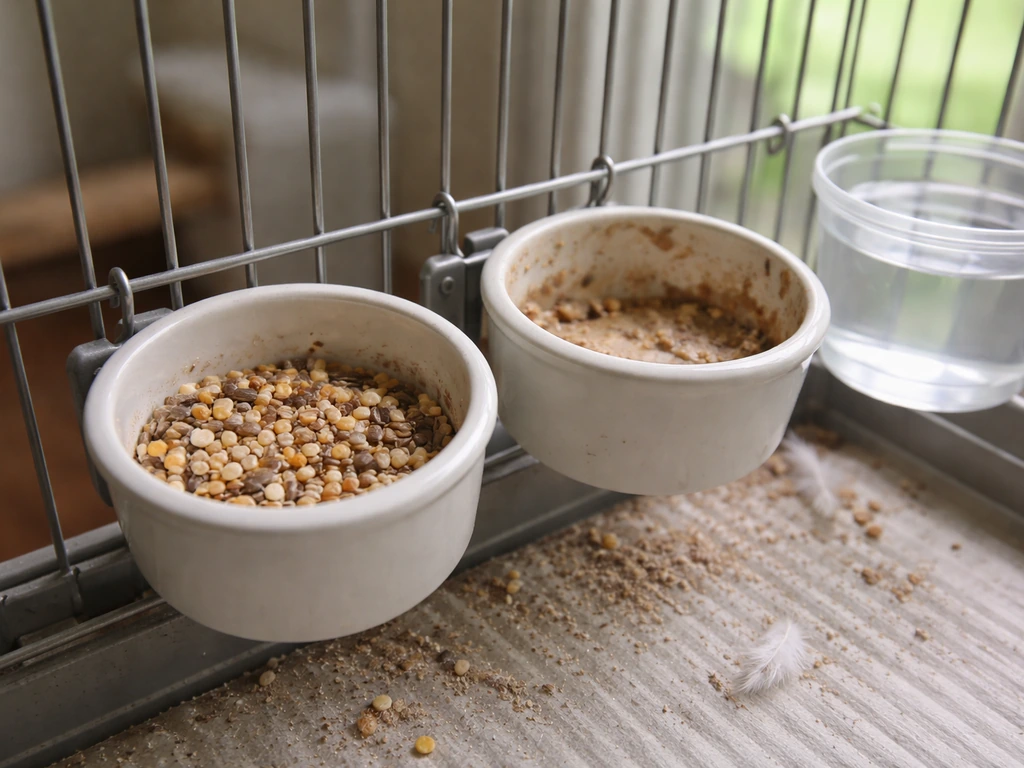
Bird Table Problems: Troubleshooting and Fixes for Pet Birds
Troubleshoot bird table problems fast: feeding setup, hygiene, pests, mold, pickiness, crowding, placement, and vet red
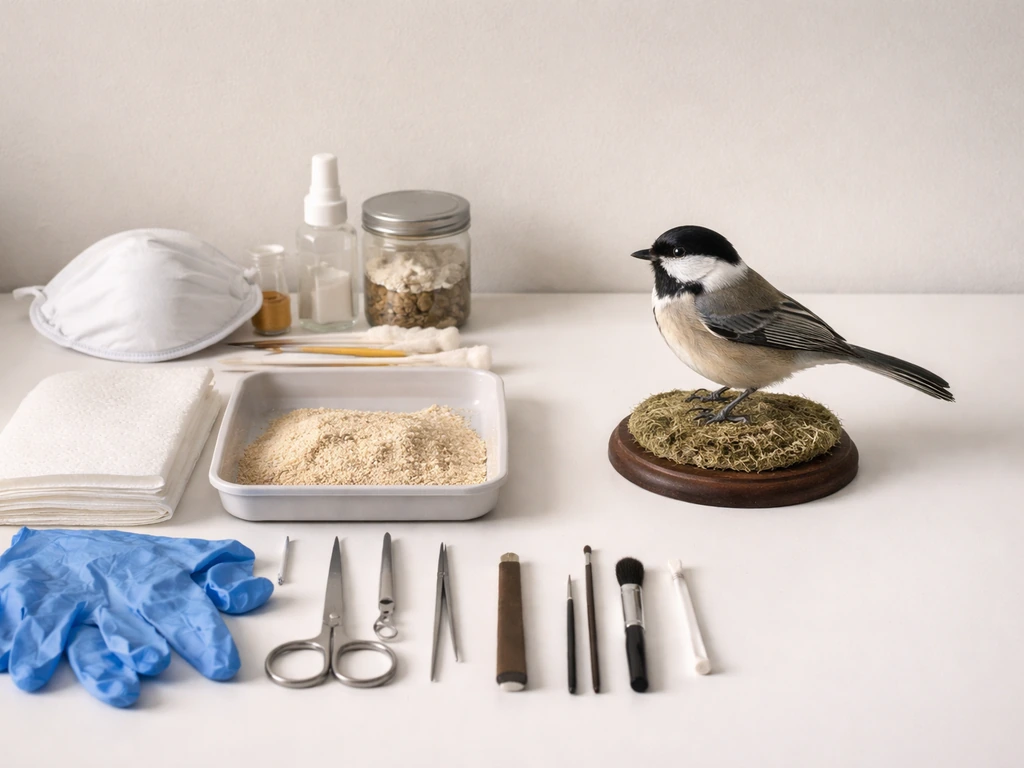
Bird Taxidermy for Beginners: A Legal, Safe Starter Guide
Legal and safe beginner bird taxidermy guide: tools, handling steps, drying basics, storage, and common mistakes