Most bird toys are not safe for rabbits, and some are genuinely dangerous. If you are wondering about playing bird sounds for your budgie, it helps to choose safe setups and avoid stressing your bird with sudden or prolonged noise changes Most bird toys are not safe. The materials, construction, and small parts that work fine for a parakeet or cockatiel can seriously injure or even kill a rabbit. That said, a small number of bird toys, mainly simple untreated wood blocks or wicker balls with no strings, coatings, or metal fittings, can be appropriate if you inspect them carefully first. The key is knowing exactly what to look for before your rabbit ever gets near the toy.
Are Bird Toys Safe for Rabbits? Vet-Style Safety Checklist

Marcus Chen
4 Jun 2026
Why bird toys are risky for rabbits in the first place
Birds interact with toys very differently than rabbits do. A parrot uses its beak to crack, pry, and manipulate, and it usually doesn't swallow large chunks of material. A rabbit chews constantly and aggressively, grinds things down with its back molars, and will ingest surprisingly large pieces of whatever it's working on. Bird toys are designed to withstand a bird's beak style, not a rabbit's sustained grinding and shredding. That mismatch is the core problem.
Rabbits also have a digestive system that's remarkably easy to derail. Unlike dogs or cats that can vomit up something they shouldn't have eaten, rabbits can't vomit at all. Once something is swallowed, it has to move through the GI tract. If it doesn't, you get GI stasis, a condition where the intestines slow or stop moving, gas builds up, and the rabbit experiences serious pain and can deteriorate fast. Even materials that are technically "safe" can trigger stasis if ingested in large enough quantities. This is not a wait-and-see situation.
The real chewing and ingestion hazards in most bird toys
Before handing any bird toy to a rabbit, you need to understand what's actually in it. Bird toy manufacturers aren't thinking about rabbit safety when they source materials, and the hazard list is longer than most people expect.
Plastic
Hard plastic is generally safer than soft plastic, but soft plastic, vinyl, and latex are serious risks because a rabbit can bite them into chunks that are easy to swallow and hard to digest. Brittle plastic is equally bad because it snaps into sharp fragments. There's also a subtler concern: some older or lower-quality plastics use lead-based pigments in their coloring. You won't see a label that says "lead paint," so if a bird toy has colored plastic parts and you can't verify the manufacturer's safety standards, skip it.
Wood
Untreated wood is generally one of the safer materials for rabbits, and this is where some bird toys actually overlap with rabbit-safe options. The problem is the qualifiers. "Untreated" means no stains, varnishes, preservatives, or chemical dips. Woods with aromatic oils, like cedar and pine, can be unsafe unless they're kiln-dried first.
Petco notes that pine branches are generally considered safe when they are Eastern white pine, and it says pine should ideally be kiln-dried before being offered Eastern white pine and kiln-dried pine.
Kiln-drying burns off the volatile oils that cause the problem. So a raw cedar block from a bird toy is riskier than a kiln-dried pine block sold specifically for small animal use. And any wood from an unknown source, like branches a manufacturer picked up without disclosure, is a no-go.
Strings, cords, and rope
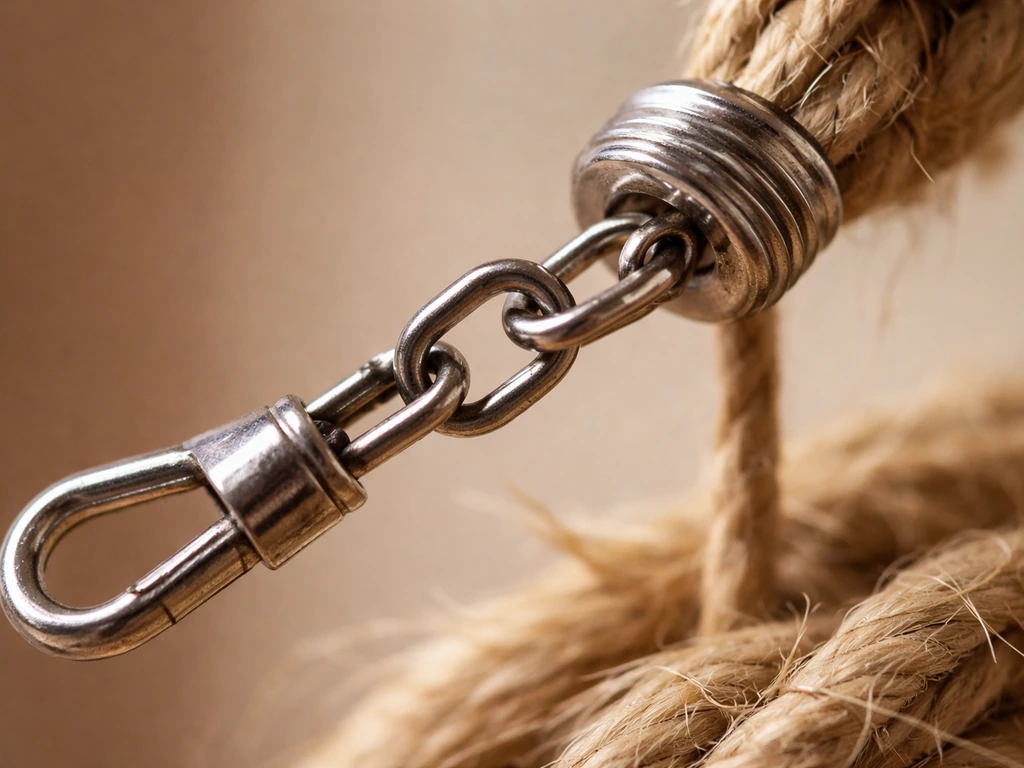
This is the biggest red flag in most bird toys. Rope perches, hanging toys, and knotted cord toys are extremely common in the bird world, and they are genuinely dangerous for rabbits. A rabbit will chew through rope and swallow fiber strands, which can clump in the GI tract and cause an obstruction. Fabric that unravels presents the same problem. Even natural fiber ropes like sisal or cotton aren't safe if a rabbit is actively chewing them apart, because the ingested length adds up fast.
Metal parts
Most bird toys are hung or assembled with metal hardware: chains, clips, wire, screws, or staples. If you are wondering about safety in a different context, people also ask why a bird can stand on an electric wire without being electrocuted. These are hazards for rabbits on multiple levels. Sharp edges can injure the mouth and gums. If a metal piece breaks loose and gets swallowed, it can cause a physical obstruction. And metal that rusts or that contains zinc or lead introduces toxicity risk. Quick-links, wing nuts, and the small metal bells common in bird toys all fall into the "remove before offering" category at minimum.
Paints, dyes, and coatings
Peeling paint is an obvious hazard, but even paint that isn't visibly peeling gets chewed off by rabbits. Unless a toy is explicitly labeled as using food-safe or pet-safe dyes with no toxic pigments, you're guessing. Heavy glue is another issue. Many bird toys are assembled with adhesives that aren't meant to be ingested, and a rabbit will absolutely chew at the glued joints.
Feature-by-feature red flags to check before you even hand it over
| Feature | Risk for Rabbits | Verdict |
|---|---|---|
| Rope or knotted cord | Fiber ingestion, GI obstruction | Avoid entirely |
| Soft plastic or vinyl | Bites into swallowable chunks | Avoid entirely |
| Brittle plastic | Snaps into sharp fragments | Avoid entirely |
| Latex or rubber | Chunks cause GI blockage | Avoid entirely |
| Foam or fabric that unravels | Ingested strands cause obstruction | Avoid entirely |
| Metal chains, clips, or bells | Sharp edges, swallowing risk, toxicity | Remove before use or skip |
| Staples | Oral injury, internal puncture if swallowed | Avoid entirely |
| Painted or dyed surfaces (unknown source) | Lead pigments, toxic adhesives | Skip unless verified safe |
| Peeling or chipped coating | Ingestion of paint/adhesive | Discard immediately |
| Small detachable pieces | Choking, obstruction | Only allow if piece is too large to swallow |
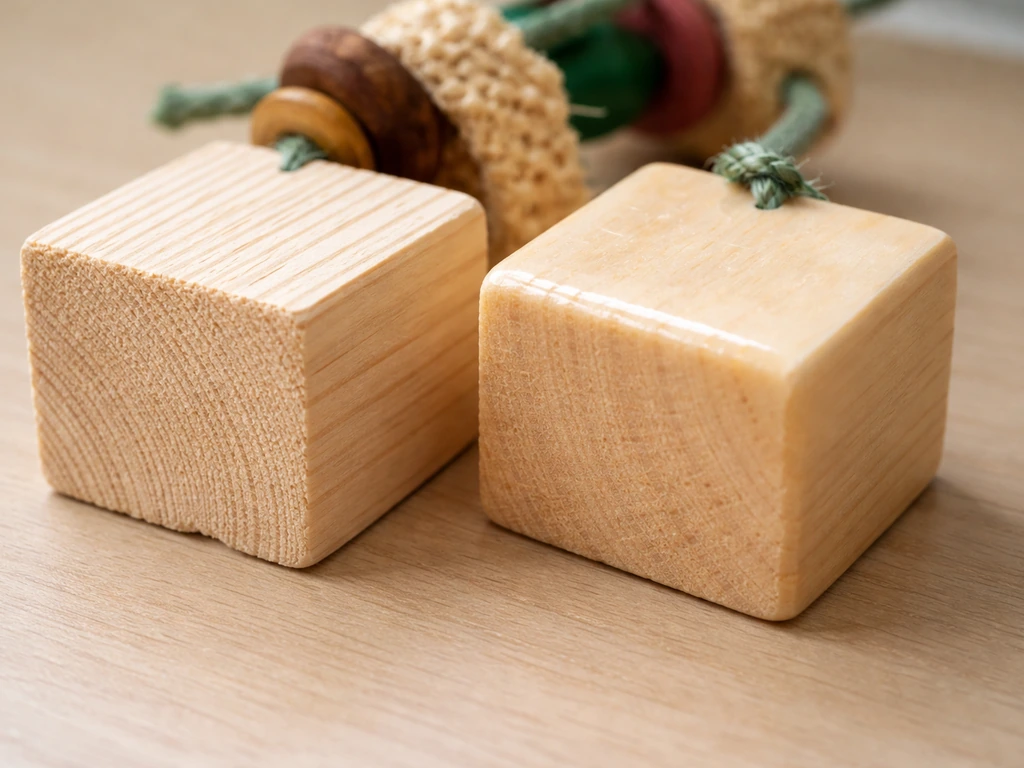
| Untreated kiln-dried wood blocks | Minimal if wood species is safe | Generally OK with inspection |
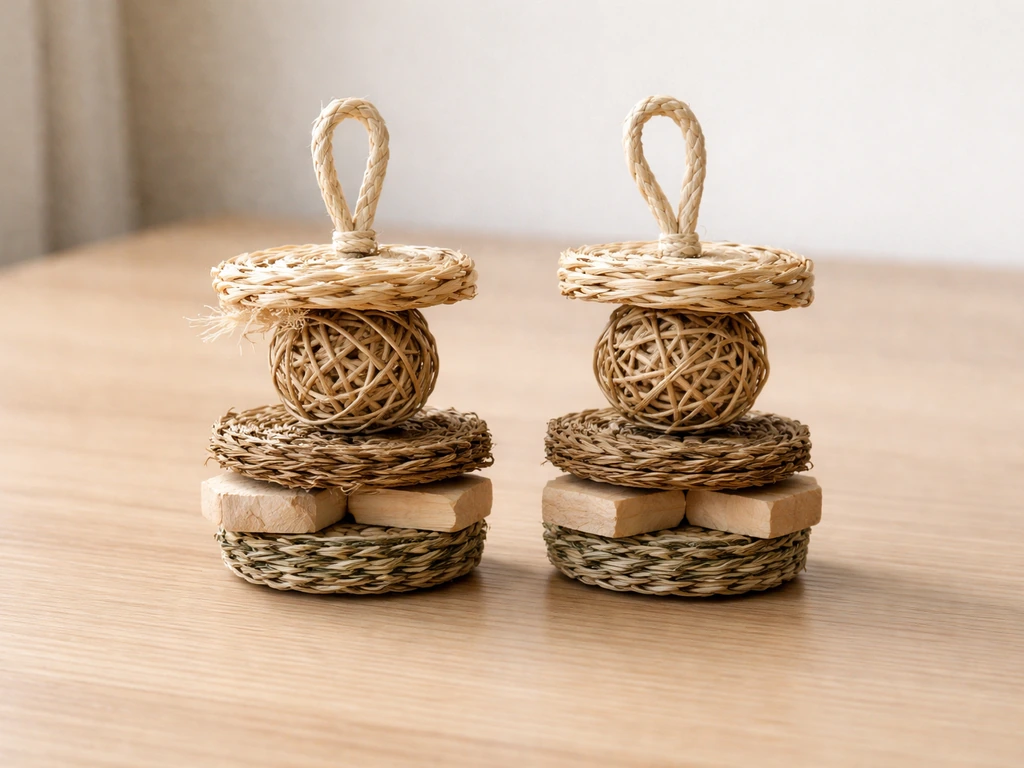
| Untreated wicker or seagrass (no adhesive) | Low if construction is solid | Usually OK if no strings |
What to look for when choosing rabbit-safe alternatives
The good news is that rabbits don't need bird toys at all. Their enrichment needs are well served by materials that are cheap, widely available, and purpose-built for their chewing and foraging behaviors. If you're looking for alternatives, here's what actually works.
- Untreated cardboard: boxes, tubes, and paper bags are fantastic for chewing and shredding. Plain, unprinted, no tape.
- Hay-based toys: balls, mats, and tunnels made from timothy hay or orchard grass double as enrichment and a safe snack.
- Untreated kiln-dried wood blocks or apple wood sticks: sold specifically for small animals and rabbits, these are the safest wood option.
- Natural wicker or seagrass mats and balls: safe as long as they're not dyed, treated, or glued together with unknown adhesives.
- Paper-based foraging toys: hide pellets or herbs inside a folded paper packet or cardboard roll for foraging stimulation.
- Hard plastic baby keys or rings (rabbit-specific): hard non-brittle plastic with no metal parts, sized so it can't be swallowed.
If you're determined to try a specific bird toy, stick to simple untreated wood shapes with no metal hardware, no strings, no paint, and no small detachable parts. Think a plain wood block threaded on a safe cord that you remove before giving it to your rabbit, not a full hanging bird toy with bells and rope.
Quick checklist: how to inspect a specific toy before your rabbit touches it
Run through these steps with any toy you're considering, whether it's labeled for birds, rabbits, or neither.
- Check the material list on the packaging. If it lists vinyl, latex, foam, or rubber, put it back. If it lists wood, confirm the wood species and whether it's untreated and kiln-dried.
- Look for strings, ropes, or cords. If there are any, the toy is not appropriate as-is.
- Inspect all metal parts. Remove or reject any toy with chains, clips, staples, bells, or wire.
- Check the surface for paint, dye, or coating. Press your fingernail against a painted or colored surface. If anything flakes, chips, or rubs off, the toy fails.
- Check joints and seams for glue. If you can see adhesive residue or the pieces are clearly glued rather than mechanically fastened, skip it.
- Try to break off a piece with your hands. If any part snaps off easily, your rabbit will chew it off and swallow it.
- Check for size traps. Hold the toy and look for any gap, loop, or hole that a rabbit's head or paw could get wedged into.
- Check for small parts. Any component smaller than your rabbit's head is a choking risk.
- Ask yourself: if my rabbit chews this for 10 minutes straight, what comes off? If the answer is anything other than nothing or safe fine dust, the toy needs to go.
Introducing a new toy safely for the first few days
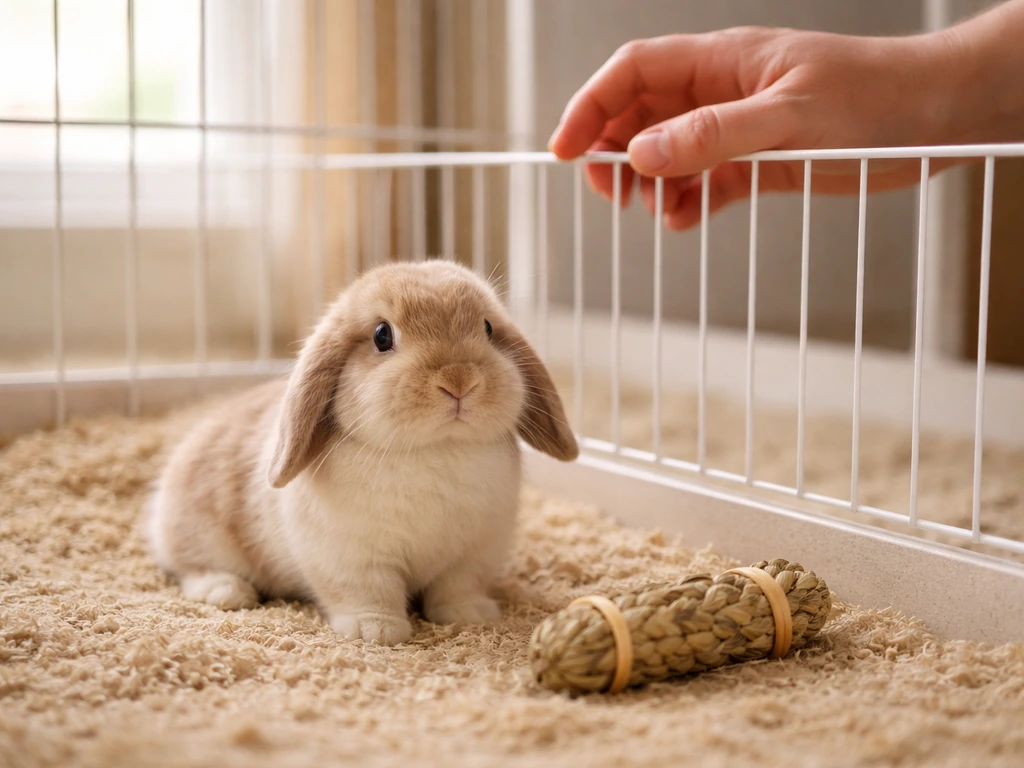
Even a toy that passes every check above needs to be introduced with supervision. Rabbits behave differently with new objects than you'd expect, and a toy can reveal hazards only after a rabbit has been working on it for a while.
- Sit with your rabbit for the first 15 to 20 minutes with the new toy. Watch how it interacts, specifically whether it's chewing aggressively versus tossing and nudging.
- After that first session, inspect the toy. Look for bite marks, missing chunks, frayed edges, or any piece that's now loose. If the toy is damaged in any way, remove it and don't return it.
- For the first two or three days, only give the toy during time when you can check in every hour or so. Don't leave it in the enclosure overnight unsupervised.
- Monitor your rabbit's droppings during this period. Normal droppings should be round, firm, and consistent in size. Any change, such as smaller droppings, fewer droppings, or droppings covered in mucus or jelly-like coating, is a warning sign.
- Watch for behavioral changes: reduced appetite, sitting hunched, grinding teeth, or pressing their belly to the floor. These can signal GI discomfort.
- If the toy survives the first few days with no damage and your rabbit shows no GI changes, you can be more relaxed about supervised access, but still check the toy regularly for wear.
When something goes wrong: remove the toy and know when to call the vet
Here's the honest truth: if you suspect your rabbit swallowed a piece of a toy, do not wait and see. Rabbits can't vomit and they deteriorate quickly once GI motility is disrupted. The window for effective treatment is narrow, and a vet will often need imaging to locate an obstruction before deciding whether it can be managed with supportive care or requires surgery.
Remove the toy immediately if you notice any of these
- Any piece has broken off or been chewed away
- Strings, rope fibers, or fabric strands are visibly shorter or frayed
- Metal parts are bent, sharp, or missing
- Paint, coating, or adhesive is visibly damaged or missing from an area your rabbit was chewing
Call your exotics vet right away if you see any of these symptoms
- Reduced or absent fecal output for more than a few hours
- Droppings that are very small, misshapen, or covered in a jelly-like or mucus coating
- Loss of appetite, especially if your rabbit normally eats eagerly
- Lethargy, low energy, or a hunched posture
- Bloated or visibly distended abdomen
- Teeth grinding or repeatedly pressing the belly to the floor
- Drooling, gasping, stretching the neck forward, or any sudden noisy breathing (these are choking emergency signs, call immediately or go to an emergency exotic vet)
- Pale or bluish gums
GI stasis can move from uncomfortable to life-threatening in under 24 hours. If your rabbit hasn't passed droppings in three to four hours and also isn't eating, that's not something to monitor at home overnight. Get to a vet who sees rabbits and exotic animals specifically, since not all general practice vets are experienced with rabbit GI emergencies.
If you're ever unsure whether something your rabbit ingested is toxic, poison control resources that cover pets can help triage the situation while you arrange veterinary care. Don't sit on it. Foreign body obstructions that can't be resolved with supportive care often require surgery, and early intervention makes a real difference in outcome.
The bottom line: a few bird toys can be adapted for rabbit use, but most can't, and none should be offered without a close inspection and supervised introduction. If you're wondering about yarn specifically, it can unravel into fibers and loose strands that are risky if your rabbit starts chewing. Rabbits can play with bird toys only in very limited, supervised situations where the toy is inspected closely and is appropriate for chewing. Your rabbit's enrichment needs are real, but they're much better served by hay-based toys, cardboard, and safe wood than by repurposed bird accessories built around completely different chewing physics and safety assumptions.
FAQ
What are the safest types of bird toys to try if I really want to repurpose one for my rabbit?
If the toy has any hanging section, rope, cord, knotted fibers, or anything that can be pulled free and swallowed, treat it as unsafe. For a rabbit, the safest “bird-toy style” option is a solid, plain wood piece with no strings and no detachable parts that your rabbit can access all at once. Avoid any design that encourages chewing off lengths.
Can a “pet-safe” or “non-toxic” bird toy still be unsafe for rabbits?
It is not enough for the toy to be labeled “non-toxic.” For rabbits, you need to confirm there is no paint or dye, no glue line accessible for chewing, and no small hardware that could break loose. If you cannot verify the exact materials and lack of coatings or pigments, skip the toy.
How should I introduce a bird toy to my rabbit for the first time?
Start by offering a small, supervised test session (short duration) with the toy present only while you watch closely. Remove it if you see any chewing that produces crumbs, stringy fibers, or detached fragments. Then assess again later rather than leaving it out overnight.
How can I tell if my specific bird toy has hidden hazards even after a visual inspection?
A useful rule is “if it can be bitten into swallowable pieces, it is unsafe.” That includes soft/vinyl/latex parts, brittle plastics that snap, painted or dyed surfaces, and any part held together with adhesives that become accessible to chewing. Also watch for metal bells, clips, and quick-links, since small pieces can detach during chewing.
My rabbit chewed part of a toy, what symptoms mean I should treat it as an emergency?
In a rabbit, “GI stasis risk” is not something to delay. If you notice reduced or missing droppings plus inappetence, lethargy, hunched posture, gas, or grinding teeth, contact a rabbit-experienced vet immediately. Do not wait for the next day, and do not try home remedies to “see if it passes.”
Why is obstruction treatment for rabbits different from pets that can vomit?
Because rabbits cannot vomit, your goal is early veterinary evaluation if foreign material was swallowed. Imaging (often X-rays or other modalities) can identify obstruction and guide whether supportive care or surgery is needed. The faster the check, the more options the vet typically has.
Is untreated wood always safe, or are there wood types or labels I should avoid?
Yes, even wood can be risky. Avoid cedar and pine unless you know it is kiln-dried and truly untreated (no stains, varnishes, preservatives, or chemical dips). Also avoid wood of unknown origin, since the source and treatments are usually not disclosed.
What should I do if I am not sure whether the toy piece was toxic or just caused blockage?
If you suspect ingestion, start triage right away by calling a poison control resource that covers pets while you arrange the vet visit. Be ready to share the toy type, colors, brand or material if known, and when ingestion happened. Do not delay the vet due to waiting on a call-back if symptoms are present.
Can I leave a bird toy out as a chew toy for my rabbit when I am not actively watching?
Never leave a rope, cord, or string-like toy unattended, even if you plan to “supervise.” If you are using a wood-only option, you still should not provide it as a long-term chew toy unless you have repeatedly confirmed it does not splinter, shed fibers, or create small detachable fragments.
Is yarn ever safe for rabbits if it is only used as a bird-toy-style decoration?
Yes. Yarn and similar fibers can unravel into loose strands that wrap or clump in the GI tract, especially if your rabbit is actively chewing. Treat yarn as high risk, even if it seems soft and the original amount is small.