The best bird toys for budgies are foraging toys, shreddable paper or natural wood toys, swings, ladders, and small bells, chosen specifically because they satisfy a budgie's drive to chew, climb, forage, and make noise. Start with two or three toys max in the cage at once, rotate them weekly, and place them at perch height on the sides of the cage (never directly over food or water). That setup alone will keep most budgies genuinely busy and mentally stimulated.
Best Bird Toys for Budgies: Safe, Practical Buyer Guide
Marcus Chen
14 Jun 2026
What budgies actually like to do (and why it matters for toy shopping)
If you understand what budgies are wired to do, choosing toys becomes simple. Budgies are small parrots built for active foraging in the wild, they spend the bulk of their day searching for food, manipulating plant material with their beaks, climbing through grass and scrub, and socializing. In captivity, none of that happens automatically, so toys are how you give those instincts somewhere to go.
A budgie's beak never stops growing, which means chewing isn't just fun, it's a physical need. Giving your bird things to shred and gnaw is one of the most important things you can do for beak health. Beyond that, budgies are curious and love problem-solving, which is why foraging toys (hiding millet or seeds inside something the bird has to work to open) get used so enthusiastically. Climbing satisfies their movement instincts. Bells and mirrors engage their social drive, budgies are flock birds and a little jingle or a reflection is genuinely stimulating for them.
- Chewing and shredding: beak maintenance, stress relief, natural destruction behavior
- Foraging: searching for hidden food, problem-solving, mimics wild feeding patterns
- Climbing: movement, coordination, physical exercise
- Swinging and balancing: spatial play, proprioception, just plain fun for them
- Bell/mirror interaction: social stimulation, mimics flock signaling
How to choose safe, enriching toys
This is where most beginners go wrong. It's easy to grab a colorful toy off a shelf without checking what it's actually made of, and some of those materials are genuinely dangerous. Here's what to look for and blank" rel="noopener noreferrer">what to avoid.
Safe materials
- Untreated natural wood (pine, balsa, basswood) — safe to chew and shred
- Stainless steel hardware — for hooks, bells, and links; avoid zinc-plated or lead-plated metal
- Paper and cardboard — completely safe for shredding
- Natural fiber (untreated cotton, sisal, jute) — safe if strands are short and tightly woven
- Vegetable-tanned leather — a natural chew material when untreated
What to avoid
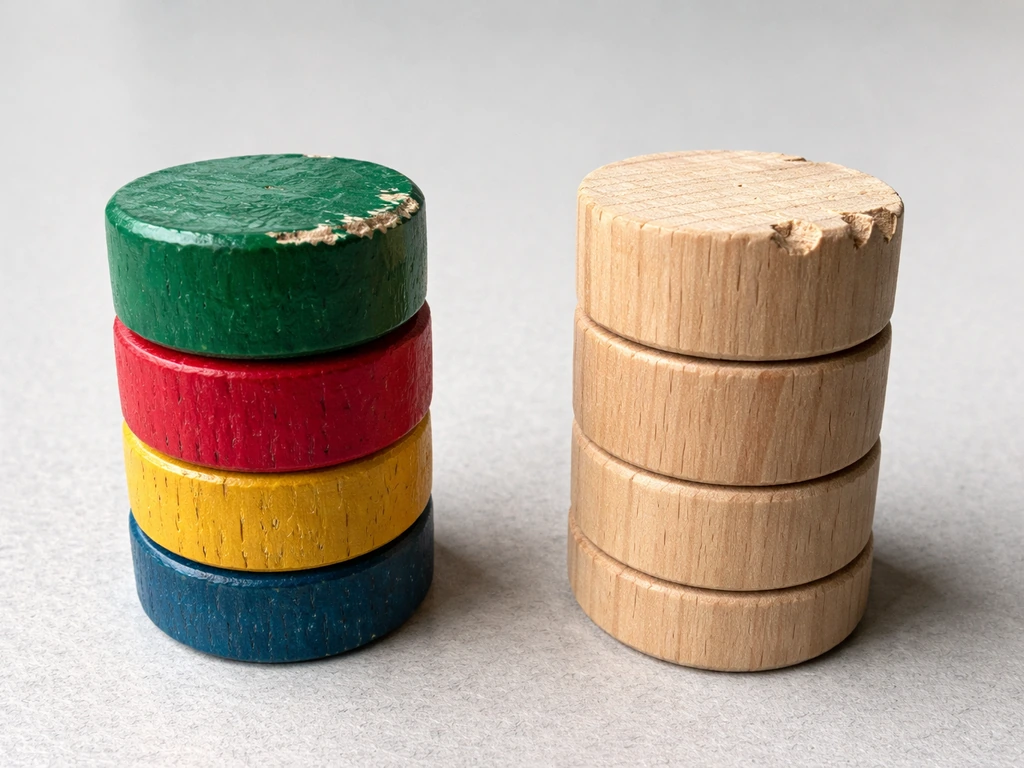
- Painted or varnished toys — paint and coatings are toxic when chewed
- Spray-painted cage components or toy hardware
- Loose synthetic fibers or long rope strands — these can wrap around toes and cut off circulation
- Small parts that can detach and be swallowed
- Any design where a foot, toe, beak, or head could get trapped (rings, narrow loops, tight weave)
- Rusty or sharp metal edges
- Glitter, foil, or decorative materials with unknown composition
Size matters too. A toy designed for a large parrot can have gaps, loops, or openings that trap a budgie's tiny foot. When you're shopping, think about your budgie's beak, roughly the size of a small pea, and make sure everything it can reach and chew is appropriately sized. If a ring or loop is big enough to slip around a budgie's head, it shouldn't be in the cage.
One concept worth keeping in mind is planned obsolescence. A good budgie toy is meant to be destroyed. That's success, not failure. The question is whether the destroyed toy leaves behind anything dangerous: big splinters, detached metal parts, frayed synthetic fibers. Choose toys that fall apart into harmless pieces, shredded paper, wood dust, bits of natural fiber, not toys that become a hazard when demolished.
The best toy types for budgies, category by category
Rather than a generic list, here's what each toy type actually does for your bird behaviorally, so you can mix and match based on what your budgie gravitates toward.
Shreddable/chew toys
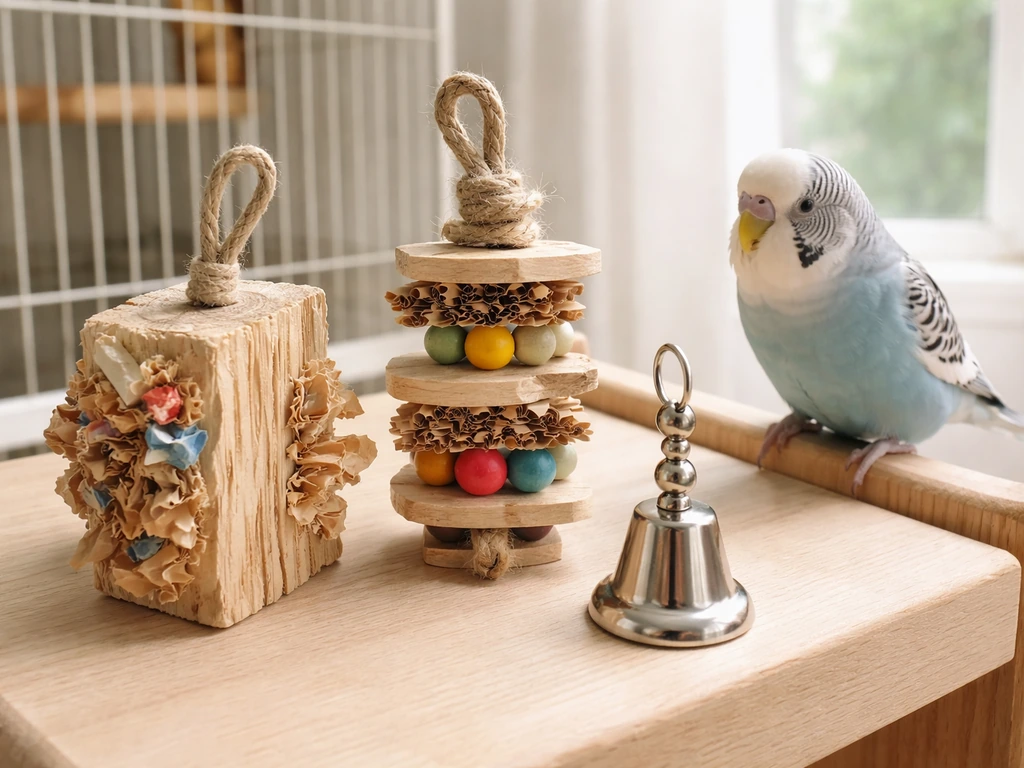
These are the most important category for budgies. Think small blocks of untreated pine or balsa wood, palm frond pieces, cork, and layered paper or cardboard structures. Your budgie will systematically tear these apart, and that's exactly the point, the chewing and shredding satisfies their beak-maintenance instinct and gives them something productive to do when you're not around. Replace them when they're destroyed; it means you picked the right thing.
Foraging toys
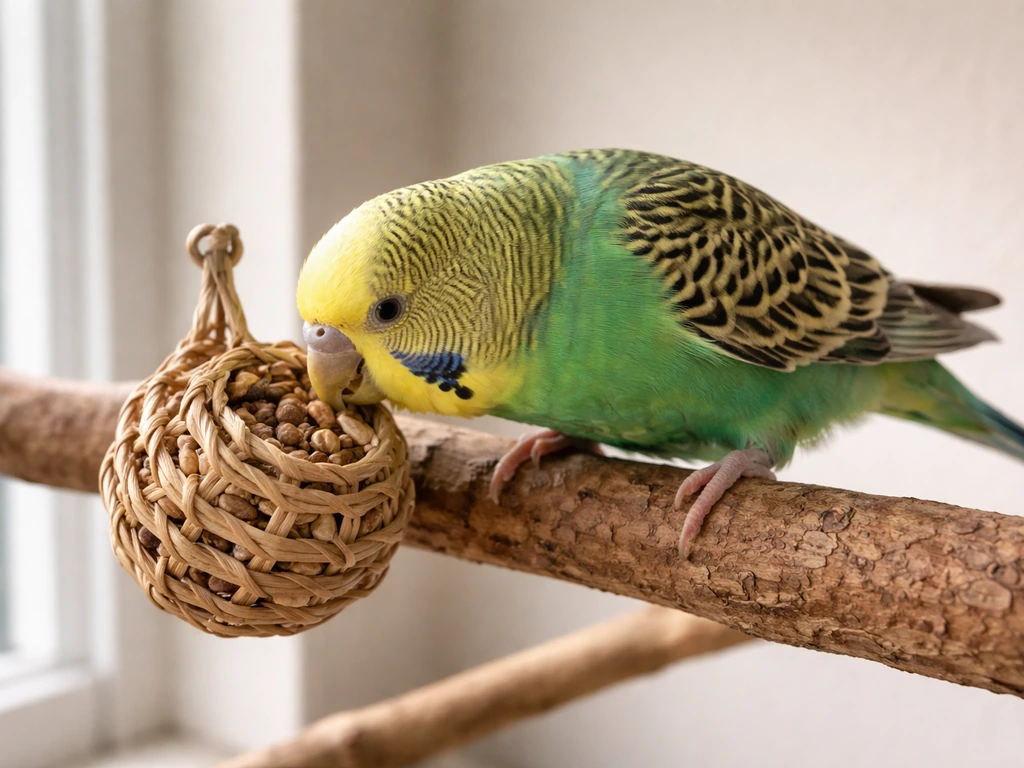
Foraging toys are anything that hides food behind a physical challenge. You can buy purpose-built acrylic foraging boxes or stacked cups with holes, or you can DIY it with small paper cups or folded paper wrapped around a bit of millet. The behavioral payoff is huge, a budgie working a foraging toy is doing exactly what its brain is designed for. Hide small seeds or a sprig of millet inside and let your bird figure it out. Start easy (loosely wrapped millet in paper) and make it harder as your bird gets more confident. Foraging toys overlap nicely with bird puzzle toys if you want to explore that category further.
Swings
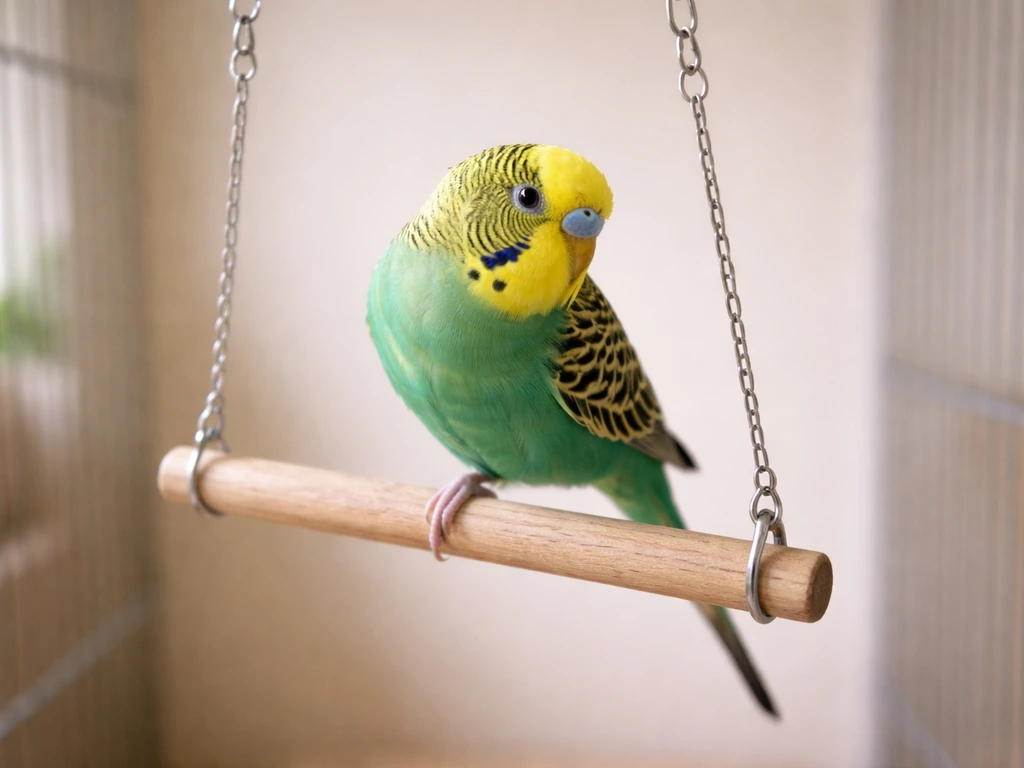
Most budgies genuinely love swings. A simple wooden swing with a natural wood dowel perch satisfies their climbing and balancing instinct and gives them a preferred resting spot that also moves. Choose one with stainless steel hardware and a perch diameter around 0.5 to 0.75 inches, thick enough that the foot doesn't wrap all the way around and strain the tendons. Avoid swings with long dangling rope ends or synthetic fiber decorations.
Ladders and climbing structures
Ladders made from natural wood rungs and stainless steel wire let budgies move vertically, something they do constantly in the wild. They also double as a chew target. A simple rope ladder is fine if it's made from tightly woven natural cotton with no loose fraying strands. Position a ladder so it connects two different height levels in the cage; your bird will use it as a highway between perching spots.
Bells
Bells tap directly into a budgie's social instinct. A small stainless steel bell that rings when nudged is often one of the most-used toys in the cage. Avoid bells with clappers that could trap a beak, the clapper should be either absent or very large relative to the bell opening. Check that the bell itself is stainless steel, not plated metal that could corrode or chip.
Mirrors
Mirrors are a little controversial in the budgie community. They do engage a bird socially, a solo budgie will often treat its reflection as a flock mate, which can reduce loneliness. However, some birds become so attached to the mirror that they ignore a real companion or become aggressive when it's removed. Use a mirror sparingly, especially if you have a single budgie, and monitor for obsessive behavior. A small mirror attached to a toy structure (rather than a full cage mirror) tends to give stimulation without overdoing it.
Puzzle/activity toys
These are small foot toys or cage-mounted toys with moving parts, spinning wheels, sliding beads, flip-open doors, that the bird has to manipulate to get a reward or just to satisfy curiosity. They're great for smart, active budgies that blow through simpler toys quickly. Keep the complexity level realistic: a toy designed for a larger parrot will frustrate a budgie whose beak and feet can't generate enough leverage. Look for budgie-specific or small-bird-rated puzzles.
| Toy Type | Behavioral Purpose | Key Safety Check |
|---|---|---|
| Shreddable/chew toys | Beak maintenance, stress relief, destruction instinct | No paint or varnish; falls apart into harmless pieces |
| Foraging toys | Problem-solving, mimics wild food searching | No small detachable parts; opening size won't trap beak |
| Swings | Balance, climbing, preferred resting spot | Stainless hardware; 0.5–0.75" perch diameter; no loose rope ends |
| Ladders | Vertical movement, climbing exercise | Tightly woven fiber only; no fraying strands |
| Bells | Social stimulation, noise play | Stainless steel; clapper won't trap beak |
| Mirrors | Social engagement (use sparingly) | Monitor for obsessive behavior; small size preferred |
| Puzzle/activity toys | Mental stimulation, problem-solving | Sized for small birds; no rings large enough to trap head |
How many toys, and how to rotate them
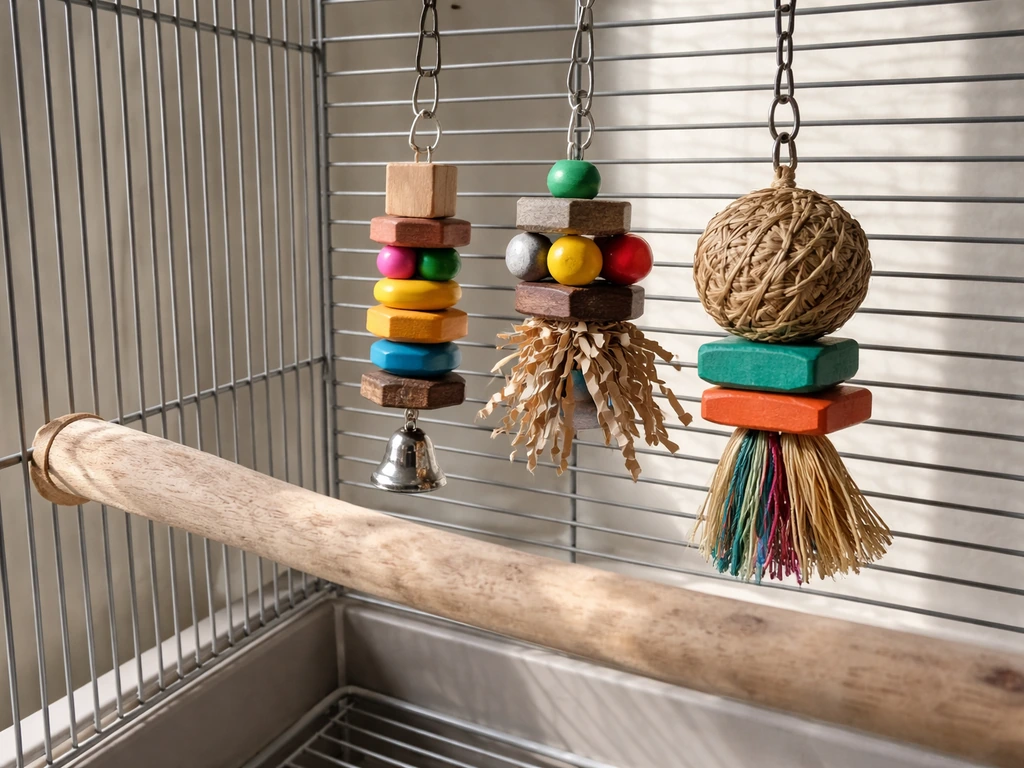
Two to four toys in the cage at a time is the sweet spot for most budgies. Too few and you've got a bored bird; too many and the cage becomes cluttered, movement gets restricted, and the bird can't tell what it's supposed to interact with. Think of your toy selection as a small curated set, not a toy store.
Rotation is the key to keeping things interesting long-term. Every few days to once a week, swap one or two toys out for something that's been stored out of sight. When a familiar toy reappears after a week away, many budgies treat it like it's new. This also prevents the pattern where a bird latches onto one toy and ignores everything else, which is common and fixable with consistent rotation.
When you pull toys for rotation, inspect them. Frayed rope, broken wood pieces with sharp edges, detached hardware, or rust are all reasons to retire a toy permanently rather than store it. A quick visual check every time you rotate takes thirty seconds and prevents a lot of potential injury.
Where to place toys in the cage and play area
Placement is something most beginner guides skip over, but it affects whether your budgie actually uses the toys or ignores them. The general rule: toys belong at perch height on the sides or upper cage walls, not dangling in the middle of open air and not directly above food or water bowls.
The center of the cage should stay open. Budgies need room to move, and a cluttered cage center forces them to navigate obstacles instead of flying and hopping freely. Hanging toys from the top corners and mounting foraging toys on the side bars at a height your bird can reach from a perch gives them access without sacrificing floor space.
Never place toys directly above the food or water bowl. Shredded toy material, droppings from a perching bird, and chew debris will contaminate the bowl constantly. This sounds obvious, but it's one of the most common beginner mistakes I see when people share cage photos.
For the cage location itself: keep it in a well-lit area away from drafts and out of reach of other pets. Eye level for humans is a good height reference, budgies feel more secure when they can see the room without being down on the floor, and you'll interact with them more naturally at eye level too.
Common mistakes and safety checks
Here are the mistakes I see most often, especially from people who just got their first budgie and are enthusiastically adding toys without knowing what to watch for.
- Buying toys sized for larger parrots. A cockatiel toy's ring or loop can trap a budgie's foot or head. Always check sizing against small-bird or budgie-specific ratings.
- Using rope toys with long loose ends or synthetic fibers. These wrap around toes and can cut off circulation within hours. Natural cotton is fine if it's tightly woven and short; long synthetic strands are not.
- Leaving worn or frayed toys in the cage. Inspect weekly and replace anything that has sharp edges, loose hardware, or fraying fibers.
- Overcrowding the cage with toys to 'keep the bird busy.' More toys don't equal more enrichment if there's no room to move.
- Placing a swing or hanging toy directly over the food bowl. Droppings and debris will land in the food constantly.
- Using painted or varnished wood toys. The paint is toxic when chewed, and budgies will absolutely chew it.
- Ignoring a toy the bird seems obsessed with while cycling everything else. If your budgie is fixated on one toy to the point of guarding it aggressively, that's a signal to temporarily remove it and reintroduce more gradually.
For a quick safety check on any new toy: run your hand over all surfaces for sharp edges, check every loop and ring for head/foot entrapment risk, tug on all attached parts to verify nothing pulls free easily, confirm materials are natural and uncoated, and look for any loose strands or threads. If anything fails that check, don't use the toy.
If a toy ever causes bleeding from the beak, foot, or wing, remove it immediately and contact an avian vet. Birds hide injury instinctively, so ongoing bleeding is always an emergency, don't wait to see if it stops on its own.
How to introduce new toys to a hesitant budgie
Some budgies are naturally bold and will start investigating a new toy within minutes. Others, especially birds that haven't had much enrichment, or that are newer to your home, may treat any new object as a potential threat. This is completely normal and it's fixable with a little patience.
The key principle is desensitization: introduce the new toy gradually rather than hanging it right next to your bird's favorite perch overnight. Start by placing the toy on top of or near the cage on the outside, so the bird can see it without being forced to interact. Once the bird is clearly unbothered by its presence (no alarm postures, no avoidance of that side of the cage), move it inside the cage but away from the main perching area. Let the bird approach on its own timeline.
Food pairing speeds things up significantly. Tie a sprig of millet to the new toy, or hide a few seeds in or around it. Your budgie's curiosity about the food will override its wariness about the unfamiliar object, and after a few sessions of eating near the toy, the association shifts to positive. This works well for foraging toys especially.
For birds that only ever engage with one toy and ignore everything else: try removing the favorite for a few days during rotation, and make the new toy the only option. Don't starve the bird of enrichment, but shift the context so exploring the new toy becomes the natural thing to do. Introduce changes slowly for particularly cautious birds, the goal isn't to force interaction, it's to make the new thing feel unremarkable over time.
Troubleshooting specific toy behavior problems
| Problem | Likely Cause | What to Do |
|---|---|---|
| Bird ignores all toys | Toys too unfamiliar, or placed out of comfortable reach | Use food pairing; reposition toys at perch height; start with simpler textures |
| Bird obsessed with one toy only | That toy hits the right instinct; nothing else is as engaging | Rotate the favorite out temporarily; introduce variety while it's gone |
| Bird guards toy aggressively | Hormonal behavior or over-attachment | Remove the toy for a week; reintroduce during a non-hormonal period |
| Toy debris falling in food/water | Poor placement | Reposition toys away from bowls; add a cage cup cover if needed |
| Bird seems scared of new toy | Neophobia (fear of new things), common in under-enriched birds | Desensitize gradually; start with toy outside cage, pair with millet |
| Toy destroyed within a day | Budgie is engaged and enthusiastic — this is good | Replace with same type; buy in bulk for chew/shreddable toys |
| Toy not being destroyed at all | Material too hard, or bird doesn't know it's interactive | Try softer balsa or paper-based options; hide food inside to encourage contact |
Your first toy setup, today
If you want a simple starting point, here's exactly what I'd put in a beginner budgie cage on day one: one shreddable toy (small balsa wood blocks or a paper shred toy), one swing with a natural wood perch and stainless hardware, and one small bell toy. If you're shopping for the best bird toys, this three-item setup is a great place to start for most budgies beginner budgie cage.
For cockatiels, the best bird toys balance safe chewing, natural materials, and enrichment that encourages active play beginner budgie cage. That's three items, all with clear behavioral targets, all easy to inspect and replace. Add a foraging option in week two once your bird is comfortable with the first set, tie some millet inside a folded piece of paper and watch what happens.
If you want to build a similar enrichment setup for a conure, you can use the best bird toys for conures as your starting point.
From there, rotate every five to seven days, inspect every time you rotate, and pay attention to which toy types your specific bird gravitates toward. SpectrumCare advises rotating parakeet toys every few days or weekly, and introducing new changes slowly for cautious birds rotate every five to seven days.
If you have a parakeet instead of a budgie, focus on the same principles but choose parakeet-sized, durable options like shreddables, foraging toys, and safe swings best bird toys for parakeets. Some budgies are obsessive chewers; others are climbers; others will ring a bell for twenty minutes straight. Let their behavior guide your next purchases rather than buying every category at once. And remember, the toy getting destroyed is the goal, not a problem.
That's your bird being a budgie.
FAQ
Can I leave budgie toys in the cage permanently, or do I have to rotate them?
Rotation helps prevent boredom and obsessive attachment. Even if you leave toys up, still swap out at least one item every 5 to 7 days so the bird experiences variety. Also use rotation as your routine inspection time, since broken fibers, loose hardware, and rust often show up gradually.
My budgie ignores new toys for days. Should I keep trying or take them out?
Keep the toy available but introduce it gradually. Place it outside the cage or at the far side first, then move it inside away from the bird’s favorite perch once the bird shows relaxed behavior. Pairing with millet or seeds worked into or near the toy often speeds up acceptance, especially for foraging toys.
What size should the bells, loops, and openings be for the best bird toys for budgies?
Use your budgie’s head and foot as the guide. If a loop can slip over the head, or if a tiny foot can get stuck between a ring and a bar, the toy is not appropriate. When in doubt, choose budgie-specific versions with small, tight hardware rather than adapting larger-parrot toys.
Are mirrored toys safe for budgies?
Mirrors can stimulate a solo budgie, but overuse can lead to fixation, neglect of real flock contact, or aggression when the mirror is removed. Use a small mirror attached to a larger toy structure rather than mounting a full cage mirror, and limit sessions by rotating it in briefly then out if you notice obsessive behavior.
How do I clean shreddable and foraging toys without making them unsafe again?
Dry debris is safer than damp material because moisture can worsen spoilage or mold risk in paper and natural fibers. For wood and paper toys, remove and replace when visibly soiled, then store new/unused items dry. If a toy gets wet from droppings or splashes, retire it or replace it rather than trying to “rescue” it if fibers have swollen.
Do I need to worry about beak and foot injuries from toy debris?
Yes. Even if the toy itself is safe, shredded material can create sharp clumps or contaminated bits near bowls. Inspect after heavy chewing, check for pointy splinters, and remove any toy that leaves behind large, rigid fragments. Never position toys directly above food or water where debris will continuously fall into bowls.
What should I do if a toy starts to rust or the hardware chips?
Retire it immediately. Stainless hardware is preferred, but if you see plated metal chipping, rust spots, or loose parts, the toy can lose structural integrity and sharp edges can form. Replace with the same toy category using fully stainless components or untreated natural materials.
Are rope ladders okay, and what’s the safest rope type?
Rope ladders are fine when the rope is tightly woven natural cotton and has no loose fraying strands. Avoid decorative rope ends that dangle or separate easily, since budgies can tug at loose fibers. Also make sure the ladder connects two stable heights so it cannot shift or twist under climbing pressure.
How many toys should I have in the cage for the best bird toys for budgies?
For most budgies, two to four toys at a time is a practical sweet spot. Too few reduces exploration, too many restricts movement and flight paths, and the bird may not interact with everything. Treat your toy set like a curated rotation, not a permanent toy store.
Can I DIY budgie foraging toys with household items?
You can DIY safely if you stick to bird-safe materials and avoid anything with coatings, inks, or hard-to-clean adhesives. Paper cups and folded paper around millet can work, but make sure there are no staples, string ties that can entangle, or materials that crumble into sharp pieces. If the DIY toy creates persistent dust or rigid shards when shredded, switch to untreated wood blocks or purpose-built foraging options.
My budgie is a heavy chewer, should I buy harder toys?
Not necessarily. Heavy chewers often do best with toys that are meant to be destroyed safely, like small untreated wood blocks or shreddable paper structures that fall apart into harmless bits. The key is that “destroyed” should mean shredded or wood-dust type breakdown, not splinters, detached metal, or sharp fragments left behind.