The best bird toys for parakeets are small-scale chew toys made from untreated softwood, shreddable paper or palm leaf toys, simple rope or cotton swings, foraging puzzle feeders sized for small birds, and bells with stainless steel hardware. Those five categories cover almost everything a budgie actually needs. The tricky part isn't finding toys at all, it's avoiding the ones that look fun but are secretly unsafe, and knowing how to introduce and rotate them so your bird doesn't ignore them after day two.
Best Bird Toys for Parakeets: Safe Picks and Buying Guide
Marcus Chen
15 Jun 2026
What parakeets actually need from toys
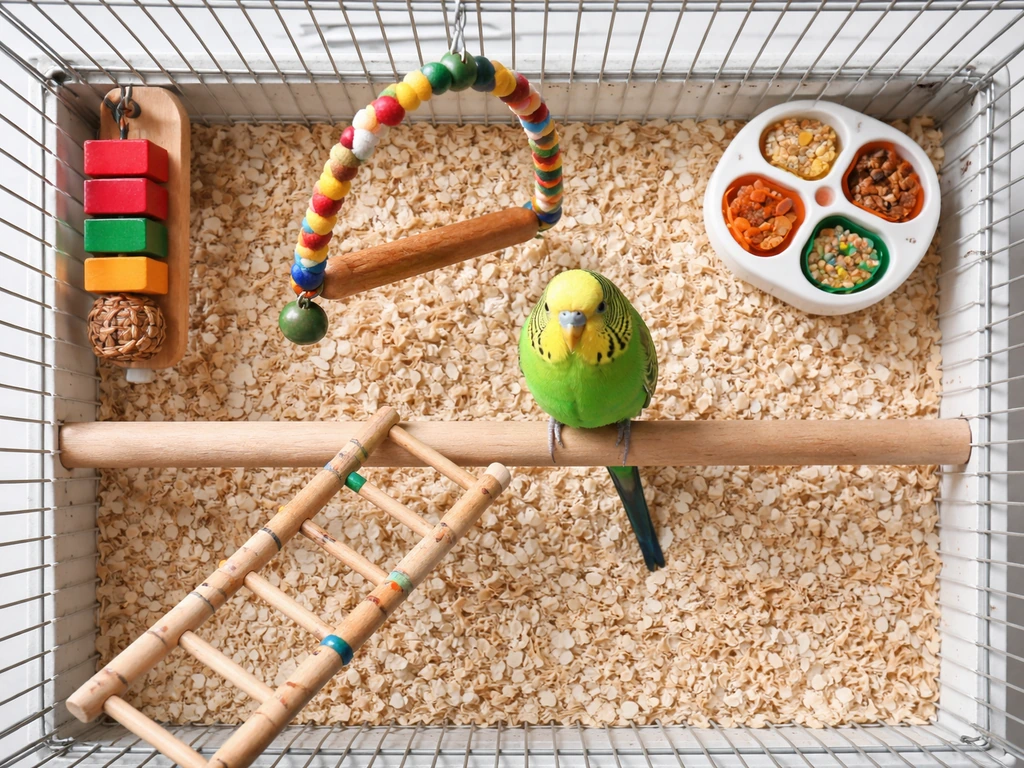
Parakeets aren't just playing when they chew, climb, and shred, they're meeting real behavioral and physical needs. A budgie's beak grows continuously, so gnawing on wood and tough fibers helps wear it down naturally. Without something to chew, beaks can become overgrown, which leads to feeding problems. That's reason enough to always have chew toys in the cage.
Climbing is just as core. Watch a healthy budgie for five minutes and you'll see them scaling cage bars, hanging upside down from the roof, and swinging on anything they can grip. Their feet and legs need that kind of workout. Toys that encourage movement, ladders, swings, suspended perches, support what parakeets would naturally do across a tree canopy. A relevant Reddit discussion adds: "Reddit user reports that parakeet/budgie toes/beaks can get tangled in bells and chains, and advises caution with bells connected to chain/links." Read the comment.
Foraging is the need that most beginners overlook. In the wild, parakeets spend hours searching for food. Vet researchers at Tufts have pointed out that feeding a bird solely from a single bowl leaves them deeply under-stimulated, even if the cage is full of perches and swings. Hiding food inside puzzle feeders or wrapping seeds in paper forces your bird to work for a meal, and that mental engagement matters more than almost anything else you can provide.
Put simply, a well-stocked parakeet cage should cover four functions: chewing and shredding, climbing and swinging, foraging and problem-solving, and sensory exploration (sound, texture, movement). If you're missing one of those categories, your bird is missing something too.
Toy safety basics you need to know before buying anything
This is the section I wish someone had handed me before I bought my first batch of toys. Safety problems in bird toys fall into a few predictable categories, and once you know them, spotting the bad ones gets fast.
Materials: what's safe and what isn't
Untreated softwood (pine, balsa, willow) is the gold standard for chew toys. Avoid wood that has been stained, lacquered, or treated with anything, you have no way of knowing what's in it. Natural fiber options like cotton rope and sisal can work, but they come with a caveat: rope toys fray. Frayed ends create loose threads that can wrap around a toe or leg and cut off circulation, and birds that ingest rope fibers risk digestive tract obstructions. If you use rope toys, inspect them every few days and retire them the moment they start to fall apart.
Hardware is where the real toxicity risk hides. Zinc is toxic to birds, and it's everywhere in cheap toy hardware, galvanized wire, certain snaps and clasps, some anti-rust coatings. Copper poses similar risks. The only safe choice for any metal component (clips, bells, chains, fasteners) is stainless steel. It costs more, but it's the only hardware you can feel genuinely confident about. When a listing doesn't specify the metal type, that's a red flag.
Plastic parts can be fine in moderation, but avoid brittle plastics that crack into sharp shards when chewed, and be cautious with anything that has small detachable pieces. Brightly colored painted plastic is especially suspect if the dye source isn't listed, food-safe or bird-safe coloring is what you want to see on the label.
Size and design hazards
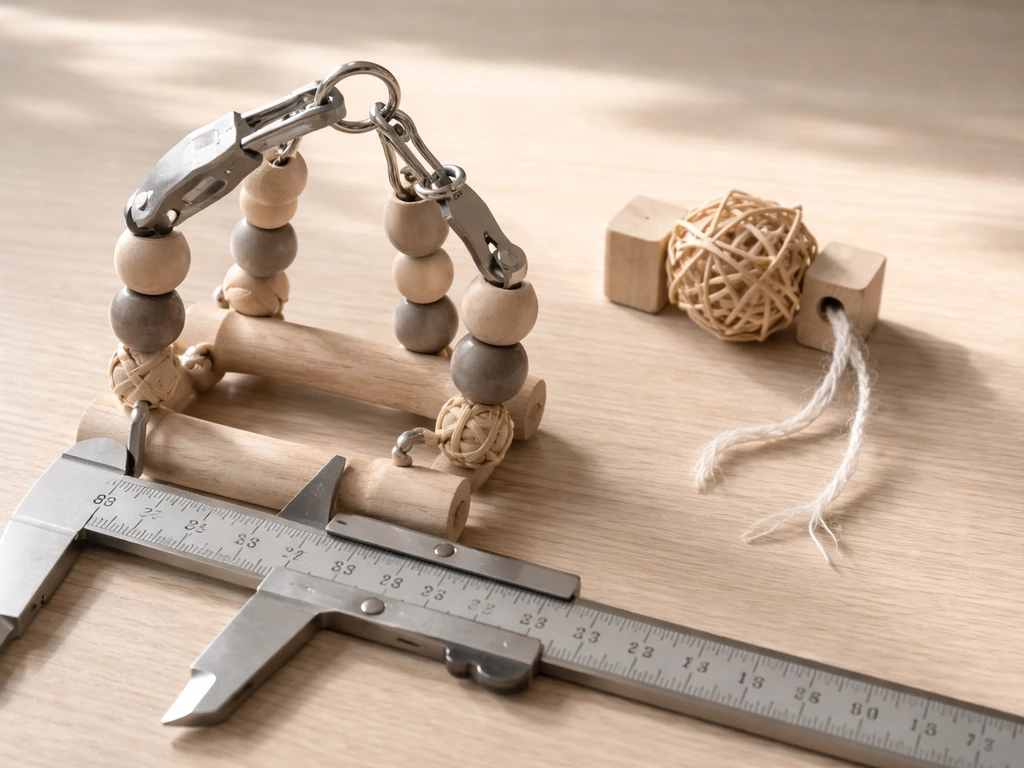
Toy sizing is critical and chronically underestimated. A toy built for a cockatiel or conure can have rings, gaps, and links big enough to trap a budgie's head, beak, toe, or tongue. Hoop-style toys are particularly risky for small birds. Any gap or loop in a toy's design is a potential trap, if your finger can wiggle through it, a budgie's head might fit through it too. Similarly, toys with many tiny detachable parts (small beads, loose bells inside fabric) create choking risks once the bird starts pulling things apart. And they will pull things apart, plan for it.
One more design issue worth flagging: loose strings. If a string or thread falls free inside the cage, it can form a loop that a bird steps into without realizing. Regularly check that all attachment points are secure and that nothing is drooping unsupported into the cage floor space. blank" rel="noopener noreferrer">Best Parakeet Toys — Omlet US notes that omlet groups parakeet toys into four basic categories—swinging, climbing, chewing, and exploring—reflecting different behavioral/interaction functions.
A quick safety checklist before any toy goes in the cage
- Hardware is stainless steel (not galvanized, not zinc-coated)
- No gaps or hoops large enough to trap a budgie's head or toe
- No brittle plastic that could splinter into sharp pieces
- No loose small parts that could be swallowed once detached
- Wood is untreated (no stain, lacquer, or chemical coating)
- Rope and fiber toys are tightly woven with minimal fraying
- Toy is labeled or confirmed safe for small birds/budgie size
- No rusted metal components anywhere on the toy
The best toy types for parakeets, broken down
Chew and shred toys
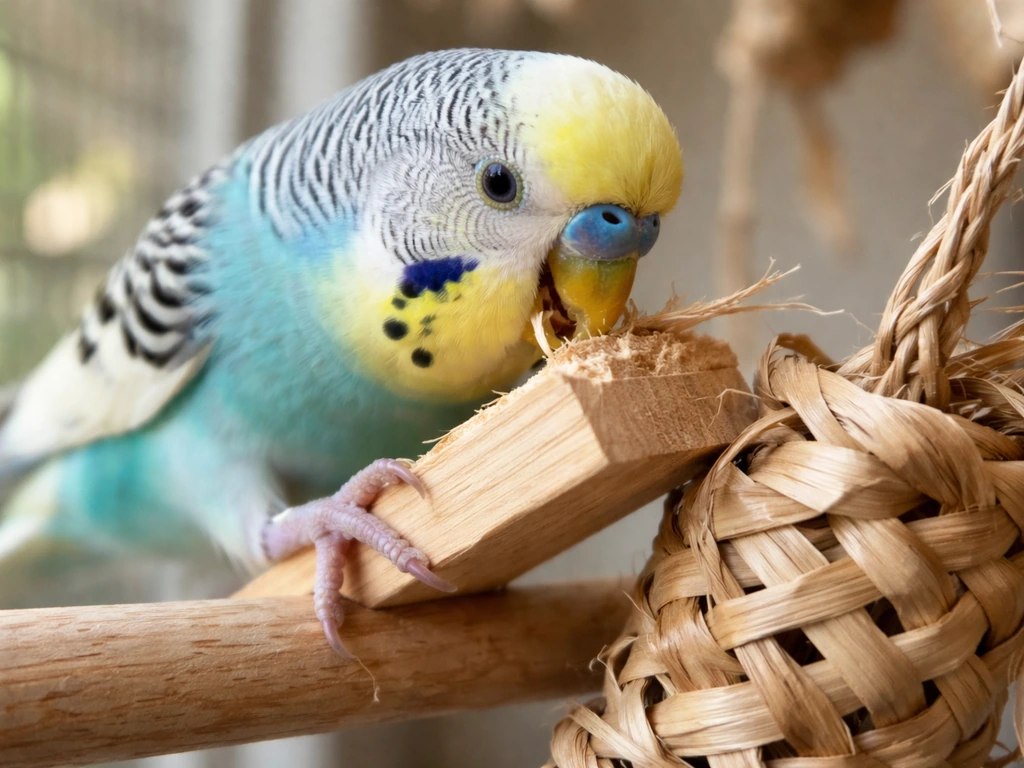
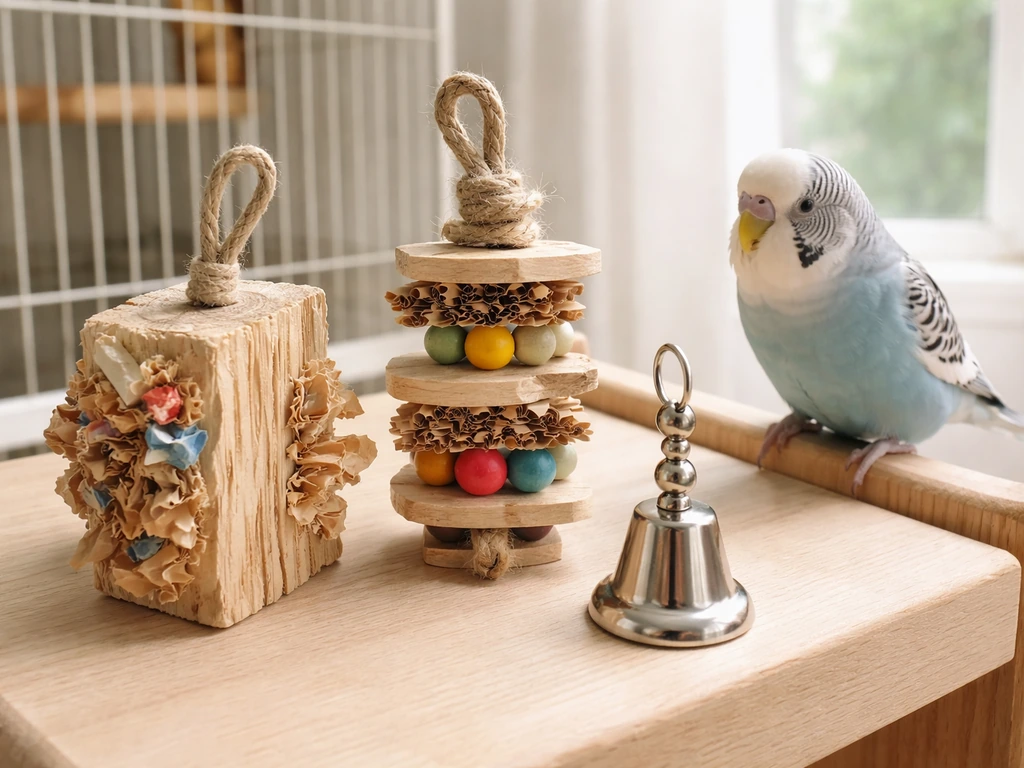
These are the workhorses of any budgie setup. Small blocks or slices of untreated pine or balsa, woven palm leaf toys, and layered paper/cardboard toys all give parakeets something to really go at. Shred toys made from natural materials like corn husk, bamboo strips, or loofah are also excellent. Expect these to get destroyed, that's the whole point. Budget for replacing them regularly. A toy that lasts forever isn't being used.
Foraging and puzzle feeders
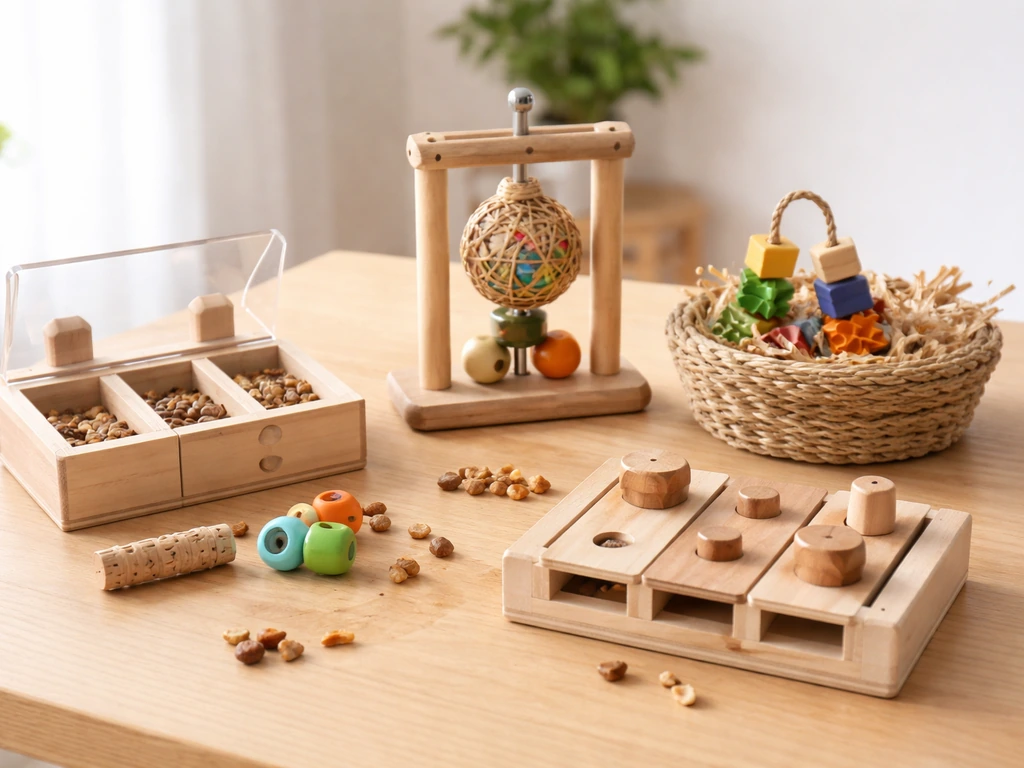
This category makes the biggest difference in a bird's quality of life, and it's the most underused by beginners. Foraging toys hide food inside compartments, wrapped in paper, or tucked behind movable pieces that the bird has to manipulate to reach. If you want more variety beyond simple foraging, puzzle-style toys are often a great way to build out the best bird puzzles selection for your parakeet. VCA Hospitals notes that puzzle feeders can keep birds occupied for hours, that's hours of healthy mental engagement instead of boredom. Start with simple options: a small foraging box with a lid the bird can flip, or pellets tucked inside a paper tube. DIY versions work just as well as purchased ones, the RSPCA recommends rolling food in newspaper and wedging it in cage bars as a zero-cost foraging option.
Swings
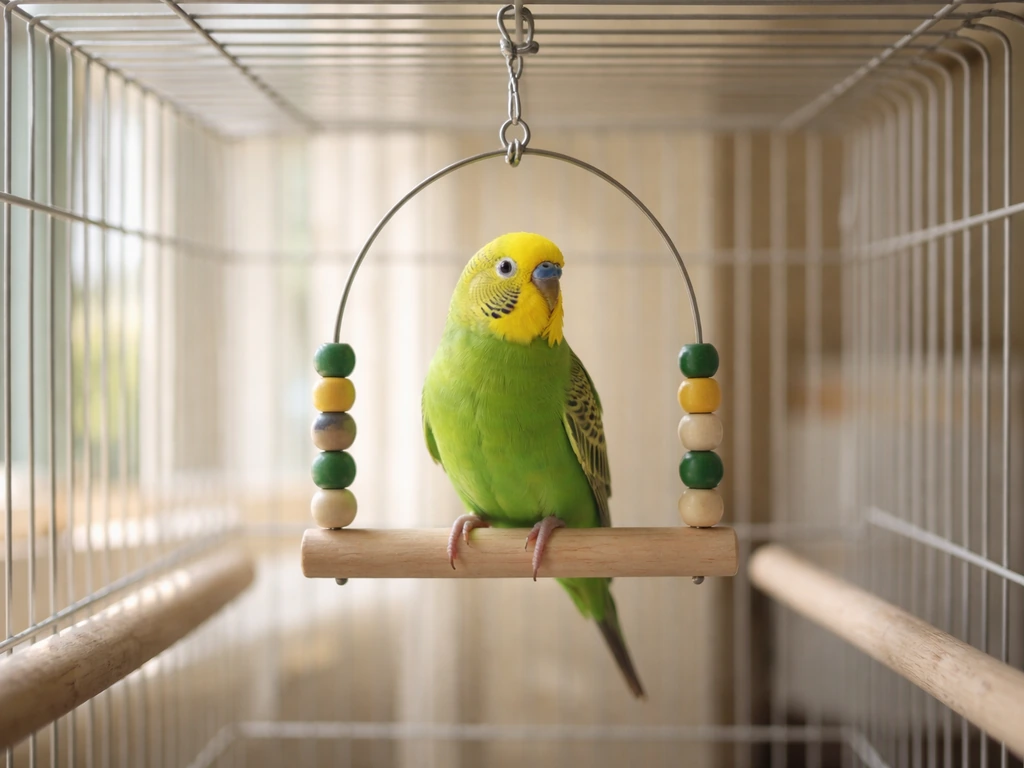
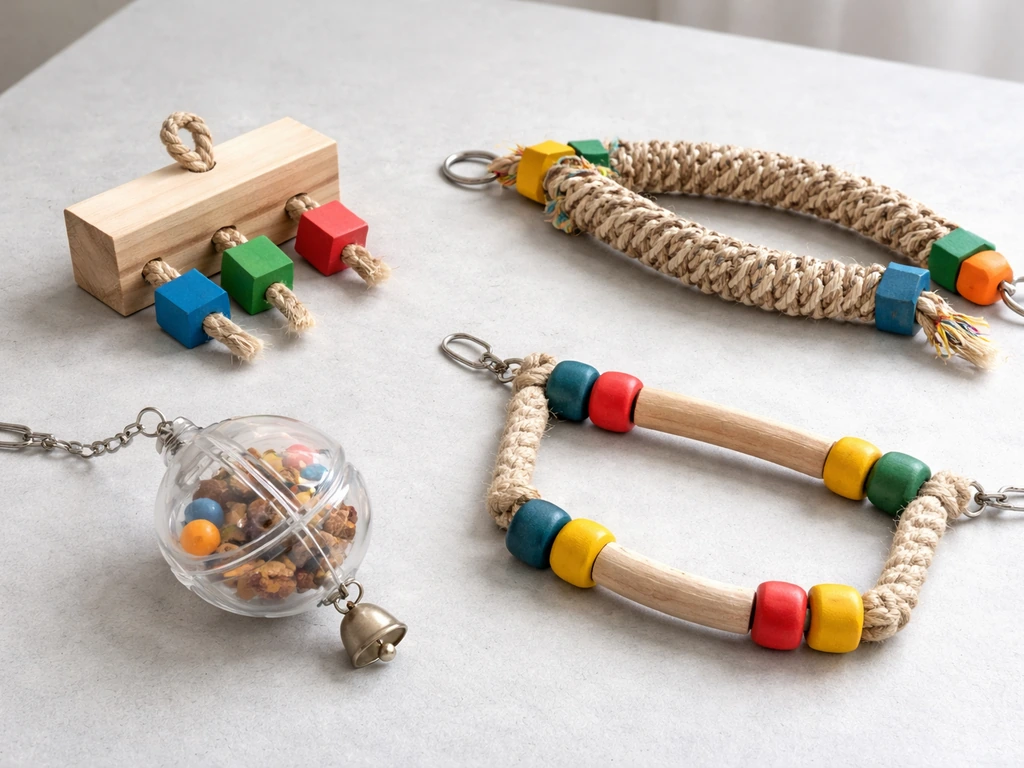
A swing is almost mandatory for parakeets. They naturally use suspended objects for perching and gentle movement, and a swing hits both the physical and behavioral bases simultaneously. Choose a swing with a flat or contoured perch (not a round dowel, which strains feet over time) and stainless steel hooks. Simple cotton rope swings and wooden platform swings both work well for budgies.
Ladders and climbing toys
Rope ladders, wooden rung ladders, and spiral perches encourage the kind of full-body movement budgies love. Place these between perch levels so the bird actually has a reason to climb them. Avoid metal ladders with sharp cut edges, and check that rung spacing is small enough that a foot can't get caught between rungs.
Bells
Parakeets are genuinely drawn to bells, the sound and the physical act of tapping them becomes part of a bird's daily routine. The safety concern here is the attachment hardware and the bell opening itself. Bells with small clappers that can be pulled out become choking hazards. Bells attached via chain links can trap a beak or toe. Look for bells with a solid, enclosed design and stainless steel hooks rather than open chain links. One bell in the cage is enriching; three is probably excessive and can veer into obsessive repetitive behavior. Toy Safety — Parrot Rescue Centre notes that parrot Rescue Centre (bird toy safety) states zinc poisoning risk is tied to actual ingestion of toy hardware over time; it also suggests stainless replacement parts for owners concerned about zinc.
Puzzle feeders
I'm listing these separately from general foraging toys because purpose-built puzzle feeders, small acrylic boxes with compartments, spinning dial feeders, sliding door feeders, give you a lot of control over difficulty level. Start easy and increase complexity as your bird figures out each level. Size matters hugely here: a puzzle designed for a cockatiel or conure will often have components too large or too complex for a budgie to interact with effectively. Always check that a puzzle feeder is rated for small birds.
Best toy picks by parakeet personality
Not all parakeets are the same, and matching toys to your bird's temperament makes a real difference in whether those toys actually get used.
| Personality Type | Best Toy Choices | What to Avoid |
|---|---|---|
| Nervous or newly adopted bird | Simple swing, single wooden chew block, one soft shred toy | Noisy bells, large unfamiliar objects, many items at once |
| High-energy chewer/destroyer | Balsa wood blocks, thick palm leaf toys, layered cardboard shredders | Thin plastic toys, rope toys with loose ends, anything with accessible hardware |
| Curious forager | Puzzle feeders, paper-wrapped treats, foraging boxes with lids, hidden-food toys | Toys with no interactive element, plain perches with nothing to investigate |
| Active climber/gymnast | Rope ladders, spiral perches, multi-level climbing frames, swings | Cluttered cage with no room to move between toy stations |
If you're not sure which type your bird is, start with a swing and one shred toy. Watch what gets used in the first week. A bird that ignores the shred toy and heads straight for the cage bars is telling you it wants to climb, add a ladder. A bird that shreds everything in 48 hours is a chewer, buy in bulk and keep replacements on hand.
How to introduce new toys without stressing your bird out
Here's something counterintuitive: plopping a new toy directly into the cage often backfires, especially with nervous or newly adopted birds. Parakeets are prey animals, and an unfamiliar object suddenly appearing in their safe space can genuinely frighten them. The Association of Avian Veterinarians recommends a gradual approach, start with the toy placed near the cage on the outside, then move it closer over several days before introducing it inside.
- Day 1-2: Place the new toy near the cage but not inside it. Let the bird observe it from a distance.
- Day 3-4: Attach the toy to the outside of the cage bars so the bird can investigate it without being forced to interact.
- Day 5+: Move the toy inside the cage, starting at the bottom or a less-trafficked area rather than the prime perching zone.
- Monitor for the first few days: watch that the bird isn't getting tangled, that no parts are being chewed off and swallowed, and that the bird seems interested rather than distressed.
For confident, outgoing birds this whole process can be compressed significantly. But for a bird that's new to your home or one that tends to startle easily, the slow approach prevents a lot of unnecessary stress and actually gets the toy used faster in the long run.
Where to put toys in the cage and how to rotate them
Placement inside the cage
Placement matters more than most people realize. Parakeets spend most of their active time in the upper half of the cage, so that's where your highest-value toys should go, a swing near the top, a chew toy within reach of a main perch. Foraging toys can go lower since birds will climb down to investigate them. Leave the cage floor clear of toys so your bird has a safe landing zone. Avoid jamming so many toys in that the bird can't move freely between them, a cluttered cage is actually less stimulating because the bird has no room to engage.
Don't place toys directly above food or water dishes. Chewed debris, feathers, and droppings will contaminate the bowls. Keep a clear zone of about 6 inches around feeding stations.
Building a simple rotation schedule
Toy rotation is one of the highest-impact, lowest-effort things you can do for your bird's mental health. Birds habituate quickly to static environments, the same toys in the same spots become invisible within a week or two. Rotating toys every 2 to 3 days is a solid general rule for parakeets. You don't need to buy new toys constantly; just keep 8 to 10 toys total and cycle 3 to 4 in and out at a time. When a toy comes back after a week away, it often gets investigated like it's brand new.
A simple weekly rhythm works well: swap out two or three toys on Monday, swap a different set on Thursday. That's it. Some birds are more sensitive to change and do better with monthly rotations, so pay attention to whether your bird seems stressed or excited when new things appear and adjust accordingly.
Common toy mistakes that beginners make
I've made most of these mistakes myself, so this list comes from experience rather than theory.
- Buying toys sized for bigger birds: A toy labeled 'small parrot' is often built for a conure or even a small Amazon. For budgies, look specifically for 'budgie' or 'parakeet' sizing, and physically check any rings, loops, or openings for head/toe trap potential.
- Ignoring hardware materials: Cheap clip-on toys often use galvanized or zinc-coated hardware. This is the most common safety mistake and the hardest to spot. If the listing doesn't say stainless steel, assume it isn't.
- Not replacing worn toys: Frayed rope toys, cracked plastic components, and toys missing original parts should be removed and replaced. A toy that's falling apart is a trap and ingestion hazard. Expect destruction and budget for it.
- Skipping cleaning: Toys accumulate droppings, food residue, and bacteria fast. Wash plastic and metal toys with hot water and bird-safe soap weekly. Replace natural fiber and wood toys rather than trying to clean them once they're visibly soiled.
- Buying bells with open chain links: The chain links that connect bell toys can catch a beak or toe. Choose bells with solid enclosed attachment hardware.
- Too many toys at once: A cage stuffed with 12 toys feels overwhelming and actually reduces exploration. Five to six well-chosen toys in rotation is better than a cluttered cage.
- Never rotating: Leaving the same toys in place for weeks is one of the fastest routes to a bored, inactive bird.
- Ignoring foraging entirely: This is the biggest gap I see. A bird with no foraging outlet is genuinely under-stimulated even if the cage looks well-equipped.
Budget vs premium options: what to buy first
You don't need to spend a lot to get your parakeet well set up. The core needs, chewing, swinging, foraging, and climbing, can all be met at reasonable prices if you know what to prioritize. The main area where spending more genuinely pays off is hardware: stainless steel clips and fasteners cost more than zinc alternatives, but they're not optional from a safety standpoint.
| Category | Budget Pick | Premium Pick | Worth Upgrading? |
|---|---|---|---|
| Chew/shred toy | Paper and palm leaf shred toy ($3-6) | Balsa and hardwood multi-piece chew toy ($10-15) | Only if your bird is a heavy chewer |
| Swing | Basic cotton rope swing with stainless clip ($6-10) | Wooden platform swing with contoured perch ($15-20) | Yes, for foot health over time |
| Foraging toy | Paper tube with seeds or DIY newspaper roll (free-$2) | Acrylic puzzle feeder with adjustable difficulty ($15-25) | Yes, if your bird takes to foraging quickly |
| Ladder/climber | Simple wooden rung ladder ($5-8) | Rope ladder or spiral climbing perch ($12-18) | Nice upgrade, not essential early on |
| Bell toy | Single enclosed bell with stainless hook ($4-7) | Multi-textured bell toy with safe chew components ($10-14) | Only for birds who are bell-obsessed |
For a first shopping list, I'd recommend: one swing, one shred toy, one simple foraging toy (or DIY one), and one chew block. That's roughly $20 to $30 total at the budget end, and it covers all four behavioral needs. Add a ladder and a bell once you know your bird's personality better. From there, build your rotation stock gradually rather than buying everything at once.
When browsing listings online, look for these phrases as green flags: 'stainless steel hardware,' 'bird-safe dye,' 'untreated wood,' and 'sized for budgies or parakeets. Use this checklist to find the best bird toys for budgies that match both safety standards and your bird's needs stainless steel hardware. ' Red flags include vague terms like 'metal hardware,' no mention of materials at all, and sizing descriptions that reference larger species. Buying from bird-specific retailers rather than general pet or dollar-store toy sections is worth it, especially for anything with metal components.
Parakeets are genuinely playful, intelligent little birds, and the right toys make a visible difference in how active and engaged they are day to day. If you're also looking at toys for other species, the needs and safety rules for cockatiels, conures, and budgies overlap in some areas but differ enough that species-specific guidance matters, what works perfectly for a conure can be oversized or underpowered for a budgie. The same kind of species-specific thinking helps you choose the best bird toys for conures too. Cockatiels can use many of the same toy categories, but their size and safety considerations mean you should focus on the best bird toys for cockatiels rather than assuming budgie picks will fit toys for other species. Get the basics right for your bird's size and temperament, keep rotating, and replace worn toys without hesitation. That routine, more than any single toy purchase, is what keeps parakeets happy long term.
FAQ
How many toys should I have in a parakeet cage, and how many should be “active” at once?
A good target is 8 to 10 toys total, with 3 to 4 in rotation at the same time. Keep the rest stored out of sight, and prioritize putting the swing, one chew/shred toy, and one foraging option in the top or main perch area where your bird spends most of its time.
Can I use toys meant for other birds, like cockatiels or conures?
Sometimes, but you must downsize by design, not just by “overall length.” Check for budgie-specific risks like hoop gaps, large ring sizes, wide link openings, and any parts that a budgie can wedge its head or toe into. If a toy listing says “for small to medium parrots” without sizing details, treat it as unsafe until you can confirm the gaps and attachment hardware are budgie-appropriate.
What’s the safest way to introduce a new toy to a nervous or newly adopted parakeet?
Use a three-step approach: place the toy outside the cage at first, then move it closer to a favorite perch, and only then clip it inside. After it goes inside, keep a food-free trial period of a few minutes so the bird can inspect it without extra pressure, then offer a small foraging item to encourage interaction.
How often should I inspect toys for safety, especially rope and paper-based ones?
Inspect rope and shreddable materials every few days, because fraying and loose fibers can develop quickly. For wood blocks, check for splintering or residue, and for bells and hardware check that fasteners remain tight and the clapper cannot be pulled out.
My parakeet ignores new toys, is that normal?
Yes, especially at first, but ignoring for multiple days usually means the toy doesn’t match the bird’s preferred behavior. Start by matching categories to how it behaves that week (chewing on cage bars, climbing, or investigating). If a toy type repeatedly goes unused, rotate it out and try a different texture or action type (more shredding, more climbing, or a simpler foraging puzzle).
Are bells always safe for parakeets?
They can be, if the bell is built with an enclosed design and stainless steel attachment hardware. Avoid bells where the clapper can be dislodged or removed, and avoid open chain-style mounts that can create toe or beak entanglement. Also keep the bell count modest so the bird does not get stuck in one repetitive behavior.
Is it okay to let my parakeet chew on natural wood from outdoors, like branches I find?
Not without preparation. Outdoor wood may have unknown treatments, residues, or pesticides, and it can introduce pests or mold. If you want to use branches, only do so with properly identified, clean, and thoroughly processed wood (and still remove it if it splinters or sheds questionable flakes). Buying untreated softwood toys is usually lower risk.
What should I do when a rope or shredded toy starts to fall apart?
Remove it immediately once you see loose strands, a frayed section that can wrap around feet or toes, or any section that breaks into hanging threads. Do not “trim and keep going” unless you can eliminate all loose ends, because hidden fibers can remain even after cutting the visible part.
How should I place toys so they do not contaminate food or water?
Keep a clear zone of about 6 inches around food and water stations, and avoid hanging toys directly above bowls. Chewed debris and droppings can land quickly from overhead toys, so if your bird perches or swings above feeding areas, reposition the toy or add a physical change in placement to create fall-free space.
How do I know whether a puzzle feeder is too complex for my parakeet?
If your bird cannot access any part of the food after a brief trial, or it becomes frustrated and stops attempting, reduce difficulty. Choose simpler mechanisms first, like a flip-lid foraging box or food in a paper tube, and only increase complexity once the bird consistently finds the reward within a short time.
Should I ever reuse toys that were previously worn or shredded?
Yes only if they remain safe and intact. For shreddable items, replace quickly because wear creates new hazards (sharp edges, loose fibers, detached pieces). For chew blocks, you can reuse until they splinter or shed material that looks inconsistent or fragile, and for metal components always replace if hardware loosens or shows corrosion.
My cage has gaps and lots of climbing space, do I still need toys for climbing?
Yes, because toys provide structured exercise and surfaces designed for foot and beak engagement. Even if the bird can climb bars, include ladders, rope ladders (only if not fraying), or rung-based options placed between perch levels so climbing is purposeful rather than accidental.