Most pet birds do well with 2 to 3 toys inside the cage at any one time, plus a rotating stash of 6 to 10 toys stored out of sight to swap in regularly. You might also wonder if certain toys and treats, like bird toys, can go in the dryer, but you should use the right method to keep them safe can you put bird dogs in the dryer. That's the practical baseline from avian vets and bird care organizations. But here's the thing: the number matters less than what those toys do and how often you change them up. A cage stuffed with 10 identical bells is worse than a cage with 3 well-chosen toys that cover different types of play.
How Many Toys Should a Bird Have Beginner Guide
Marcus Chen
6 Jun 2026
The baseline toy count (and why rotation is the real secret)
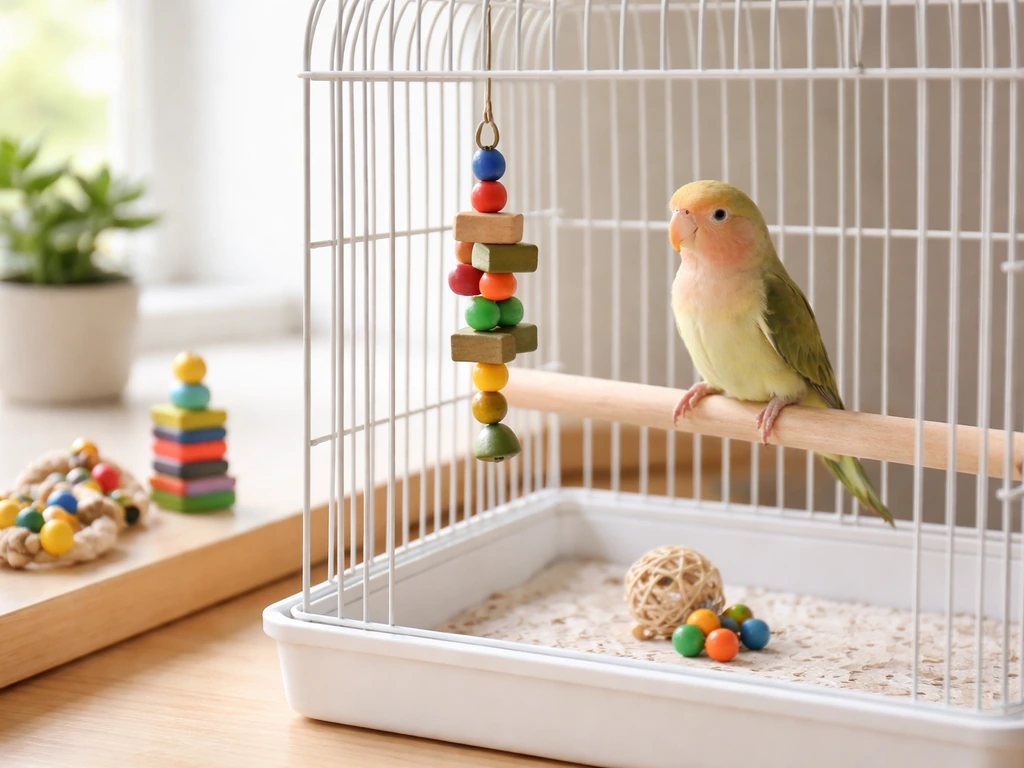
PetMD's vet-authored guidance puts it simply: most birds really only need 2 to 3 toys at a time to stay engaged. That's not a lot, but it's intentional. Too many toys at once can overwhelm a bird, make the cage feel cramped, and actually reduce how much your bird interacts with any individual toy. Think of it like a kid's toy box overflowing onto the floor, nothing gets played with because everything is always available.
The real toy plan is about what's in the cage right now plus what's waiting in rotation. If you aim for 2 to 3 in the cage and 4 to 7 in reserve, you can swap toys every few days to a week without spending a fortune. The Association of Avian Veterinarians recommends rotating toys every day or every week for most birds, and notes that deep-clean days (when you're already pulling everything out) are a perfect time to swap the lineup. Something as simple as turning a toy to a different angle or moving it to a new spot in the cage can make it feel brand new to your bird.
| Bird Size / Type | Toys Active in Cage | Total Rotation Stock | Swap Cadence |
|---|---|---|---|
| Small (budgie, finch, canary) | 2 | 4 to 6 | Weekly |
| Small-medium (cockatiel, lovebird, parrotlet) | 2 to 3 | 6 to 8 | Every 3 to 7 days |
| Medium (conure, caique, Senegal) | 3 | 6 to 10 | Every 2 to 5 days |
| Large (African grey, Amazon, cockatoo, macaw) | 3 to 4 | 8 to 12 | Every 1 to 3 days |
These ranges aren't rigid rules. A bird that gets 4+ hours out of the cage daily may need fewer in-cage toys because it's getting enrichment through interaction and exploration. A bird that spends most of its time in the cage needs its toy setup to work harder.
How to actually build variety into your toy lineup
The biggest mistake beginners make isn't having too few toys, it's having several toys that all do the same thing. Your 2 to 3 in-cage toys should cover different categories of play. Here's how to think about it:
- Chew toys: Wood blocks, cork, softwood sticks, or palm fiber. These let birds do what comes naturally — destroying things. They're especially important for hookbills like cockatiels, conures, and parrots of all sizes.
- Shredding toys: Paper, palm fronds, seagrass, or woven materials. Shredding is a calming, absorbing behavior for many birds. A shredding toy often gets used daily without the bird even seeming to 'play' with it.
- Foraging toys: Puzzle feeders, cups with hidden food, or toys where the bird has to work to extract a treat. VCA notes that these can keep birds occupied for hours. If your bird only has one foraging toy, add another — it's that effective.
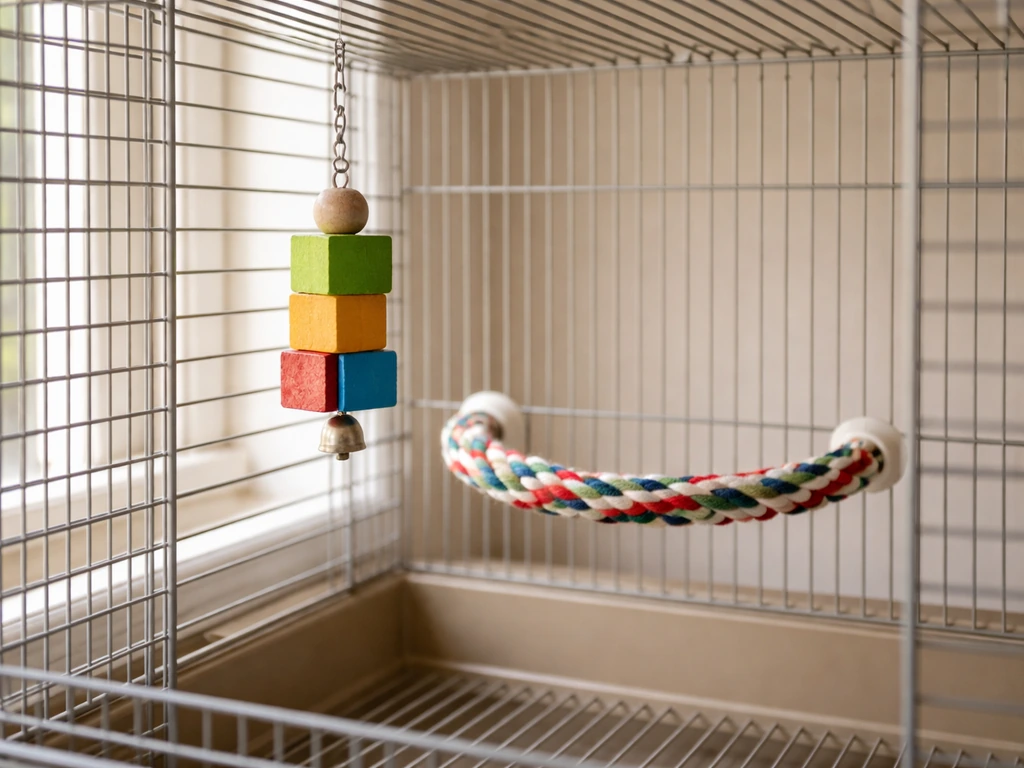
- Swings and foot toys: Swings, ladders, rope perches, and small hand-held items. These support physical movement, balance, and foot dexterity. Foot toys are especially useful for larger parrots.
- Hang and explore toys: Toys with multiple textures, colors, and dangly bits. These are more about visual stimulation and casual interaction rather than sustained problem-solving.
When you rotate, try to keep at least one foraging toy and one chew or shred toy in the cage at all times. Those two categories deliver the most behavioral benefit. The third slot can rotate more freely between swings, foot toys, or exploration-style toys depending on what your bird gravitates toward.
Sizing, materials, and placement, get these wrong and a toy becomes a hazard
Toy count means nothing if the toys aren't safe. This is where a lot of beginners (myself included, early on) go wrong by assuming anything sold in a pet store is automatically fine for any bird. It isn't.
Size matching is non-negotiable
Best Friends Animal Society is explicit on this: toys must be sized for your specific bird. A cockatiel toy is not safe for a large parrot, it can become a choking or entrapment hazard. Go the other direction and a macaw-sized toy can physically trap or injure a small bird. When in doubt, match the toy size to toys specifically labeled for your bird's species or size category.
Hardware and attachment hazards
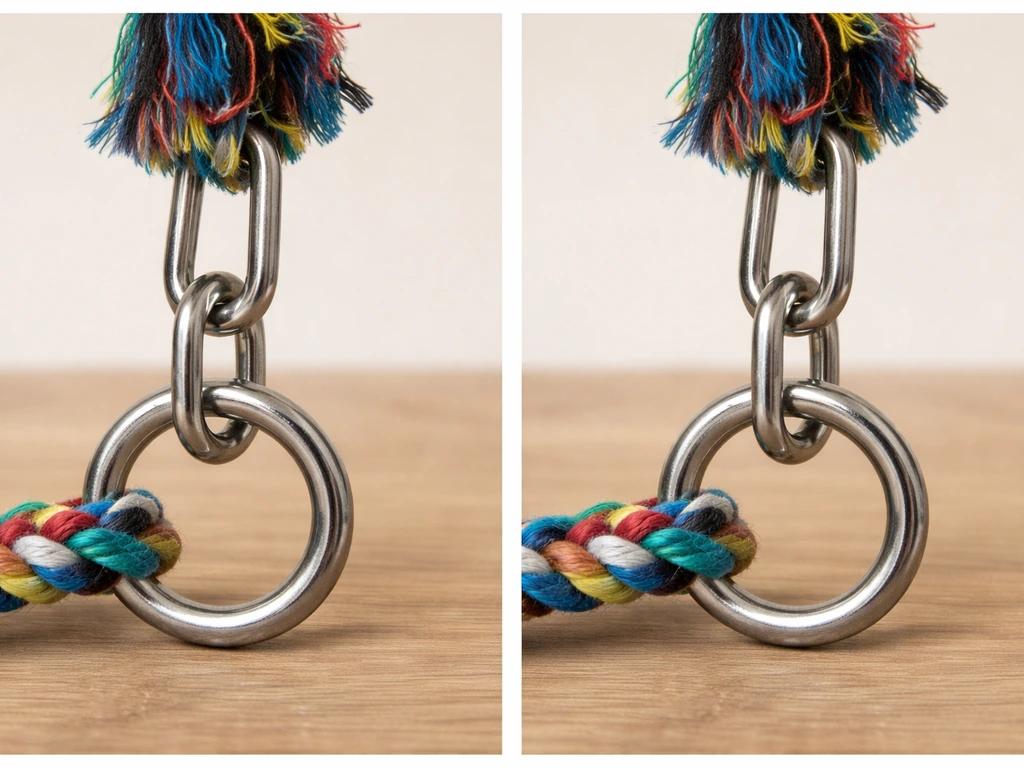
blank" rel="noopener noreferrer">Check every link, chain, and ring before it goes in the cage. Lafeber's toy safety guidance says hardware links should be large enough that a toe cannot get trapped in the gap. Rings must be completely closed, an open ring can catch a beak or foot in seconds. Best Friends also warns against chain links with tiny gaps for exactly this reason. For attachments, blank" rel="noopener noreferrer">avoid anything made with copper, silver, zinc, or iron, as these metals are toxic to birds. Stainless steel is the safe standard for metal hardware.
Materials to avoid entirely
- Toxic coatings, dyes, or treatments on wood or plastic
- Loose threads or fabric strips that can wrap around a neck, wing, or foot (the Gabriel Foundation identifies these as a serious injury and death risk — remove loose threads immediately)
- Small parts that can be twisted off and swallowed
- Toxic metals in any hardware or decorative element
Placement inside the cage
Don't hang toys directly over food or water dishes, birds fidget with toys, and debris falls. Place toys at different heights so your bird can interact with them from perches at multiple levels. Leave clear flight paths and landing zones inside the cage. If your bird can't easily move around without bumping into toys, you have too many in at once.
How to rotate toys so they always feel fresh
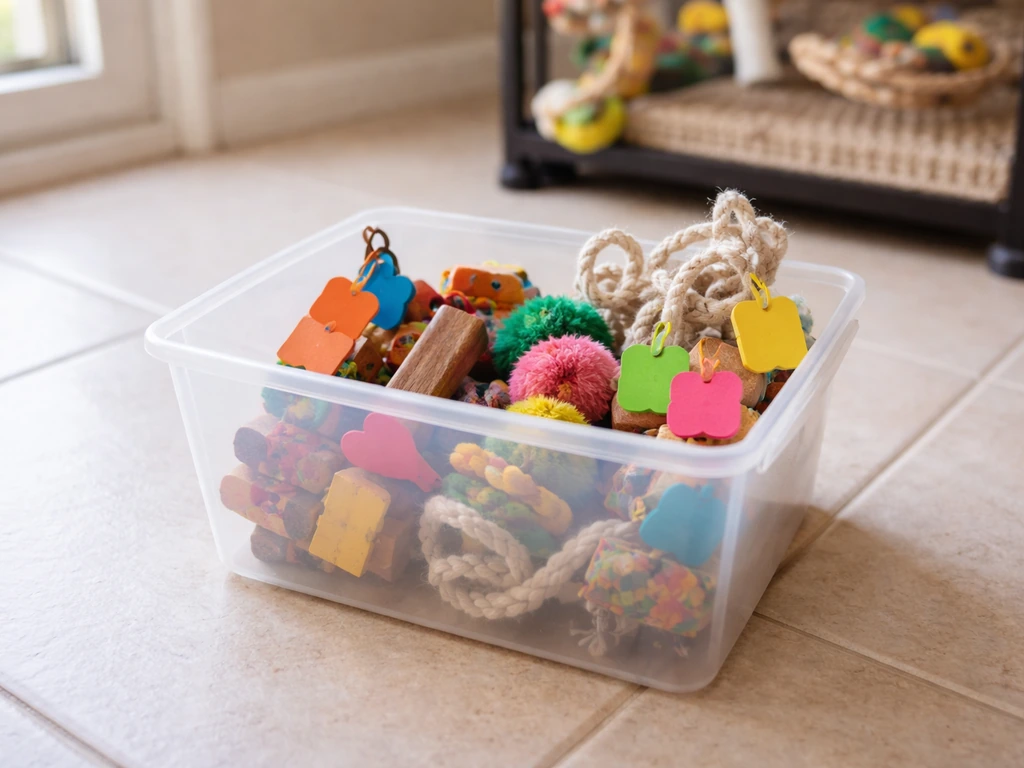
Rotation doesn't have to be complicated. The AAV recommends swapping every day to every week depending on your bird's engagement level. Here's a simple system that actually works:
- Label or group your rotation toys in a small bin or bag. You don't need anything fancy — a labeled container works fine.
- Every cage-cleaning day (ideally once a week), pull one or two toys out and replace them with toys from your rotation bin. Clean the outgoing toys before returning them to storage.
- Between cleaning days, try a 'position swap' — move a toy to a different part of the cage, hang it upside down, or attach it at a different height. This genuinely resets a bird's interest.
- Track which toys get heavy use and which get ignored. Over time you'll learn what your specific bird actually loves versus what just fills space.
- Retire a toy when it's heavily damaged or has parts missing. Purdue's vet college notes that destroyed toy parts can be swallowed and cause obstructions — don't keep a toy around past its useful life.
The goal of rotation is to trigger novelty-seeking behavior. Birds in the wild encounter new objects and challenges constantly. Rotation is your low-effort way of simulating that. A bird that gets fresh toys regularly is almost always more engaged, less screamy, and less destructive toward cage furnishings.
Toy budgets and starter setups for common beginner species
If you're just starting out, you don't need to buy an entire toy library on day one. Build up your rotation stock over a month or two. Here's a realistic starting point for the species beginners most often choose:
| Species | Starting Kit (In-Cage) | What to Prioritize | Budget Range to Start |
|---|---|---|---|
| Budgerigar (budgie) | 1 swing, 1 foraging/foot toy, 1 shred/bell toy | Lightweight toys, bird-safe mirrors, small foraging cups | $15 to $30 |
| Cockatiel | 1 chew toy, 1 shred toy, 1 foraging toy | Softwood chews, shreddable paper toys, a swing perch | $25 to $50 |
| Lovebird or parrotlet | 2 to 3 small sturdy toys | Durable chews, foraging cups, foot toys | $20 to $45 |
| Green cheek or sun conure | 1 foraging toy, 1 chew, 1 swing or rope toy | Destructible wood toys, puzzle feeders, foot toys | $35 to $70 |
| Cockatiels or conures (upgrade path) | Add 3 to 5 rotation toys over weeks 3 to 8 | Build variety across all 5 toy categories | $50 to $100 total |
Bird toys vary a lot in price, and the most expensive option isn't always the most engaging. If you want to estimate costs, check typical prices for the number of toys you plan to keep in rotation Bird toys vary a lot in price. Foraging toys, in particular, can be made cheaply at home using paper cups, cardboard rolls, and safe food items. If you're buying toy refills or building a rotation, you can also look for a make-your-own bird toys coupon code to keep costs down Foraging toys, in particular. Many birds are just as excited about a piece of plain cardboard to shred as they are about a $20 toy. If budget is a concern, prioritize one good foraging toy and fill the rest of the rotation with DIY-friendly options.
Common beginner mistakes (and how to spot boredom versus stress)
A few patterns come up again and again with new bird owners, and most of them are easy to fix once you know what to look for.
Mistake 1: Leaving the same toys in the cage for months
This is the most common one. You set up the cage with three toys, your bird plays with them for a week, then gradually ignores them. You assume your bird just isn't a 'toy bird.' In reality, almost every bird will re-engage with toys when they're rotated. If you've never swapped a toy in more than two weeks, start there before assuming your bird doesn't like toys.
Mistake 2: Overcrowding the cage
More toys does not mean more enrichment. A cage so packed with toys that your bird struggles to move around, land comfortably, or access its food and water is actually stressful. The cage should feel stimulating, not cluttered. If you can't clearly see your bird when it's on its main perch, you've got too much going on.
Mistake 3: Ignoring behavior cues
Your bird will tell you when the toy situation isn't working, you just have to know what to look for. Boredom looks like repetitive behavior (pacing, head-bobbing in a loop, excessive bar-chewing), feather-picking, or a general lack of activity during the day. Stress from an overcrowded cage or a scary new toy can look like aggression toward toys, fluffed feathers near a specific area of the cage, or avoidance of a whole section. When you introduce a new toy, place it near (but not directly next to) where your bird spends most of its time. Let it get used to seeing the toy before it needs to interact with it.
Mistake 4: Skipping the safety check
Every toy, even one labeled 'bird safe,' should be inspected before it goes in the cage. Check for loose threads, open rings, tiny gaps in chains, and any small parts that look like they could be pulled off. This takes 60 seconds and can prevent a serious injury. VCA specifically recommends examining each toy carefully with your particular bird's size and beak strength in mind, a toy that's fine for a budgie could be dangerous for a conure that can actually snap it apart.
Build your toy plan today
You don't need to overhaul everything at once. Here's what to do in the next few days to get your bird's enrichment on track:
- Count what's in the cage right now. If you have more than 3 to 4 toys, pull the least-used ones out and put them in a rotation bin. If you have fewer than 2, add one foraging or chew toy this week.
- Check that your current toys cover at least two different categories (chewing, shredding, foraging, swinging, or exploring). If they're all the same type, replace one with something from a different category.
- Inspect every toy currently in the cage for safety hazards: loose threads, open rings, chain gaps, and suspicious materials. Remove anything that doesn't pass.
- Set a rotation reminder. Weekly cage-cleaning days are ideal. Pick a day and commit to swapping at least one toy each time.
- Over the next month, build your rotation stock to at least 5 to 6 total toys across different categories. You don't have to buy them all at once — add one or two per week.
- Watch your bird for two weeks after making changes. More active engagement with toys, less repetitive or destructive behavior, and more time exploring are all signs the setup is working.
That's really all there is to it. Two to three toys in the cage, a solid rotation stock, variety across toy types, and regular swaps. If you also want to know what to give your bird to start with, use a beginner-friendly setup tailored to your species and budget. If you want a quick shortcut, look for the best bird dog puppy toys that match your pup's chewing style and replace worn items before they become a hazard Two to three toys in the cage, a solid rotation stock, variety across toy types, and regular swaps.. These same principles also help you choose the best toys for bird dogs, tailored to your pup’s chewing and play style. Get those basics right and you'll have a noticeably more engaged, content bird, without spending a fortune or turning toy management into a part-time job.
FAQ
What if my bird is out of the cage a lot, how many toys should it have inside?
If your bird gets several hours out of the cage daily (playtime, training, or supervised exploration), you can usually lean toward 2 toys in the cage rather than 3, because enrichment is happening outside. Still keep at least one foraging and one chew or shred toy in the cage so you always have a behavioral outlet available when it is home.
My bird plays with toys for a week, then ignores them, should I buy more toys?
Don’t increase the count to “fix” lack of interest. If your bird ignores toys after a week, first rotate to a different category or presentation (for example, swap the foraging toy type or change the height), then wait another few days. Most birds re-engage when novelty changes, even if they seemed disinterested with the original lineup.
How do I know if I have too many toys in the cage?
A simple rule is to ensure there is clear access to food and water and enough space for safe landing on the main perch. If your bird has to squeeze around toys to reach dishes, or you can’t see the bird comfortably from its favorite spot, reduce to 2 toys in-cage and keep the rest in rotation.
How often should I swap the toys, daily or weekly?
For most beginners, aim to rotate the in-cage set every day to every week. If your bird is less interested or shows boredom cues, use the shorter end (daily or every other day). If your bird is easily stressed by change, use the longer end (closer to a week).
Can I keep the same toys in rotation, or should I buy new ones?
Yes, but only if they are appropriate for your specific bird and securely attached. Avoid adding duplicates of the same type as “extra enrichment,” because you can create clutter without adding new behaviors. Instead, use the third slot to cover a different category (foraging, chew or shred, or another play style your bird prefers).
Do I have to inspect toys every time I rotate them, or only when I first buy them?
Do a quick safety review for every toy you reuse: check for worn fibers, frayed rope, loose threads, open or stretched rings, and any chain links with tiny gaps. Even toys that were safe weeks ago can become hazards if they loosen or get damaged by the bird’s beak strength.
Where should foraging toys be placed in the cage?
If you are using a foraging toy, make sure it is still accessible without forcing the bird to bump or cling awkwardly. A good foraging toy should work from normal perch positions, not require your bird to reach over food or water. Place it near the main activity zone but not directly above dishes.
Are there metal materials I should avoid on bird toys and attachments?
Copper, silver, zinc, and iron attachments are not safe for birds. If you are unsure, choose stainless steel hardware, and confirm that any metal parts are part of the toy and not added later in an unsafe way.
What should I do if a new toy seems to stress my bird?
If a new toy causes fluffed feathers, avoidance of one section, or aggressive reactions toward the area rather than the toy itself, pause rotation and reintroduce more gradually. Start by placing the toy near where your bird spends time so it can observe first, then offer interaction after it looks comfortable.
How do I know when it is time to replace a toy rather than rotate it?
Worn toys should be replaced, not kept because they still look mostly intact. If threads are frayed, rings or connectors are distorted, or small parts can be pulled off, remove it immediately and replace with a toy made for your bird’s size and beak strength.